Showing posts with label Indigo Bunting. Show all posts

Tuesday, April 19, 2011

Bulletin #136 – migration #2


David McDonald Photography
Friendswood Texas

April 18, 2011

(Click on the photos to see a larger image)

I will be posting the reports of the birds found on my various outings on the blog now. I posted the first one Sunday April 17th from LaFitte's Cove, Galveston. Please feel free to check in often to the blog to find my field reports.
Last weekend provided better birding and we actually had a fall-out on Friday, with a front that came through before noon and the winds shifted to the north. I birded at Quintana on Friday and LaFitte’s Cove on the weekend.
The rock-star bird in the spring is always the gaudy male Painted Bunting (Passerina ciris). I had good looks at several of them at Quintana and here are 2 photos.


There were many Indigo Buntings (Passerina cyanea) all weekend. The male is all blue, but sometimes some will not be completely molted and still showing some brown feathers during spring migration. This one at the water feature in Quintana was all blue.


The female Indigo Bunting is light brown, with a slight bluish wash on the wings and tail. Also, there is some streaking on the breast. This streaking, on the breast, is an important field mark to differentiate the female Indigo from the female Blue Grosbeak who lacks the breast streaks.


In keeping with the colorful birds, here is my best photo ever of a breeding male Summer Tanager (Piranga rubra). It is a simple ID as it is the only bird in North America that is all red (even the cardinal has black on the face).


A nice treat was a pair of Scissor-tailed Flycatchers (Tyrannus forficatus) that landed in the Quintana sanctuary. This spectacular bird has the longest tail of any songbird in the USA. The male has the longer tail.


The female has a tail about 1/3 shorter.


Now I turn from the beautiful non-warblers to the plainest of warblers. I got my best photos of the waterthrushes. These 2 species are difficult if not impossible for beginners to separate in the field. I still have trouble myself and I like when an expert is present to call the correct ID. With these photos, I think it should be easier to see the differences in the species.

So here is the Louisiana Waterthrush (Seiurus motacilla). The field marks are the wide white eye-stripe that goes a long way down the back of the neck, the buffy flanks best seen in the second photo, and the pink legs as seen in the first photo.


Here is the Northern Waterthrush (Seiurus noveboracensis). The differing field marks are the narrower eye-stripe that doesn’t extend as far down the neck, the flanks are white to slightly yellowish, and the legs are grayer.


Happy Birding and Photography,

David McDonald

davidkmcdmd@yahoo.com

photos copyright 2011 David McDonald

To have these trip reports sent to your email, please email me at the above address and ask for subscribe.

Tuesday, May 11, 2010

Bulletin #111 – Spring Migration #6

David McDonald Photography
Friendswood Texas
May 11, 2010


Bulletin #111 – Spring Migration #6


Hello friends,


Spring migration is winding down here on the upper Texas coast. However, last Saturday was still pretty exciting.


I am going to highlight various birds that I photographed over the course of the spring that I didn’t have an opportunity to include in previous bulletins.


Here is a Yellow-throated Warbler (Dendroica dominica). It is an easy ID with gray back, black and white breast and bright yellow throat. This is another of my nemesis birds. It is a common early spring migrant, but I have not seen a single bird in the last 3 years until last Saturday.


Next is an even better photo of a male Bay-breasted Warbler (Dendroica castanea) than the one in the previous bulletin.


This is the best photo I have ever obtained of a male Baltimore Oriole (Icterus galbula). This well known bird has a black head and wings with white wing-bars. The rest of the body is bright orange.


The female is duller orange with just a smattering of black on the head. This bird is disheveled as she had just finished bathing.


The male Indigo Bunting (Passerina cyanea) is all blue without wing-bars.


The Great Crested Flycatcher (Myiarchus crinitus) is a brown backed flycatcher with gray throat and yellow belly. It is a long time favorite of mine as they nested in a birdhouse in our yard when I was growing up in Ontario. I still remember their harsh song and I can ID this bird by voice (one of the few bird songs I know).


Another flycatcher is the dapper Eastern Kingbird (Tyrannus tyrannus). It looks like he is wearing a tuxedo. The white tip on the tail confirms the ID.


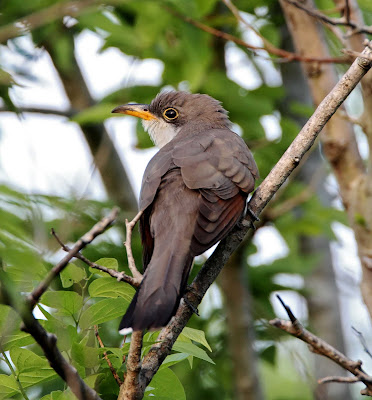
Lastly, we have a non-passerine migrant, the Yellow-billed Cuckoo (Coccyzus americanus). It is a long-tailed slender bird with brown back, white breast and yellow lower mandible. When flying, the rufous color on the wings is visible.


Now, to identify the Quiz bird from Bulletin #108, we need look closely at the few parts of the bird that are seen. It has a thin bill, some black on the face, yellow cap and a white wing bar can be seen on the right wing. The bill suggests a warbler rather than vireo or finch. There are only 2 species (golden-winged and chestnut-sided) that have yellow caps. Both can have black on the face, but the golden-winged has bright wide gold wing patches, while the chestnut-sided has white wing-bars. This bird however, has no chestnut bands along the flanks. But if you look at the first winter female in Sibley, she lacks these chestnut stripes. So, our bird is a first winter female Chestnut-sided Warbler. Thank you to those who responded to the Quiz. Almost everyone, who answered, got the correct ID – congratulations.


So here is a new Quiz. This bird puzzled me at first when I saw it last weekend. Please email me with your answers.


I will be leading a 9 day bird photography tour to Costa Rica in conjunction with Lillian Scott-Baer of Baer Travel March 3-11, 2011. We have worked out an itinerary to visit La Selva Preserve, Savegre Mountain Hotel in the central mountains for Resplendant Quetzal and other montane species and Wilson Botanical Gardens (Las Cruces). We have also retained the services of local guide Rudy Zamora to accompany us and locate and ID the birds for us to photograph. We will also have beautiful flowers and hopefully some mammals - tamanduas, monkeys etc.

I will be giving several talks in the evening on bird photography, Photoshop etc.


The price will be $1960 double to $2380 single. This includes hotels, all meals, guide, transportation in Costa Rica etc. The only other cost will be airfare and personal purchases (alcohol, souvenirs etc) . Space is limited to 10 persons to maximize our opportunity to see and photograph the birds. I have birded in Costa Rica previously. It is a wonderful country to visit and the bird life is exceptional. I hope that you can join us.


Here is the schedule of payments for the trip.


$ 25 reservation fee (not refundable)
$ 575 due April 30, 2010
$ 600 due July 30, 2010
$ 740 due January 15, 2011
Please send deposits to:


ScoBar Inc.
34 Galway Place
The Woodlands, TX 77382


Note - we will try to pair up singles and triple would be $1890 per person.


There are only 2 spaces left for this trip as of today, so please email me, if interested.


All comments and suggestions are welcomed and appreciated.


Happy birding and photography,

David McDonald

email: davidkmcd@comcast.net

photos copyright 2010 David McDonald

To have these trip reports sent to your email, please email me at the above address and ask for subscribe.