Showing posts with label Pink-headed Warbler. Show all posts

Sunday, July 9, 2017

Bulletin 296 - Guatemala 2017 #2 - Warblers and Vireos

I went for a second visit to Guatemala at the end of May. Once again, I used the wonderful local guide Knut Eisermann of Cayaya Birding. On this visit, we concentrated on the western highlands and Pacific lowlands along the Mexican border, as several Mexican species just make it into Guatemala here. I had a list of 10 species in particular I wanted to see and we got 9 of the 10 and saw the other, but I was not able to get a photo of the bird.

There were 3 target warbler species for the trip. The first was the absolutely stunning 5" Golden-browed Warbler (Basileuterus belli). It is hands down the most beautiful warbler I have seen so far.


Golden-browed Warbler
The second was the 5.5" Goldman's Warbler (Setophaga goldmani). If you are not familiar with this bird yet, it is part of the split of Yellow-rumped Warbler, but the AOU hasn't accepted it yet, although the IOU has. It is shown in current guide books. It has a black head, back and breast with a yellow throat.


Goldman's Warbler - male
The female is streaked below rather than solid black.


Goldman's Warbler - female
The third was the Fan-tailed Warbler. But despite chasing it for an entire day and seeing it flying around, it never alighted long enough to get a photo.

We also saw several other warblers. The 4.5" Crescent-chested Warbler (Oreothylpis superciliosa) is olive with a white eye stripe, yellow breast and rufous spot in yellow.


Crescent-chested Warbler
We again saw the fabulous 5" Pink-headed Warbler (Cardellina versicolor). It has a pink head and bright red body.
Pink-headed Warbler

The last was the 5" Grace's Warbler (Setophaga graciae). This bird is a target bird for southeast  Arizona, but its range extends south to Nicaragua


Grace's Warbler
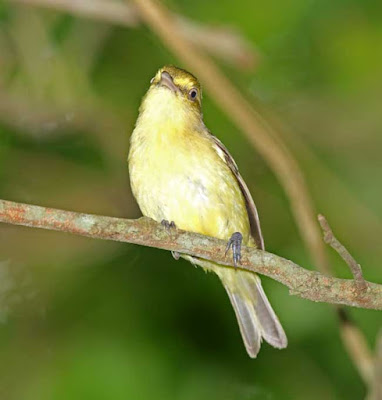
We also found 3 vireo species, 2 of which I had seen and but had poor photos. The 5" Mangrove Vireo (Vireo pallens) is similar to our White-eyed Vireo with yellow spectacles and wing bars, As his name suggests, he inhabits mangroves on both coasts in Middle America from Mexico to Costa Rica.


Mangrove Vireo


And another photo of the same bird.


Mangrove Vireo

The 5" Brown-capped Vireo (Vireo leucophyrs) has a light brown back and dark brown cap. His range is Mexico to Bolivia.


Brown-capped Vireo
We also saw a 7" Chestnut-sided Shrike-Vireo (Vireolanius melitophrys). .This bird is very distinctive with a yellow green back, gray cap, black line through the eye and yellow stripe above the eye. He also has a chestnut collar and streaking on his flanks. He stays in the canopy of the trees. His range is in mountains from central Mexico to Guatemala. He was a lifer for me. The first shows his head pattern.


Chestnut-sided Shrike-Vireo
And this shows his back.

Chestnut-sided Shrike-Vireo
I have put the different bird families in single folders for easy perusal.

I have photos of 73 of the 120 New World warblers.

And I have photos of 23 of the 63 worldwide vireos.

Happy birding and photography,

David McDonald

dkmmdpa@gmail.com

photos copyright 2006 - 2017 David McDonald

To have these trip reports sent to your email, please email me at the above address and ask to subscribe.

Sunday, February 14, 2016

Bulletin 251 - Guatemala #2 - warblers and tanagers; 2 Houston Owls


First I have to apologize to my guide Knut Eisermann, as I called him Kurt in last weeks newsletter. 

I photographed 4 new warblers, 2 of which are vagrants to the USA. The Pink-headed Warbler (Cardellina versicolor) has a red body and pinkish head. It is found at high elevations. It was one of my target birds for the trip. It just so happened that the sunrise pink sky was behind the bird and I didn't notice that until looking at my photos in the evening.


Pink-headed Warbler

The Crescent-chested Warbler (Oreothlypis superciliosa) was a tough bird to photograph as he stayed in the canopy almost directly overhead. The gray back, yellow breast and brown crescent on the yellow are the ID marks.


Crescent-chested Warbler
The Golden-crowned Warbler (Basileuterus culicivorus) is a vagrant to south Texas. It is gray above and yellow below with a striped head with a central gold stripe.


Golden-crowned Warbler
Lastly is the other vagrant to south Texas, the Gray-crowned Yellowthroat (Geothlypis poliocephala). It is olive above, bright yellow below, with a gray head and small black mask.


Gray-crowned Yellowthroat

I also got a nice photo of a Slate-throated Redstart (Myioborus miniatus). This bird is gray above with a red crown and red below. Of interest is the color variation in different parts of the range. The northern birds in Mexico and Guatemala have a red belly, while further south in Costa Rica the birds have a yellow belly. Click this link to see the difference.

Slate-throated Redstart

I also got a few new tanagers. The 4.25" White-collared Seedeater (Sporophila torqueola) is a vagrant to Texas as well. The male is black and white and the female brownish.

White-collared Seedeater - male
We have met flowerpiercers before. Theses tanagers have a hooked beak to tear open the base of flowers to get the nectar directly. The Cinnamon-bellied Flowerpiercer (Diglossa baritula) is found in Mexico and northern Central America and is the most northerly species of flowerpiercers. The male is gray with cinnamon below. the female is brownish. This is a juvenile male who has not quite molted to full adult plumage.

Cinnamon-bellied Flowerpiercer - juvenile male
The 7" Yellow-winged Tanager (Thraupis abbas) is bluish purple with a bright yellow patch on black wings.

Yellow-winged Tanager
The last is the 6" Azure-rumped Tanager (Tangara cabanisi). This bird is endangered as it is only found in Chiapas Mexico and the Pacific slope in Guatemala. Much of its habitat has been converted to coffee plantations.

Azure-rumped Tanager
Lastly of local interest to Texas, there is a Burrowing Owl (Athene cunicularia) at Anahuac NWR that is readily seen. This is only the third of this species I have seen here in 25 years. He is 30 feet away from the road and thus easy to see. Here are the directions in case the Visitor's Center isn't open.

Proceed down the main road towards Frozen Point. Once you come to the
bay, there are several pullouts for parking for fishing. At the third
one, park by the handicapped marked spot. Just across the road beyond
the fence is a 3x5 slab of concrete with the right front corner
broken. He is roosting under the slab and can be seen at that corner.


Here are 2 photos of this neat little (9.5") owl.


Burrowing Owl
Anahuac NWR
And here he is standing up.


Burrowing Owl
Anahuac NWR
I also got photos of a Barred Owl (Strix varia) in my back yard last night.


Barred Owl

Happy birding and photography,

David McDonald

dkmmdpa@gmail.com

photos copyright 2006 - 2016 David McDonald

To have these trip reports sent to your email, please email me at the above address and ask to subscribe.


Wednesday, December 9, 2015

Bulletin 244 - Best of 10 years #10 - New World tropics

The sheer diversity of birds in the New World tropics is staggering. 6 of the top 7 countries with the most species are in South America. Columbia is number 1 at 1934 species or almost 1 in 5 of all the birds in the world can be found in that country!  Brazil has 1850 and Peru is number 3 at 1844. Ecuador comes in at #5 with 1686, followed by Bolivia at 1431 and Venezuela at 1414. Indonesia is the only country outside South America to make the top 5 at number 4 with 1724 species. China and India are number 8 and 9. We all think of the wonderful wildlife in Africa and for mammals that is true, but the Democratic Republic of Congo is the only one in the top 10 with only 1186 species.

There are 2 'A' words to explain this..Andes and Amazon, leading to so many different ecosystems and habitats. There are several families of birds that are only in the New World tropics such as toucans, tinamous, trumpeters, screamers, antbirds and relatives, cotingas and many others.

I have had the pleasure of birding in Costa Rica, Panama, Ecuador and Guatemala in the last 2 years. So here are some of my favorites from these countries. Many have already appeared in Bulletins, but a few from haven't yet. So here are a dozen of my favorites. All will be confined to the New World families unless noted.

Toucans are perhaps the best known family of birds from the tropics due to the breakfast cereal Fruit Loops that has a toucan as the mascot. My best photo is a Collared Aracari.


Collared Aracari

Parrots are worldwide, but the largest parrots are, of course, the macaws. They are confined to the New World. The only macaw I have photographed so far is the Great Green Macaw.


Great Green Macaw

Jacamars look like large hummingbirds with their long pointed beaks. Here is the Rufous-tailed Jacamar.


Rufous-tailed Jacamar

The motmots are plump birds and most are distinguished by a long racquet tail. Here is the Rufous Motmot.


Rufous Motmot
The cracidae family includes chachalacas, guans and currasows. The 36" Great Currasow is probably the largest. The male has a curly feathered crest and large yellow knob on his bill.


Great Currasow - male

The cotingas are a family of songbirds that contain several unusual looking birds. One of these is the Andean Cock-of-the Rock. The male is orange with dark wings and tail. He has a large crest and even his bill is orange and difficult to see in this photo.


Andean Cock-of-the-Rock
Tinamous are chicken like birds of the forest floor. Generally they are shy and difficult to see, but in Ecuador at Copalinga, they had a feeding place and blind so this Little Tinamou was in the open, 20 feet away.


Little Tinamou

Puffbirds are a family of large headed birds who sit quietly waiting to spot a lizard or large bug. This is the White-whiskered Puffbird.


White-whiskered Puffbird
Manakins are small colorful songbirds noted for there elaborate courtship dances in which several related males perform to attract a mate. This is the male White-collared Manakin.


White-collared Manakin - male
Antpittas are small tailless looking birds that walk upright on the ground. Generally they are exceedingly difficult to see. This Jocotoco Antpitta came to a feeding station in Ecuador.


Jocotoco Antpitta
Trogons and Quetzals are a small worldwide family of colorful birds. Most of them are in the New World tropics and the most famous and beautiful is the Resplendant Quetzal. The male has long tail feather plumes.


Resplendant Quetzal - male

New World Warblers are in the temperate climates as well as tropics of the New World. This Pink-headed Warbler photographed recently in Guatemala is the prettiest one I have yet found. The photo is made even more artistic as the sky behind the leaves was pink at sunrise.


Pink-headed Warbler

Lastly is a Black-and-white Owl photographed in Ecuador. This is my most amazing photo ever as the grasshopper in its mouth is facing the camera and in focus. It is my first owl photo with some prey in its mouth.


Black-and-white Owl
Happy birding and photography,

David McDonald

dkmmdpa@gmail.com

photos copyright 2006 - 2015 David McDonald

To have these trip reports sent to your email, please email me at the above address and ask to subscribe.