Saturday, October 27, 2012

Bulletin 163 - miscellaneous birds

This edition will have various birds that I saw over the summer, but did not feature previous bulletins.

The Houston area was host to a couple of very uncommon birds this summer.

The first was a Tropical Mockingbird (Mimus gilvus) at Sabine Woods. This bird first appeared near the end of spring migration. If accepted, it will be the first North American record for this bird. I didn't have a chance to see it in the spring and as I had seen it many times in the tropics, wasn't particularly interested in driving 120 miles to attempt to locate it. Through May, there were not any further reports and then in early June, it again was mentioned on Texbirds. It apparently was a female and had mated with a Northern Mockingbird and was raising a family in Sabine Woods. So I went to see it. It is IDed by the lack of white wing patches. Notice how dark the wings are as well.

Tropical Mockingbird
The other rare visitor was a female Black-tailed Godwit (Limosa limosa) in breeding plumage. This shorebird is native to Eurasia. It will occasionally appear on the east coast or in Alaska. I did not see it on my Alaska trip in 2010 however, so it was a lifer for me. It was found by an astute birder in late May, at Brazoria National Wildlife Refuge in with a group of Hudsonian Godwits. Pretty amazing that a rare bird like this appears 25 miles from home! This was the first Texas record for this species. It is identified as a godwit by the 2 tone straight beak.

Black-tailed Godwit - female
The next 2 photos confirm the species. Here is the solid black tail with white terminal band and white uppertail coverts.

Black-tailed Godwit - female
Most importantly, however, to differentiate the bird from the Hudsonian Godwits was the white underwing. Hudsonians have black underwings.

Black-tailed Godwit - female
IOn the Arizona trip in August, T again saw the Whiskered Screech-Owl (Otus trichopsis). This small 7.25" owl came in to the tape and posed long enough to give me my best photos ever.

Whiskered Screech-Owl
Like many buteo hawks, the Swainson's Hawk (Buteo swainsoni) comes in various colors from light to dark. They are called color morphs. This is an intermediate morph juvenile bird on a power pole.

Swainson's Hawk - intermediate morph juvenile
One type of photo I have always admired is a hawk with a snake. I have seen a number of these photos over the years, but only once did I actually see a hawk with a snake. That was in my neighbor's yard but several years before I started doing photography. Well I finally hit pay dirt on the AZ trip in August. We stopped to photograph a Swainson's Hawk on a pole. He flew off and I saw him carrying a rather long snake in his talons. Fortunately, he circled around overhead and I was able to get the photos.

Swainson's Hawk with snake
And another.

Swainson's Hawk with snake
On a visit to Galveston in September, I saw this beautiful male Scissor-tailed Flycatcher (Tyrannus forficatus). The salmon-red color is stunning along with his magnificent tail.

Scissor-tailed Flycatcher - male
Now, we have a quiz. I saw this Yellow-throated Vireo (Vireo flavifrons) at LaFitte's Cove in Galveston in early September. What field mark isn't showing in this photo and why? Please email me with your answers. I will publish other photos in the next bulletin along with the correct answer.

Yellow-throated Vireo


Happy birding and photography,

David McDonald

dkmmdpa@gmail.com

photos copyright 2012 David McDonald

To have these trip reports sent to your email, please email me at the above address and ask to subscribe
. 

Sunday, September 30, 2012

Bulletin 162 - AZ hummers #2

The Magnificent Hummingbird (Eugenes fulgens) is another large (5.25") hummingbird of southeast AZ. It is appropriately named, as the male has a bright green gorget and purple crown. The rest of his body appears dark.

Magnificent Hummingbird - male
We also saw for the first time, a juvenile male. He is just starting to get some of his bright green throat feathers and purple crown feathers.

Magnificent Hummingbird - juvenile male
The Black-chinned Hummingbird (Archilochus alexandri) is a common hummingbird of the USA southwest. It is very similar to his cousin, the Ruby-throated Hummingbird of eastern North America. The male has a black chin and thin purple gorget below the black. I have always found it difficult to photograph to show off the purple feathers. This time I got lucky.

Black-chinned Hummingbird - male
Here is another hovering while doing his business.

Black-chinned Hummingbird - male
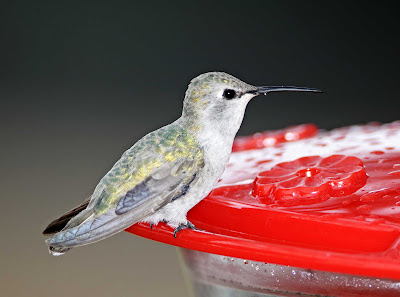
The Costa's Hummingbird (Calypte costae) is a very small (3.5") hummingbird of southern California and Arizona. I photographed a male bird last November in Tucson. This trip I got the female. She is IDed more by her shape. Notice the large round head and short thick neck. Also, the wing tips extend just beyond the tail.

Costa's Hummingbird - female
The familiar Rufous Hummingbird (Selasphorus rufus) is a small (3.75") hummingbird of the Pacific northwest. However, a few winter along the Gulf coast and I have been blessed to have had a few birds visiting my feeders the last 3 winters. The adult male is almost completely orange. We saw a single bird, but I wasn't able to get a photo. However, here is a juvenile male.

Rufous Hummingbird - juvenile male
Here is another juvenile male. He appears to have some sort of tumor on his face, as there is a tuft of feathers just above the beak.


Rufous Hummingbird - juvenile male
The female has less rufous and just a couple of red throat spots.

Rufous Hummingbird - female
Lastly we had a hybrid hummingbird. This was explained as a Lucifer x Costa's cross. The Costa's is evident with the purple crown. I am not sure how the Lucifer was delineated. The Lucifer does have a very narrow tail, and maybe this bird had that, but I didn't see it, if that was the case. They called it a Costifer Hummingbird for the parents.

Lucifer x Costas's Hummingbird - hybrid
Happy birding and photography,

David McDonald
dkmmdpa@gmail.com

photos copyright 2012 David McDonald

To have these trip reports sent to your email, please email me at the above address and ask to subscribe.

Tuesday, September 11, 2012

Bulletin 161 - Arizona hummers #1

Southeast Arizona in late summer has a possible 13 species of  hummingbirds. These species include all the 10 normal western hummers (Lucifer, Violet-crowned, Broad-billed, Blue-throated, Magnificent,  Allen's, Costa's, Rufous, Calliope, and Broad-tailed). Several Mexican vagrants are possible as well (Plain-capped Starthroat, Berylline and White-eared). Lisa and I spent a few days there is mid August with guide Melody Kehl and searched for them.

We saw all of the western birds except Broad-tailed and Violet-crowned. In addition we saw a Plain-capped Starthroat (lifer for me) but were unable to get any photos. The other two Mexican species were not present this year at all.

The Lucifer Hummingbird (Calothorax lucifer) is a small (3.5") hummer with a curved beak. The male has a long purple gorget. An important ID mark is the very narrow tail. Here are several photos of a male.


Lucifer Hummingbird - male
The Broad-billed Hummingbird (Cyanthus latirostris) is a most beautiful bird. The male has a green back, blue throat, dark tail, and red bill tipped with black.

Broad-billed Hummingbird - male
We saw several juvenile males as well whose throats and breasts had some blue feathers molting into full adult plumage. Here are a couple of different birds in various stages of molt. This one lacks much of the blue throat.

Broad-billed Hummingbird - juvenile male
And another with a full throat of color, but incomplete breast feathers.

Broad-billed Hummingbird - juvenile male
The male Anna's Hummingbird (Calypte anna) has a red throat and a red crown. The back is green


Anna's Hummingbird - male
The juvenile males lacked a complete set of red feathers.

Anna's Hummingbird - juvenile male
The Blue-throated Hummingbird (Lampornis clemenciae) is a large (5") hummer of mountain canyons. Both sexes has extensive white coners to their tails as an important field mark. The male has a blue throat and gray breast. The female has a gray throat. The bill is black. Here is a male in profile. The blue is not as dramatic as in the Broad-billed hummer above.

Blue-throated Hummingbird - male
Here is a bird looking at the camera and I was able to catch the iridescence of his gorget. The white in his tail is clearly seen as well.


Blue-throated Hummingbird - male
Happy birding and photography,

David McDonald
dkmmdpa@gmail.com

photos copyright 2012 David McDonald

To have these trip reports sent to your email, please email me at the above address and ask to subscribe.


Sunday, August 12, 2012

Bulletin 160 - AZ birds and wildlife

We found several warblers in Arizona. The first shown here is the Red-faced Warbler (Cardellina rubrifrons). This unique bird has a gray back, white breast, red face and black hood. The sexes are similar.
Red-faced Warbler
The Olive Warbler (Peucedramus taeniatus) was formerly in the same family as the wood warblers, but DNA has shown it to be unique. It has since been put in its own family. This bird is gray with 2 white wing bars. The head is yellow with a black ear patch. This is the female or immature male plumage. The adult male has orange instead of the yellow.
Olive Warbler - female or immature male
We saw several Painted Redstarts (Myioborus pictus). Neither of us were able to get a decent photo. However, what we did see was a nest of this bird. They nest on the ground and we were able to see the babies in the grassy nest.
Painted Redstart - nest with babies

Other wildlife we saw on this trip were several squirrels, pronghorn and several lizards. The Arizona Gray Squirrel (Sciurus arizonensis) is a typical large bushy tailed squirrel.
Arizona Gray Squirrel
The Desert Spiny Lizard (Sceloporus magister) is a large (8-12") lizard seen on the ground or climbing in trees.
Desert Spiny Lizard
Thanks again to our guide Melody Kehl for finding the birds and IDing the other wildlife.

Happy birding and photography,
David McDonald
dkmmdpa@gmail.com

photos copyright 2012 David McDonald

To have these trip reports sent to your email, please email me at the above address and ask to subscribe.


Sunday, July 22, 2012

Bulletin 159 - AZ birds #2


One of my favorite birds of the southwest USA is the Phainopepla (Phainopepla nitens). This 7.5" bird is the only USA member of the Silky-Flycatcher family. Despite the name, this bird eats mostly berries. The male is glossy black with a bushy crest and red eye. The female is gray.

Phainopepla - male
We saw several members of the flycatcher family. The Ash-throated Flycactcher (Myiarchus cinerascens) is a dull colored medium sized (7.5") myarchius. This genus are brown backed with gray breasts and yellow bellies. Sometimes they also have rufous in the wings or tail feathers.

Ash-throated Flycatcher
The Western Wood-Pewee (Contopus sordidulus) is a small (6.25") gray brown flycatcher that has wing bars but lacks an eye-ring.

Western Wood-Pewee
The Acorn Woodpecker (Melanerpes formicivorus) is a medium sized woodpecker of the western USA. It has a black and white face, black back and breast and white belly. The male shown here has an extensive red cap.


Acorn Woodpecker - male
As their name implies, acorns are their main food. They store acorns in caches by drilling holes in trees or wooden buildings and forcing the acorns into the holes. I have never seen such a cache before, but finally saw one on this trip. Here is the side of a cabin at Santa Rita Lodge in Madera Canyon. There are numerous holes, but no acorns yet.

Holes for Acorn Woodpecker to cache acorns
The Bewick's Wren (Thryomanes bewickii) is a bird of the southwest and west coast of the USA. It is a typical brown wren with a white eye stripe. The underparts are gray. This one caught a large caterpillar and proceeded to smash it against the stump it was sitting on beforte devouring it.

Bewick's Wren
Happy birding and photography,

David McDonald
dkmmdpa@gmail.com

photos copyright 2012 David McDonald

To have these trip reports sent to your email, please email me at the above address and ask for subscribe.

Monday, July 2, 2012

Bulletin #158 - SE Arizona birds

Lisa and I went to Arizona to photo some of the remaining birds that I missed on 4 previous visits. There were 2 birds in particular that I was searching for, and of course any other that we could find and improve on. Once again I hired guide Melody Kehl in Tucson. Melody had located nests for both these birds and the first morning we nailed both of them!

The first is the only regular trogon in the USA, the Elegant Trogon (Trogon elegans). If you have birded the tropics at all, you are familiar with this family of large (13") long-tailed slow moving birds. The males have green backs and red bellies. Also notice the gray wing patches. This was not a lifer as I had seen a female in Mexico in the 90's.
Elegant Trogon - male
The female is browner, with a white breast, coppery tail, and white line behind the eye. She also has a red belly, but it doesn't show in this photo.
Elegant Trogon - female
The second target bird was only about 50 yards away, also at a nest hole in a tree. This was the Northern Pygmy-Owl. Melody pointed out to us that their are 2 populations of this species that differ by voice. This bird was the Mountain Pygmy-Owl (Glaucidium gnoma). It is listed as such in the National Geographic field guide. Sibley uses the Mexican race for this one. The ABA has not split this species yet, but the IOU already has in their 2012 list of world bird names. So I will conform to the IOU listing and call this a full species of Mountain Pygmy-Owl. So I now have to find the Northern Pygmy-Owl somewhere else! This is a diurnal owl that hunts small birds. Either one was a lifer.
We saw a male come to the nest and feed the female inside. The sexes are similar in this small (7"0 brown owl with spots on back and streaked breast.
Mountain Pygmy-Owl
Next he flew to a branch and perched for about 5 minutes before flying off to hunt.

Mountain Pygmy-Owl
A common bird but with an interesting story is the local race of Purple Martins (Progne subis). Everyone is familiar with our largest swallow. The male is dark purple and the female has a purplish back, but gray breast. In the eastern part of the country, they almost always nest in man-made martin houses. However, the Sonoran Desert race in southeast Arizona nest exclusively in Saguaro cacti. Here is the male.
Purple Martin - Sonoran race - male
The female is paler and has a prominent white forehead and nape of neck compared to the eastern birds that I am familiar with.
Purple Martin - Sonoran race - female
Here is a male at a nest hole in a Saguaro cactus.
Purple Martin - Sonoran race - male
Another bird that I managed to get improved photos was the male Western Tanager (Piranga ludoviciana). As you may remember from a bulletin last year, there was talk of moving the piranga genus of tanagers to the cardinal family of birds. So far, neither the ABA nor the IOU has done so. It is still a tanager. The breeding male has a yellow body, red head, black tail and wings with 2 wing bars - one yellow and one white. I caught this bird on a feeder in Madera Canyon. I had seen one of these birds at High Island during spring migration, where it is a real rarity, but didn't get a photo before it flew away.
Western Tanager - breeding male
He then flew to a branch and allowed me to photograph his other side.
Western Tanager - breeding male
On an evening trip to California Gulch along the Mexican brder, we found a family of Canyon Wrens (Catherpes mexicanus). At first we just saw 6 babies making their way across the rock face. No adults were to be seen.
Canyon Wrens - 6 babies
As they moved to the right, they came to a small hole in the rock and the parents were there calling to the little ones. Here is an adult with the brown belly and 2 babies. The opening is just above the blades of grass on the left of the photo. At dusk when we were there, the opening just looked black, but the flash illuminated the interior. The babies started going into the small cavity in the rock.

Canyon Wren adult and 2 babies beside nest cavity in rock face
Once the babies were all in, the parents also went in. Here is a photo showing an adult just above and several babies inside, their eyes bright from the flash. It was fascinating to see this whole scene. Nature is so interesting if one just takes the time to stop and watch life unfold before your eyes.

Canyon Wren nest cavity in rock with several babies seen inside
Lastly, I have a Curve-billed Thrasher (Toxostoma curvirostre). The Arizona race of this bird have very indistinct breast spots and a yellow eye. The south Texas birds in contrast have distinct spots and a red or orange eye.

Curve-billed Thrasher - Arizona
Happy birding and photography,

David McDonald
dkmmdpa@gmail.com

photos copyright 2012 David McDonald

To have these trip reports sent to your email, please email me at the above address and ask for subscribe.