Showing posts with label Yellow-throated Vireo. Show all posts

Sunday, December 2, 2012

Bulletin 164 - Fall/winter birds

I hope everyone had a wonderful Thanksgiving last weekend.

The majority of the fall migrants have passed through. However, a number of warbler species do winter over in limited numbers, according to the Checklist of Birds of the Upper Texas Coast.

The common winter resident warblers are Myrtle, Orange-crowned and Pine. So it is always fun to find some other species that are either very late migrants, or birds that have decided to go no further south.

Here is an Ovenbird that I found by the drip at LaFitte's Cove in Galveston on Oct 26th.

Ovenbird
And here is a Black-throated Green Warbler from Thanksgiving weekend.

Black-throated Green Warbler
This beautiful female Summer Tanager was also seen on Oct 26. According to the checklist, a few of this species also winter over here.

Summer Tanager - female
That same day also produced my first pair Lark Sparrows at LaFitte's Cove in Galveston. The distinctive facial pattern make this sparrow an easy ID.

Lark Sparrow
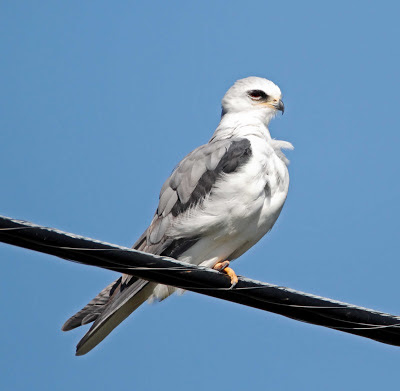
The White-tailed Kite (Elanus leucurus) is a beautiful all white raptor with black shoulder patches. I had been told about a pair of these birds nesting along Stewart Road in Galveston in a dead tree. It was difficult to get any photos of the birds on the nest as they sat very low down in the nest. Last weekend, the 3 babies had fledged. the family group of 5 birds were in the tree and 2 were on the wires beside the road. I stopped my car and took photos out of the car window. Using the car as a blind in this fashion doesn't disturb the birds like getting out of the car would.

Here is one of the adults. It is all white with a gray back and black shoulder patches.

White-tailed Kite - adult
This was the first time that I had seen and photographed the juvenile plumage. They are washed on the head, breast and back with reddish brown.

White-tailed Kite - juvenile
Later I found another juvenile eating lunch on top of a post. The diet of these birds is insects and small rodents. Also notice on these juveniles, that the wing feathers are all edged in white.

White-tailed Kite - juvenile eating rodent
Now, what about that quiz bird form the last bulletin. Here it is again, a Yellow-throated Vireo.

Yellow-throated Vireo
The question was a missing field mark and why. I had a few people makes some guesses, but no one got the answer as to what was missing.

Here is a photo of another vireo.

Warbling Vireo
The field mark that isn't visible is the hook on the upper mandible. The beak is the differenting field mark of vireos from warblers. Warblers have thinner straight beaks. The vireos have thicker beaks and the upper mandible is hooked at the end.

Notice in the photo that the upper mandible of the quiz bird doesn't reach to the end of the lower mandible and the hook is not visible.

Why? I think the bird has a beak deformity. Here is a photo of the same bird head on and you can see the upper mandible is bent to the right. The hook is visible here and it almost looks like a crossbill.

Yellow-throated Vireo
I was interested in this phenomenon, as there had been an article in Birding magazine several years ago about beak deformities in Black-capped Chickadees in Alaska. I did a Google search for beak deformities and the only reference was the chickadees. So I guess it is a rare occurrence. I was pleased to get a photo of it. I only noticed it after getting home and looking at the photos on the computer and I knew something was wrong with the beak., Fortunately, I had a number of photos and could ascertain the problem. Thanks to those who took the time to send in their answers.

Happy birding and photography,

David McDonald   dkmmdpa@gmail.com

photos copyright 2012 David McDonald

To have these trip reports sent to your email, please email me at the above address and ask to subscribe.

Saturday, October 27, 2012

Bulletin 163 - miscellaneous birds

This edition will have various birds that I saw over the summer, but did not feature previous bulletins.

The Houston area was host to a couple of very uncommon birds this summer.

The first was a Tropical Mockingbird (Mimus gilvus) at Sabine Woods. This bird first appeared near the end of spring migration. If accepted, it will be the first North American record for this bird. I didn't have a chance to see it in the spring and as I had seen it many times in the tropics, wasn't particularly interested in driving 120 miles to attempt to locate it. Through May, there were not any further reports and then in early June, it again was mentioned on Texbirds. It apparently was a female and had mated with a Northern Mockingbird and was raising a family in Sabine Woods. So I went to see it. It is IDed by the lack of white wing patches. Notice how dark the wings are as well.

Tropical Mockingbird
The other rare visitor was a female Black-tailed Godwit (Limosa limosa) in breeding plumage. This shorebird is native to Eurasia. It will occasionally appear on the east coast or in Alaska. I did not see it on my Alaska trip in 2010 however, so it was a lifer for me. It was found by an astute birder in late May, at Brazoria National Wildlife Refuge in with a group of Hudsonian Godwits. Pretty amazing that a rare bird like this appears 25 miles from home! This was the first Texas record for this species. It is identified as a godwit by the 2 tone straight beak.

Black-tailed Godwit - female
The next 2 photos confirm the species. Here is the solid black tail with white terminal band and white uppertail coverts.

Black-tailed Godwit - female
Most importantly, however, to differentiate the bird from the Hudsonian Godwits was the white underwing. Hudsonians have black underwings.

Black-tailed Godwit - female
IOn the Arizona trip in August, T again saw the Whiskered Screech-Owl (Otus trichopsis). This small 7.25" owl came in to the tape and posed long enough to give me my best photos ever.

Whiskered Screech-Owl
Like many buteo hawks, the Swainson's Hawk (Buteo swainsoni) comes in various colors from light to dark. They are called color morphs. This is an intermediate morph juvenile bird on a power pole.

Swainson's Hawk - intermediate morph juvenile
One type of photo I have always admired is a hawk with a snake. I have seen a number of these photos over the years, but only once did I actually see a hawk with a snake. That was in my neighbor's yard but several years before I started doing photography. Well I finally hit pay dirt on the AZ trip in August. We stopped to photograph a Swainson's Hawk on a pole. He flew off and I saw him carrying a rather long snake in his talons. Fortunately, he circled around overhead and I was able to get the photos.

Swainson's Hawk with snake
And another.

Swainson's Hawk with snake
On a visit to Galveston in September, I saw this beautiful male Scissor-tailed Flycatcher (Tyrannus forficatus). The salmon-red color is stunning along with his magnificent tail.

Scissor-tailed Flycatcher - male
Now, we have a quiz. I saw this Yellow-throated Vireo (Vireo flavifrons) at LaFitte's Cove in Galveston in early September. What field mark isn't showing in this photo and why? Please email me with your answers. I will publish other photos in the next bulletin along with the correct answer.

Yellow-throated Vireo


Happy birding and photography,

David McDonald

dkmmdpa@gmail.com

photos copyright 2012 David McDonald

To have these trip reports sent to your email, please email me at the above address and ask to subscribe
. 

Monday, April 12, 2010

Bulletin #107 – Spring Migration #2

David McDonald Photography

Friendswood Texas
April 13, 2010

Bulletin #107 – Spring Migration #2

Hello friends,

Most, if not all, birders have some species of birds that seem to be very difficult for them to find. The popular term is a nemesis bird. For the most part, they are rare birds. However, sometimes, even a reasonably common bird, just seems to be invisible. It almost feels as if they have some diabolical plan to disappear when we go to look for them.

There are at least 3 common spring migrants on the Upper Texas Coast (UTC) that are nemesis birds for me. These are 2 warbler species (Prothonotary(PROW) and Yellow-throated (YTWA)), and Yellow-throated Vireo (YTVI). I have only found 1 YTWA on my own and never found a YTVI. I do occasionally find a PROW. This is in 20 years of birding! I did get a photo of a YTVI 2 years ago with a guide, but they were not very good, and I wanted to improve on them. Also, I need better photos of the YTWA.


Well, last weekend April 9-11, I hit the jackpot with 2 of them. I went to LaFitte’s Cove in Galveston ( #68 on UTC Birding Trail) in the late afternoon on Friday. There were probably a dozen Prothonotary Warblers (Protonotaria citrea) in the woods, and at times, they sat in the wide open on the path. This bird is IDed by the bright yellow head and body and gray wings without wingbars. The sexes are similar, but the female is a little duller yellow. These are probably males. What a stunning bird!


I also saw several more on Saturday and Sunday, for a total of 20 or so birds. This is more birds of this species than I had seen in 20 years previously.


The other nemesis bird to finally break my jinx was the Yellow-throated Vireo (Vireo flavifrons). I went to LaFitte’s Cove early Saturday morning and found a single bird. I managed a couple of fairly good photos. Sunday I saw another YTV at LaFitte’s Cove where it was high in the trees (their usual habitat). Next I went to Corps Woods sanctuary on Galveston Island (#61 on UTC Birding Trail). I walked into the woods and immediately saw another YTV. It disappeared before I could take its picture. However, I found a 4th bird, who was low down in a tree and I was able to get quite close to him for some decent photos. He is Ided by the green head and back, yellow spectacles, yellow throat and breast and 2 wing bars. Thus I found 4 birds this weekend, which is probably as many as I have seen in total previously, and never had I found one myself. The sexes are similar.


I also saw him catch and devour a caterpillar.
There were a number of other migrants this past weekend.

Here is a Red-eyed Vireo (Vireo olivaceous). He is named for the red iris in his eye. Like a number of birds, he was named for the most obscure field mark. One almost never sees this feature. But in this photo, he was in the sunlight and the red iris was visible in binoculars. So how do you ID this bird if his red eye can’t be seen? It is IDed by the brown back, gray head and light eyeline between 2 black stripes. The sexes are similar.


2 species of thrush were at LaFitte’s Cove on Friday afternoon. The more numerous one was the Swainson’s Thrush (Catharus ustulatus). He is a brown backed thrush with a prominent eye-ring and a few spots on the breast. The sexes are similar.


The secretive Wood Thrush (Hylocichla mustelina). Normally this is a difficult bird to find as it prefers deep woods. There were at least 4 at LaFitte’s Cove on Friday and several were momentarily in the open to have their photo taken. This bird is IDed by the rufous head, brown back, large breast spots. In this photo he appears to have a bushy crest, but that is not normally the case. Perhaps he was startled by all the people watching him. The sexes are similar.


I found a single breeding male Blue Grosbeak (Passerina caerula) on Friday. He is normally completely blue on his head and body. This bird hasn’t quite finished molting and still has a few spots of brown. The ID marks are the all deep blue body with 2 brown wing bars. The upper wing bar is rufous color. The beak is also blue. The female is brown with the 2 wing bars.


The last of the colorful migrants this weekend, were both species of tanagers. There were 12-15 male Summer Tanagers (Piranga rubra) Friday. This bird is all bright red. He has a large bill. The female would be yellow.


There were just a few Scarlet Tanagers (Piranga olivacea). The male is an easy ID with dark red head and body and black wings and tail. The female in the second photo is yellow-green with darker wings.


I will be leading a 9 day bird photography tour to Costa Rica in conjunction with Lillian Scott-Baer of Baer Travel March 3-11, 2011. We have worked out an itinerary to visit La Selva Preserve, Savegre Mountain Hotel in the central mountains for Resplendant Quetzal and other montane species and Wilson Botanical Gardens (Las Cruces). We have also retained the services of local guide Rudy Zamora to accompany us and locate and ID the birds for us to photograph. We will also have beautiful flowers and hopefully some mammals - tamanduas, monkeys etc.

I will be giving several talks in the evening on bird photography, Photoshop etc.

The price will be $1960 double to $2380 single. This includes hotels, all meals, guide, transportation in Costa Rica etc. The only other cost will be airfare and personal purchases (alcohol, souvenirs etc) . Space is limited to 10 persons to maximize our opportunity to see and photograph the birds. I have birded in Costa Rica previously. It is a wonderful country to visit and the bird life is exceptional. I hope that you can join us.

Here is the schedule of payments for the trip.

$ 25 reservation fee (not refundable)
$ 575 due April 30, 2010
$ 600 due July 30, 2010
$ 740 due January 15, 2011
Please send deposits to:

ScoBar Inc.
34 Galway Place
The Woodlands, TX 77382

Note - we will try to pair up singles and triple would be $1890 per person.

There are only 2 spaces left for this trip as of today, so please email me, if interested.

All comments and suggestions are welcomed and appreciated.

Happy birding and photography,

David McDonald

email: davidkmcd@comcast.net

photos copyright 2010 David McDonald

To have these trip reports sent to your email, please email me at the above address and ask for subscribe.