Showing posts with label Ovenbird. Show all posts

Sunday, December 2, 2012

Bulletin 164 - Fall/winter birds

I hope everyone had a wonderful Thanksgiving last weekend.

The majority of the fall migrants have passed through. However, a number of warbler species do winter over in limited numbers, according to the Checklist of Birds of the Upper Texas Coast.

The common winter resident warblers are Myrtle, Orange-crowned and Pine. So it is always fun to find some other species that are either very late migrants, or birds that have decided to go no further south.

Here is an Ovenbird that I found by the drip at LaFitte's Cove in Galveston on Oct 26th.

Ovenbird
And here is a Black-throated Green Warbler from Thanksgiving weekend.

Black-throated Green Warbler
This beautiful female Summer Tanager was also seen on Oct 26. According to the checklist, a few of this species also winter over here.

Summer Tanager - female
That same day also produced my first pair Lark Sparrows at LaFitte's Cove in Galveston. The distinctive facial pattern make this sparrow an easy ID.

Lark Sparrow
The White-tailed Kite (Elanus leucurus) is a beautiful all white raptor with black shoulder patches. I had been told about a pair of these birds nesting along Stewart Road in Galveston in a dead tree. It was difficult to get any photos of the birds on the nest as they sat very low down in the nest. Last weekend, the 3 babies had fledged. the family group of 5 birds were in the tree and 2 were on the wires beside the road. I stopped my car and took photos out of the car window. Using the car as a blind in this fashion doesn't disturb the birds like getting out of the car would.

Here is one of the adults. It is all white with a gray back and black shoulder patches.
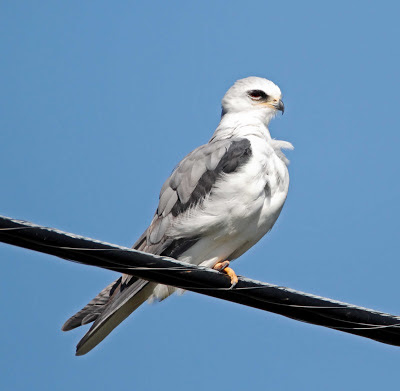
White-tailed Kite - adult
This was the first time that I had seen and photographed the juvenile plumage. They are washed on the head, breast and back with reddish brown.

White-tailed Kite - juvenile
Later I found another juvenile eating lunch on top of a post. The diet of these birds is insects and small rodents. Also notice on these juveniles, that the wing feathers are all edged in white.

White-tailed Kite - juvenile eating rodent
Now, what about that quiz bird form the last bulletin. Here it is again, a Yellow-throated Vireo.

Yellow-throated Vireo
The question was a missing field mark and why. I had a few people makes some guesses, but no one got the answer as to what was missing.

Here is a photo of another vireo.

Warbling Vireo
The field mark that isn't visible is the hook on the upper mandible. The beak is the differenting field mark of vireos from warblers. Warblers have thinner straight beaks. The vireos have thicker beaks and the upper mandible is hooked at the end.

Notice in the photo that the upper mandible of the quiz bird doesn't reach to the end of the lower mandible and the hook is not visible.

Why? I think the bird has a beak deformity. Here is a photo of the same bird head on and you can see the upper mandible is bent to the right. The hook is visible here and it almost looks like a crossbill.

Yellow-throated Vireo
I was interested in this phenomenon, as there had been an article in Birding magazine several years ago about beak deformities in Black-capped Chickadees in Alaska. I did a Google search for beak deformities and the only reference was the chickadees. So I guess it is a rare occurrence. I was pleased to get a photo of it. I only noticed it after getting home and looking at the photos on the computer and I knew something was wrong with the beak., Fortunately, I had a number of photos and could ascertain the problem. Thanks to those who took the time to send in their answers.

Happy birding and photography,

David McDonald   dkmmdpa@gmail.com

photos copyright 2012 David McDonald

To have these trip reports sent to your email, please email me at the above address and ask to subscribe.

Wednesday, May 9, 2012

Bulletin #154 - Spring Migration #3

Well it is over for another year and what a strange spring it was. I never saw even one example of some fairly common species such as Yellow-throated, Canada, and Nashville Warblers.
Three other species I saw only Tuesday May 8th after a rain.
There were reports all last week of Black-throasted Blue and Cape May Warblers at LaFitte's Cove. These are both very uncommon, but I missed them again this year, the Black-throated Blue by only 5 minutes on Friday 4th:(
However, there are always birds to photograph and the Blackpoll Warbler (Setophaga striata)provided my best photos ever of this species. This black and white male has a solid black crown with white cheeks. However, the notable feature is the orange legs.

Blackpoll Warbler - male
The female is black and white with a yellowish wash below. However, notice that she has the same color legs and this is the ID mark. I think this is the first time I have ever seen a female of this species.
Blackpoll Warbler - female
The Ovenbird (Seiurus aurocapilla) is a brown backed ground, dwelling warbler with a striped head and central orange stripe. It has a streaked breast and might be confused with a thrush, but it is much smaller. It is named for its nest that is built on the ground and resembles an oven. It is not named for its taste.
Ovenbird

The male Bay-breasted Warbler (Setophaga castanea) has a brown cap, throat and flanks. The face is black as are the wings with 2 white bars. He has an insect in his mouth in this picture.

Bay-breasted Warbler - breeding male
The Gray-cheeked Thrush (Catharus minimus) is a brown-backed thrush with spotted breast and no eye-ring. The lack of eye-ring distinguishes this bird from the similar Swainson's Thrush. The sexes are similar.
Gray-cheeked Thrush
An unusual photo was this Loggerhead Shrike (Lanius ludovicianus). Shrikes, as you know, capture insects, small reptiles etc and impale them on thorns or barbed wire to store them until eaten later. Normally, they are skittish, but this one flew onto a dead snag 15 feet from me and allowed a single photo before leaving. An important field mark of all shrikes is the heavy hooked beak. Here is a photo of the business end of this bird.
Loggerhead Shrike - detail
On May 8th at LaFitte's Cove, another birder told me there was a Great Horned Owl (Bubo virginianus) in the oak tree by the bench, above the drip. It was 8pm and had been raining a little. I found the owl, and as luck would have it, the flash was dead. I turned it off for a moment and luckily it recharged or dried out and I got a couple of flash shots. His ear tufts are in disarray due to the rain (looks like a punk haircut). Here is a frontal view.

Great Horned Owl
And here is the back of the bird.


Great Horned Owl
Happy birding and photography,

David McDonald
dkmmdpa@gmail.com

photos copyright 2012 David McDonald

To have these trip reports sent to your email, please email me at the above address and ask for subscribe.

Wednesday, May 4, 2011

Bulletin #138 - migration #4 - warblers

David McDonald Photography
Friendswood TX
5-4-11

(Click on image to see larger photo)

The Common Yellowthroat  (Geothlypis trichas) is a very widespread warbler in North America. It lives in marshy areas. I noted how brown the breast and belly were, so looked in Sibley. The eastern form is like this, but western birds are more yellow - white on the breast and belly. Also, the shape of the black mask and white line above varies. There are many subspecies in North America (about 13).


This male Bay-breasted Warbler (Dendroica castanea) was very cooperative by staying in a dead leafless tree for about 1 hour and allowing everyone to get good looks and photos.


The male Yellow Warbler (Dendroica petechia) is another widespread species in North America. This was my first opportunity to get a photo of this bird at the drip. It is IDed by being all yellow, and the male has the reddish breast streaking.


American Redstarts (Setophaga ruticilla) were everywhere the last few days. The male is black with orange wing and tail patches and orange flanks.


The female is gray with yellow patches. These birds are perhaps the most active warblers when foraging, so the best way to get a photo is at the drip. They fan their tails constantly flashing the colorful patches, as shown here.


There were also many Magnolia Warblers (Dendroica magnolia) recently. This bird is IDed by the yellow underparts with black streaks, gray head and back and white wing and tail patches. Here are 2 photos, with the second showing the white on the tail.


In an earlier bulletin, I showed the male Kentucky Warbler (Oporornis formosus). Here is the female. Notice that the black 'mustache' doesn't extend onto the breast.


The first year female Northern Parula (Parula americana) lacks the breast bands.


Lastly, I obtained my best photos of an Ovenbird (Seiurus aurocapillus). This terrestrial warbler walks along the forest floor, foraging in the leaf litter. Thus it is drab brown above. It has a streaked breast, bright white eye-ring and orange stripe on top of its head. The sexes are similar. This photos shows the profile of the bird.

This photo of its head shows the breast streaking and orange crown stripe.


Happy birding and photography,

David McDonald
photos copyright 2011 David McDonald

To have these trip reports sent to your email, please email me at the above address and ask for subscribe.