Showing posts with label Bald Eagle. Show all posts

Sunday, February 22, 2015

Bulletin 216 - Best of 10 years - #1 raptors

I can hardly believe that this is my 10th year doing bird photography. I have had almost 850,000 hits on my photos and almost 80,000 on the blog.

So in recognition of this milestone there are several special people that I would like to thank. First is Susan Billetdeaux, the web master at Houston Audubon. She encouraged me at the beginning to get photos decent enough to qualify for their web site and later suggested I start the blog. The other are 2 couples, the Alexanders and the Amunys. I met them during spring migration in 2008 at LaFitte's Cove and they asked me to send them some of the photos. Thus was born these bulletins. So from a group of 2 people on the list, I now have more than 250 who receive these by email.

Also, I would like to recognize the wonderful guides I have used over the years who have helped me find the birds to photograph. All of them are highly recommended.  I will provide a link to their web site or email.

California - Rick Fournier

Arizona - Tucson - Melody Kehl
               Patagonia - Matt Brown

Texas - Darrell Vollert

Florida - Sarasota - Rick Greenspun
               Miami - Paul Bithorn - email

Minnesota - Duluth - Sparky Stensaas

Michigan - Upper Peninsula - Skye Haas - email

Ontario - Geoff Carpentier

Panama - Gonzalo Horna

Dominican Republic - Kate Wallace 
                                  Ivan Mota

So I am going to select about a dozen photos in each group, that are my favorites. What makes a favorite photo for me? Well there are a number of things.
  1. Rarity of the bird
  2. A special bird in my yard
  3. Difficulty in finding the bird
  4. Action shots or several birds interacting
  5. The few photos that the lighting is just right, background is perfect and in my mind approach a 'work of art', if I may be so presumptuous.
I will start with the raptors, the hawks and falcons. These birds look majestic and powerful and a photo might project that.

Here is a Bald Eagle, the national bird of the USA. Just sitting still, he looks majestic.

Bald Eagle - adult
For sheer strength and power, no bird matches the awesome Peregrine Falcon, the fastest animal in the world. This Peregrine, on a ledge in Florida, is just waiting to take off on a hunt. Her breast feathers are blowing in the wind and she is staring off in the distance.

Peregrine Falcon
Cooper's Hawks hunt down birds in flight in a chase and are nimble flyers. This juvenile chased a bird, but it got away by diving into some low shrubs. He landed on my driveway. I glanced out and saw him and grabbed the camera and took the photo out the kitchen window. Is there anything more menacing looking than this bird?

Cooper's Hawk - juvenile

This Gray Hawk just happened to fan his tail while I was taking his photo.

Gray Hawk

This beautiful White-tailed Kite was in perfect morning light in Galveston. I stopped the car and he let me take his portrait. This is one of the 'almost artistic' photos. It would have been ideal if he was on a branch rather than a wire, but he wouldn't move when I asked him.

White-tailed Kite
The Merlin is a small falcon and rather plain streaky brown. This bird was wintering at Anahuac NWR and I had seen him several times. I wanted to get a photo in perfect light, so went at daybreak and he cooperated by sitting on a curved branch, adding to the artistry of the photo.

Merlin

On the trip to Panama, we were driving down a mountain road and this Broad-winged Hawk was sitting on a branch, perhaps 30 feet from the car. This is another 'ideal' photo with the bird at eye level and looking slightly forward. The background is uncluttered and blurred out. The pink on the left must have been a tree in bloom as there was nothing around.

Broad-winged Hawk


Because of their large size, it is rare to get a raptor and flowers in the same photo. They usually perch on poles, large trees etc, so when I got this photo of a Harris's Hawk in the Rio Grande Valley, it was unique for me. It was a very windy afternoon and he was perched on top of a yucca flower with another bloom beside him.

Harris's Hawk

In the summer of 2011, we had a severe drought in Houston and all sorts of birds were using the bird bath. I have photos of a Pileated Woodpecker in the bird bath as well as a couple of Red-shouldered Hawks, an adult and a juvenile. In addition, I was feeding the hawks live crayfish, so they were always waiting in the trees in the yard for 'dinner time' when I got home from work. However, I got photos of the hawk pair only twice, once in bird bath, and this time they were side by side in a tree when I arrived home from work. I ran into the house and grabbed my camera. I call this one, 'Learning to Dance'. The juvie is looking over at the parent and they both have a foot raised. It looks like he is trying to follow her foot routine.

Red-shouldered Hawks
Learning to Dance
Another pair of birds is this couple of Northern Caracaras at Anahuac NWR. Anahuac NWR was publishing a book for the 50th anniversary of the refuge. Photos could be submitted up until Dec 31, 2013. On Dec 29th, I saw this pair of birds far away on the ground, but too far far a photo. As I was leaving the refuge, I saw them together at the top of a bare tree. I took some photos from a distance as soon as I saw them, as not to scare them and gradually moved a little closer. Finally, I was probably about 25 yards away and I took quite a few. When I saw this one, with them looking in opposite directions and both in focus, I was pretty sure it would make the book. Sure enough, it made a full page photo, which was quite an honor.

Northern Caracaras
The last 3 are action photos. The first is unusual in that I got 2 things happening simultaneously. A good photo is a flight shot of raptor carrying some prey. Probably the most common one for photographers is an Osprey carrying a fish. As they have to fly back to shore with their catch of the day and perch to eat it. I have photographed this several times. A much less common occurrence is to get a raptor defecating. I have occasionally seen them do this and usually it is while perched. Well on Jan 2, 2012, I was in Galveston and saw this Osprey flying onshore with a large fish. I started filming him and, darn if he didn't let fly, as I was taking his photos. I doubt I will ever get another like it. This is the reason I always wear a hat when I am birding. LOL

Osprey
In this photo, an adult Bald Eagle flew up from the ground carrying some prey. A subadult all brown eagle followed him and was chasing him. I got several photos as he was chasing the adult and managed this one just at the instant he came up underneath and grabbed onto the prey. It was pure luck to get the right instant as the photos on either side of this one about 1/8 second apart have the birds 4-6 feet apart.

Bald Eagles

This last photos has a gray male Northern Harrier attacking a female Harrier. I was at Brazoria NWR. I watched a male Northern Harrier fly across a field and I filmed him as he flew. He veered upwards into the direct sun, so I stopped taking photos of him. About a minute later, a brown female Northern Harrier flew across on exactly the same path. As I followed her with my camera, I caught a glimpse of the male diving down at her. She saw him and swerved upwards to meet the challenge.  In this photo of their closest approach, their talons are extended and are just a foot or so apart.

Northern Harriers dueling

Happy birding and photography,

David McDonald dkmmdpa@gmail.com

photos copyright 2006 - 2015 David McDonald

To have these trip reports sent to your email, please email me at the above address and ask to subscribe.

Sunday, February 15, 2015

Bulletin 215 - Winter Birds #2 and coyote

Texas never cease to amaze me with the diversity of birds found here. In the previous winter bird bulletin, I had my first photos of a Mountain Plover. Well, this time I had to go inland a little most of the way to Austin, but a Mexican species showed up that had never before been in the USA.

The Striped Sparrow (Oriturus superciliosus) is a non-migratory resident in the mountains of Mexico. How it ended up in Texas is uncertain, but birders have been coming from all over USA and Canada to see it. It has been shy and tends to stay hidden in bushes, but I was lucky to see it within 10 minutes of arriving at the location. He is readily IDed by black mask and white line above

Striped Sparrow
On one trip to Anahuac NWR I saw 3 large birds lift off from a field near the highway. I saw one had a white tail, so I knew it was a Bald Eagle (Haliaeetus leucocephalus). I stopped and turned around and went back. Fortunately they were still close to the road. I jumped out of the car and began taking photos. A subadult all brown eagle was chasing the adult who was carrying some prey. He actually caught up to the adult and I got a photo just as he grabbed on to the prey from under the adult. An extremely lucky capture and in focus too.

Bald Eagles
Another raptor found recently was a dark morph Ferruginous Hawk (Buteo regalis). This bird is native to the southwest USA, but a few winter in Texas and east. I have only seen this bird about 5 times and all were the light morph. Sibley says that dark birds are about 9% of the population. I had joined the Louisiana bird list as perhaps some birds might show up in western Louisiana, that I would like to photo, and this was one of them.

Ferruginous Hawk - adult dark morph
Cameron Prairie NWR, LA

On a visit to Hermann Park in downtown Houston, I saw this really peculiar looking duck that I though was some kind of hybrid, although there was a pair that looked the same. They had a pair of babies with them. It turns out that this is an Egyptian Goose (Alopochen aegyptiaca).

Egyptian Goose
The babies are really cute - brown and white patterned.

Egyptian Goose - goslings
The term leucistic refers to a bird that has some abnormal white feathers. It is very rare to find a leucistic bird and I have photos of only 2 of them in 10 years. This is the second one. I saw this Great-tailed Grackle on the beach at Bolivar. As I was driving along the beach, the wind blew his long tail into the air and a flash of white caught my attention. He has 2 white feathers in his tail.

Great-tailed Grackle - leucistic
There has been a nest of Great Horned Owls (Bubo virginianus) in Brazoria National Wildlife Refuge southeast of Houston for the past 3 years. I was just made aware of it this week and visited it to take some photos. The first in mid-afternoon has an adult in the nest with 2 babies visible.

Great Horned Owl on nest
 At sunset I went back and hoped that one of the parents would be out of the nest on a bare tree. Also, the warm sunlight at sunset really enhances the image. Well sure enough, one posed on a bare tree.
Great Horned Owl
And a short time later she flew to another tree and showed her other side. What a cooperative bird. All the photographers were impressed.
Great Horned Owl
Mammals are hard to find except deer and squirrels, so this coyote on Galveston was only my second time to see them on the island. This guy was very red and appeared to be as large as a German Shepherd dog. There used to be a red wolf in the southeast USA, but it was almost extirpated by the 70's. The last group were trapped and many were found to be coyote hybrids, but the few pure wolves were set up in a captive breeding program. Due to the color and size of this one, I suspect it has at least some wolf genes in it.

Coyote
possible red wolf hybrid


Happy birding and photography,

David McDonald dkmmdpa@gmail.com

photos copyright 2006 - 2015 David McDonald

To have these trip reports sent to your email, please email me at the above address and ask to subscribe.

Monday, July 8, 2013

Bulletin 178 - Michigan #3 more birds and other things

I had a birding trip to northern Michigan in early June. I was accompanied by my stepson Seth for his first birding trip and we had a good time birding and photographing together. Also, we met some friends (Dutch and Bonnie Zonderman) from Northern Michigan and birded with them the first day to see the Kirtland's Warbler.

I employed a guide in the Upper Peninsula, Skye Haas. He doesn't have a web site yet, but his email is here. I would highly recommend him to anyone heading that way.
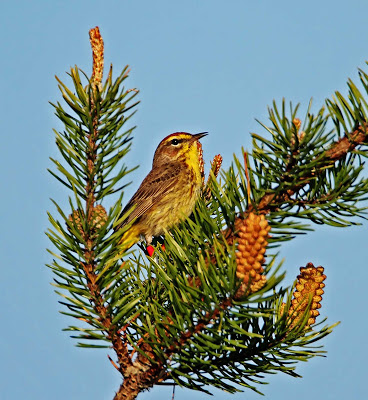
We got nice views of a banded Palm Warbler (Setophaga palmarum). You can see red bands on the , legs. This warbler is IDed by the rufous cap, brown back and yellow underparts and rump.

Palm Warbler

Here is a 3rd year Bald Eagle. It takes them 4 full years to get their adult plumage complete.

Bald Eagle - 3rd year
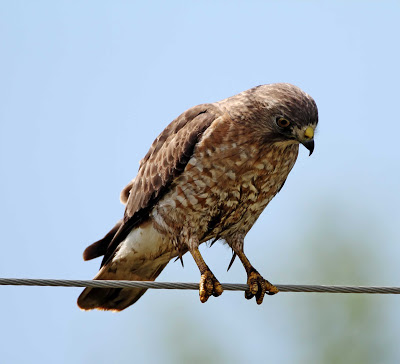
One raptor I needed was an adult plumaged Broad-winged Hawk (Buteo platypterus). This one perched on a phone wire was intent on a meal in the ditch below and didn't mind when we parked right beside him.


Broad-winged Hawk - adult
A moment later he pounced on a small mammal in the ditch beside the road, almost at our feet.

Broad-winged Hawk - adult
As he flew off, our guide saw the mammal in his talons and said it was a Star-nosed Mole.


Perhaps the most interesting finding on the trip was a pair of Sandhill Cranes (Grus canadensis), with 2 chicks only a couple of days old. The group was walking across the highway. All the cars stopped fortunately. One of the parents called the chicks down into the ditch. The other walked away from the group and proceeded to do the broken wing act to draw attention away from the chicks. I have seen Killdeers do this, but never such a large bird. Skye said he had seen that performance only 1 time previously with the cranes.

Here is the 2 day old chick.

Sandhill Crane - chick
Here is the one parent putting on the broken wing performance on the road.

Sandhill Crane - adult
He continued to walk farther away from his mate and the chicks and went down in to the roadside ditch. He then spread both his wings apart. Both parents were calling to each other while this was occurring.

Sandhill Crane - adult

Here is the other adult in the sunlight. Notice how rusty reddish the plumage is. I did not know that these cranes looked that color. It doesn't show in the bird guides. They are overall gray with a few rusty wing feathers. Skye said it was peculiar to that area, as there is a lot of iron in the ground water. When the birds preen, they put water on their feathers and gradually they become that rust color. Interesting!

Sandhill Crane - adult
Rusty colored due to iron in ground water
We were hoping to see some large mammals, but struck out. We did have an encounter with a Porcupine (Erethizon dorsatum). He was in a large open field, and when we got out, Seth left his car door open. We were photographing him and he circled around back to the car. I was afraid he would get into the car, but instead crawled under. This is my first photo of this mammal.

Here he is in defensive posture with the quills raised up on his back.


Porcupine
From behind, he is well armed. Pity the poor dog who takes on a porcupine and gets a face full of the quills.

Porcupine - from the back

As he got further away, he let his quills down.

Porcupine
We also found a good sized Snapping Turtle (Chelydra serpentina).

Snapping Turtle
Happy birding and photography,

David McDonald dkmmdpa@gmail.com

photos copyright 2013 David McDonald

To have these trip reports sent to your email, please email me at the above address and ask to subscribe.