So in recognition of this milestone there are several special people that I would like to thank. First is Susan Billetdeaux, the web master at Houston Audubon. She encouraged me at the beginning to get photos decent enough to qualify for their web site and later suggested I start the blog. The other are 2 couples, the Alexanders and the Amunys. I met them during spring migration in 2008 at LaFitte's Cove and they asked me to send them some of the photos. Thus was born these bulletins. So from a group of 2 people on the list, I now have more than 250 who receive these by email.
Also, I would like to recognize the wonderful guides I have used over the years who have helped me find the birds to photograph. All of them are highly recommended. I will provide a link to their web site or email.
California - Rick Fournier
Arizona - Tucson - Melody Kehl
Patagonia - Matt Brown
Texas - Darrell Vollert
Florida - Sarasota - Rick Greenspun
Miami - Paul Bithorn - email
Minnesota - Duluth - Sparky Stensaas
Michigan - Upper Peninsula - Skye Haas - email
Ontario - Geoff Carpentier
Panama - Gonzalo Horna
Dominican Republic - Kate Wallace
Ivan Mota
So I am going to select about a dozen photos in each group, that are my favorites. What makes a favorite photo for me? Well there are a number of things.
- Rarity of the bird
- A special bird in my yard
- Difficulty in finding the bird
- Action shots or several birds interacting
- The few photos that the lighting is just right, background is perfect and in my mind approach a 'work of art', if I may be so presumptuous.
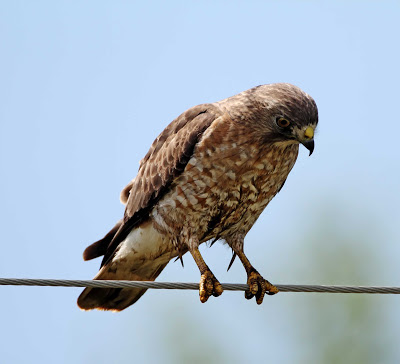
I will start with the raptors, the hawks and falcons. These birds look majestic and powerful and a photo might project that.
Here is a Bald Eagle, the national bird of the USA. Just sitting still, he looks majestic.
 |
| Bald Eagle - adult |
 |
| Peregrine Falcon |
 |
| Cooper's Hawk - juvenile |
This Gray Hawk just happened to fan his tail while I was taking his photo.
 |
| Gray Hawk |
This beautiful White-tailed Kite was in perfect morning light in Galveston. I stopped the car and he let me take his portrait. This is one of the 'almost artistic' photos. It would have been ideal if he was on a branch rather than a wire, but he wouldn't move when I asked him.
The Merlin is a small falcon and rather plain streaky brown. This bird was wintering at Anahuac NWR and I had seen him several times. I wanted to get a photo in perfect light, so went at daybreak and he cooperated by sitting on a curved branch, adding to the artistry of the photo.
 |
| White-tailed Kite |
 |
| Merlin |
On the trip to Panama, we were driving down a mountain road and this Broad-winged Hawk was sitting on a branch, perhaps 30 feet from the car. This is another 'ideal' photo with the bird at eye level and looking slightly forward. The background is uncluttered and blurred out. The pink on the left must have been a tree in bloom as there was nothing around.
Because of their large size, it is rare to get a raptor and flowers in the same photo. They usually perch on poles, large trees etc, so when I got this photo of a Harris's Hawk in the Rio Grande Valley, it was unique for me. It was a very windy afternoon and he was perched on top of a yucca flower with another bloom beside him.
In the summer of 2011, we had a severe drought in Houston and all sorts of birds were using the bird bath. I have photos of a Pileated Woodpecker in the bird bath as well as a couple of Red-shouldered Hawks, an adult and a juvenile. In addition, I was feeding the hawks live crayfish, so they were always waiting in the trees in the yard for 'dinner time' when I got home from work. However, I got photos of the hawk pair only twice, once in bird bath, and this time they were side by side in a tree when I arrived home from work. I ran into the house and grabbed my camera. I call this one, 'Learning to Dance'. The juvie is looking over at the parent and they both have a foot raised. It looks like he is trying to follow her foot routine.
Another pair of birds is this couple of Northern Caracaras at Anahuac NWR. Anahuac NWR was publishing a book for the 50th anniversary of the refuge. Photos could be submitted up until Dec 31, 2013. On Dec 29th, I saw this pair of birds far away on the ground, but too far far a photo. As I was leaving the refuge, I saw them together at the top of a bare tree. I took some photos from a distance as soon as I saw them, as not to scare them and gradually moved a little closer. Finally, I was probably about 25 yards away and I took quite a few. When I saw this one, with them looking in opposite directions and both in focus, I was pretty sure it would make the book. Sure enough, it made a full page photo, which was quite an honor.
The last 3 are action photos. The first is unusual in that I got 2 things happening simultaneously. A good photo is a flight shot of raptor carrying some prey. Probably the most common one for photographers is an Osprey carrying a fish. As they have to fly back to shore with their catch of the day and perch to eat it. I have photographed this several times. A much less common occurrence is to get a raptor defecating. I have occasionally seen them do this and usually it is while perched. Well on Jan 2, 2012, I was in Galveston and saw this Osprey flying onshore with a large fish. I started filming him and, darn if he didn't let fly, as I was taking his photos. I doubt I will ever get another like it. This is the reason I always wear a hat when I am birding. LOL
In this photo, an adult Bald Eagle flew up from the ground carrying some prey. A subadult all brown eagle followed him and was chasing him. I got several photos as he was chasing the adult and managed this one just at the instant he came up underneath and grabbed onto the prey. It was pure luck to get the right instant as the photos on either side of this one about 1/8 second apart have the birds 4-6 feet apart.
 |
| Broad-winged Hawk |
Because of their large size, it is rare to get a raptor and flowers in the same photo. They usually perch on poles, large trees etc, so when I got this photo of a Harris's Hawk in the Rio Grande Valley, it was unique for me. It was a very windy afternoon and he was perched on top of a yucca flower with another bloom beside him.
 |
| Harris's Hawk |
 |
| Red-shouldered Hawks Learning to Dance |
 |
| Northern Caracaras |
 |
| Osprey |
 |
| Bald Eagles |
This last photos has a gray male Northern Harrier attacking a female Harrier. I was at Brazoria NWR. I watched a male Northern Harrier fly across a field and I filmed him as he flew. He veered upwards into the direct sun, so I stopped taking photos of him. About a minute later, a brown female Northern Harrier flew across on exactly the same path. As I followed her with my camera, I caught a glimpse of the male diving down at her. She saw him and swerved upwards to meet the challenge. In this photo of their closest approach, their talons are extended and are just a foot or so apart.
 |
| Northern Harriers dueling |
Happy birding and photography,
David McDonald dkmmdpa@gmail.com
photos copyright 2006 - 2015 David McDonald
To have these trip reports sent to your email, please email me at the above address and ask to subscribe.
David McDonald dkmmdpa@gmail.com
photos copyright 2006 - 2015 David McDonald
To have these trip reports sent to your email, please email me at the above address and ask to subscribe.