Showing posts with label American Kestrel. Show all posts

Sunday, November 23, 2014

Bulletin 208 - Dominican Republic #1 Todies, Hawks, Falcons, Pigeons

I had a week birding in the Dominican Republic with Tody Tours. This company is owned by a retired ex -Bostonian, Kate Wallace, who has lived on the island for 20 years. She was the first person to organize bird tours in Dominican Republic and is the local guide for several international tour groups. She has several local guides to take you around. I spent most of the time with Ivan Mota who is excellent, knows his birds and really tries to bring in the birds. He also has his own tour company.

The Dominican Republic is the eastern 2/3 of the island of Hispaniola, sharing it with Haiti to the west. Hispaniola's area is 29,000 square miles. It is 2/3 size of Cuba, but much larger than Jamaica (4200 sq miles) and Puerto Rico (3500 sq miles). Together, these 4 islands make up the Greater Antilles group. The island is tectonic in origin, not volcanic like many Lesser Antilles, so earthquakes are a hazard like the major quake that hit Haiti several years ago. There are 3 mountain ranges on Hispaniola and they include the 2 largest peaks in the Caribbean (10,000 and 9,300 feet).
There are several rivers and lakes on the island. 2 of the lakes are below sea level and are saline. Both Haiti and Dominican Republic have a population of about 10 million each

Hispaniola has the most endemic birds (32) of any island in the Caribbean. These include 5 tanagers, and 2 each of parrots, cuckoos, nightjars, woodpeckers, todies, crows, warblers and finches. I was able to photograph 19 of them and saw or heard several others.

The todies are a 5 species family of birds in the Greater Antilles. Hispaniola has 2 endemic species and the other islands have 1 each. The Broad-billed Tody (Todus subulatus) is 4.5" in length. It has a bright green back, red throat and flanks and grayish belly. The lower mandible is entirely red.

Broad-billed Tody

His cousin, the Narrow-billed Tody (Todus angustirostris) is slightly smaller (4.25") but similar coloration except the lower mandible has a black tip. Also, their voices are different.

Narrow-billed Tody

There are 4 resident species of hawks and falcons, as well as several migrants. The American Kestrel (Falco sparverius) is common and we saw several. Here are a pair on a tree top. The male is above with the gray wings. Notice how little streaking there is on the belly. In USA, the birds are heavily streaked.

American Kestrel

The Red-tailed Hawk (Buteo jamaicensis) as its name suggests is a common resident in the Caribbean from the Bahamas to St. Kitts and Nevis. It is also the most common hawk in North America. This was the only bird I saw on the trip. His red tail is clearly visible.


Red-tailed Hawk

The third is the Sharp-shinned Hawk. I saw one of those but didn't get a good photo. The last resident hawk is the endemic Ridgway's Hawk (Buteo ridgwayi). I was really pleased to see and photograph this bird on my last day. It is listed as the rarest hawk in the world with about 100 breeding pairs in Los Haitises National Park. The Peregrine Fund has set up a captive breeding program in the last few years and is reintroducing the birds on another location on the island. So far, it has not been particularly successful.


Ridgway's Hawk
The next bird was a lifer for me. Quail-Doves are a group of doves that are ground dwellers and very shy. They are very hard to even see, as they walk or fly off when they see somebody. There are 3 species of Quail-Doves on Hispaniola, Key West Quail-Dove, Ruddy Quail-Dove and the endemic White-fronted Quail-Dove. I saw the first 2 and managed a photo of the Key West Quail-Dove (Geotrygon chrysia). This bird is found from the Bahamas to Puerto Rico and as its name suggests, it is a vagrant to the Florida keys. It has a green head and neck with a horizontal white line through the cheek. The back is reddish and the underparts gray. The sexes are similar.

Key West Quail-Dove

The Common Ground-Dove (Columbina passerina) is the only small (6.5") dove in the Caribbean. It is also found from the southern USA to northern South America.

Common Ground-Dove
Other pigeons on Hispaniola include the White-Crowned Pigeon (Columba leucocephala).These birds nest in the mangroves along the coast and feed inland on fruit and berries. They can be found from south Florida through the Caribbean and Central America. As I already had a photo of this bird from Florida, we didn't look for it.

The Scaly-naped Pigeon (Columba squamosa) is found in most of the Caribbean except Jamaica and Bahamas. It lives in mountain forests and we saw several fly overs, but none landed. Here is a photo I took of this bird in Puerto Rico.

Happy birding and photography,

David McDonald dkmmdpa@gmail.com

Lisa Kelly-McDonald lisajanekelly67@yahoo.com

photos copyright 2006 - 2014 David McDonald

To have these trip reports sent to your email, please email me at the above address and ask to subscribe.




Wednesday, July 16, 2014

Bulletin 203 - Panama #11 - Raptors and Owl


I was disappointed at how few numbers of raptors that we saw on the 1 week Panama trip. We saw several different species, but usually only 1 or 2 individuals. Several of the really cool looking ones that I had seen on previous tropical trips were not seen at all.

We photographed 3 species of the falcon and caracara family. The smallest (9") was our familiar American Kestrel (Falco sparverius). This species is IDed by the 2 vertical black lines on the head. This is a male as he has gray wings. This is my best photo ever of this species, so I always take their photo even if I have already some good ones.

American Kestrel - male
The Northern Caracara (Caracara cheriway) is a large (23") raptor. It occurs throughout Central America as well as the southern USA (FL, AZ, TX). There was an old turtle shell on the ground that got his attention. I don't think there was much nutrition in it. LOL

Northern Caracara - juvenile

The last was the Yellow-headed Caracara (Milvago chimachima). It is smaller at 17" and is IDed by the beige head and breast with brown wings and back.

Yellow-headed Caracara - adult

Some of our hawks are migrants through Central America. We saw a couple of these. On the last day as we were driving down a mountain road, this juvenile Broad-winged Hawk (Buteo platypterus) was on a bare branch at eye level not 25 feet from us. We rolled down the windows of the vehicle and took photos.

Broad-winged Hawk - juvenile

The last hawk we photographed was the beautiful Savanna Hawk (Buteogallus meridionalis). This 22" hawk is cinnamon colored.

Savanna Hawk
We did not see any new vultures, but we did see this downy baby Black Vulture (Coragyps atratus) who fell out of the nest. He was on the ground and being protected and presumably fed by the parents.

Black Vulture - downy young
I love owls. I have only seen a single owl in my 4 previous trips to the tropics. Nocturnal birds are so difficult to find. So when the guide told us he was taking us to a house where owls roosted, it was the highlight of the trip. The Spectacled Owl (Pulsatrix perspicillata) at 19" is the largest owl in Panama. The pair were sitting in the open several feet apart on a branch. Here is the male.

Spectacled Owl - male

Happy birding and photography,

David McDonald
dkmmdpa@gmail.com

photos copyright 2006 - 2014 David McDonald

To have these trip reports sent to your email, please email me at the above address and ask to subscribe.

Wednesday, January 8, 2014

Bulletin 188 - Anahuac NWR winter birds

I have made several trips to Anahuac NWR recently and found some great birds.

A first for me was to see and photograph Krider's color morph Red-tailed Hawk (Buteo jamaicensis) Sibley lists the Krider's as a 'scarce' prairie variant. It is very pale, almost white. One was found at Anahuac and I went to see and found a second bird as well.

Here is the first one that was seen and photographed. It has a bit of brown on the cheeks. There is also a bit of reddish wash on the tail. The eye color is yellow. This is probably a sub-adult bird as adults have brown eyes and red tails.

Krider's Red-tailed Hawk - subadult
The second bird is definitely a juvenile as it has no red on its tail and a yellow eye. This one is almost pure white on its head.


Krider's Red-tailed Hawk - juvenile
Here he is from above. Notice how light the end of the wings are, and how they are sharply demarcated from the central wing. This is exactly like the illustration in Sibley of the juvenile.


Krider's Red-tailed Hawk - juvenile
Another hawk was this juvenile White-tailed Hawk  (Buteo albicaudatus). They are almost completely brown, but have a white spot on their chest. But from the back as in this photo, it is just a big brown hawk. So how do you know this species form the photo? It has very long wings that project beyond the tail.

White-tailed Hawk - juvenile
Merlins (Falco columbaris) have always been a tough bird for me to find and photograph, but I found 2 in the past week at Anahuac. This small (10") falcon has a gray to black colored back and streaked breast. This one was perched on a fence post.

Merlin
The second one I found first thing in the morning on a low branch. The sunlight at dawn gave it a brown coloration.


Merlin

A female American Kestrel (Falco sparverius) stayed perched in a tree long enough for photos. Usually they fly off as soon as the car stops beside them. Kestrels are our smallest falcon at 9" in length. The female is all rufous - wings, back and tail and has 2 vertical black facial stripes. She even fanned her tail for the photo.


American Kestrel - female

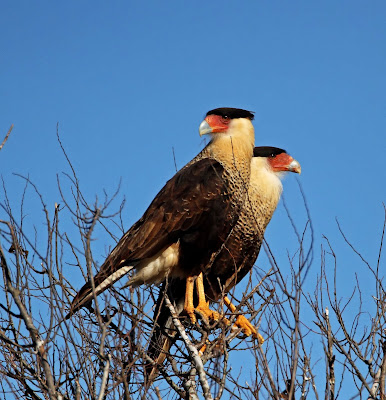
A pair of Crested Caracaras (Caracara cheriway) atop a bare tree completed a wonderful group of raptors.

Crested Caracara
An interesting sight was scores of migrating Tree Swallows (Tachycineta bicolor) perched on a fence.

Tree Swallows
A beautiful male Vermilion Flycatcher (Pyrocephalus rubinus) gave me some beautiful eye-level shots on 2 different days. These are the best ever for me of this species.

Vermilion Flycatcher - male


Vermilion Flycatcher - male


Happy birding and photography,

David McDonald dkmmdpa@gmail.com

photos copyright 2014 David McDonald

To have these trip reports sent to your email, please email me at the above address and ask to subscribe.