Showing posts with label Crested Caracara. Show all posts

Sunday, May 11, 2014

Bulletin 197 - Migration #3 and Anahuac NWR book

It certainly was a strange year for migration. The best weekend was Easter weekend April 18-20. Generally,  the following two weekends are the peak of migration. However strong southerly breezes provided a good tail wind for the birds and they must have gone far inland before alighting. All the migrant traps on the coast were as quiet as any of us can ever remember. I hope it isn't an indication of a severe decline in bird numbers.

The Yellow-breasted Chat (Icteria virens) was formally considered a warbler, but now it is uncertain of its pedigree. It is larger (7.5") than the warblers. I usually only see 1 or 2 each spring. This one was at LaFitte's Cove in Galveston.

Yellow-breasted Chat
The Yellow-billed Cuckoo (Coccyzus americanus) is a common spring migrant, but I only saw a couple of them this year.


Yellow-billed Cuckoo

A late migrant that I was pleased to find was the Bobolink (Dolichonyx oryzivorus). This 7" member of the icterid or blackbird family usually comes through in early to mid May when most birders have stopped going to the coast. This was only the 3rd time in 25 years that I saw them in the spring. The beautiful male has a black breast, white on wings and back, and a prominent yellow patch on the back of his head and neck.The female is just streaked brown like a sparrow and I have yet to get a photo of her.
Bobolink - breeding male
Phalaropes are a group of 3 species of sandpipers that are unique in several ways. They often swim
and dab at the surface of the water to feed. There is one species we get here. Additional, unlike most birds, the female is the brightly colored bird and the males are duller. The one we have in spring is Wilson's Phalarope (Phalaropus tricolor). The female has black stripe down neck with red on the wings.

Wilson's Phalarope - female breeding
The male is considerably plainer. He is IDed by the thin bill and a hint of color on his face and neck.

Wilson's Phalarope - male breeding
Anahuac NWR had a rare spring sandpiper visitor this year, a female Ruff (Philomachus pugnax). This Eurasian sandpiper is an occasional visitor to the lower 48 states. But it seems to have become rather regular as I have seen one 3 times since 2008 in the Houston area. This was my first female in breeding plumage and she is IDed by the bright orange legs.


Ruff - breeding female
Here is another photo which also shows the banding on the wing feathers just like in the Sibley guide.


Ruff - breeding female
Anahuac NWR has always been a favorite place to visit for me. 2013 was their 50th anniversary of the establishment of the refuge. The volunteer group Friends of Anahuac Refuge decided to publish a book about the refuge in their 50th year and invited photographers to submit photos for possible inclusion in the book. I was fortunate to have had 3 photos selected for the book.

The first was a full page photo of a wildflower I took way back in 2006. It is known a False Indigo.

False Indigo
The second was my photo of a Striped Skunk (without stripes) taken in 2010. It was only 1/4 page in the book.

Striped Skunk

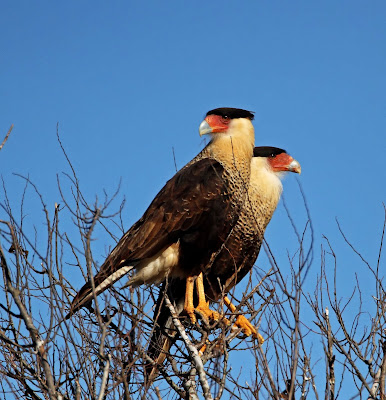
And lastly, I had a bird photo! This pair of Crested Caracaras on top of a bare tree was taken 2 days before the close of submissions last December. It was also published as a full page in the book.

Crested Caracaras

If any of you are interested in buying a copy of the book, it is only $20 plus tax and shipping. It can be purchased at the visitor center at Anahuac NWR or can be ordered online here.


Happy birding and photography,

David McDonald dkmmdpa@gmail.com

photos copyright 2006 - 2014 David McDonald

To have these trip reports sent to your email, please email me at the above address and ask to subscribe.




Wednesday, January 8, 2014

Bulletin 188 - Anahuac NWR winter birds

I have made several trips to Anahuac NWR recently and found some great birds.

A first for me was to see and photograph Krider's color morph Red-tailed Hawk (Buteo jamaicensis) Sibley lists the Krider's as a 'scarce' prairie variant. It is very pale, almost white. One was found at Anahuac and I went to see and found a second bird as well.

Here is the first one that was seen and photographed. It has a bit of brown on the cheeks. There is also a bit of reddish wash on the tail. The eye color is yellow. This is probably a sub-adult bird as adults have brown eyes and red tails.

Krider's Red-tailed Hawk - subadult
The second bird is definitely a juvenile as it has no red on its tail and a yellow eye. This one is almost pure white on its head.


Krider's Red-tailed Hawk - juvenile
Here he is from above. Notice how light the end of the wings are, and how they are sharply demarcated from the central wing. This is exactly like the illustration in Sibley of the juvenile.


Krider's Red-tailed Hawk - juvenile
Another hawk was this juvenile White-tailed Hawk  (Buteo albicaudatus). They are almost completely brown, but have a white spot on their chest. But from the back as in this photo, it is just a big brown hawk. So how do you know this species form the photo? It has very long wings that project beyond the tail.

White-tailed Hawk - juvenile
Merlins (Falco columbaris) have always been a tough bird for me to find and photograph, but I found 2 in the past week at Anahuac. This small (10") falcon has a gray to black colored back and streaked breast. This one was perched on a fence post.

Merlin
The second one I found first thing in the morning on a low branch. The sunlight at dawn gave it a brown coloration.


Merlin

A female American Kestrel (Falco sparverius) stayed perched in a tree long enough for photos. Usually they fly off as soon as the car stops beside them. Kestrels are our smallest falcon at 9" in length. The female is all rufous - wings, back and tail and has 2 vertical black facial stripes. She even fanned her tail for the photo.


American Kestrel - female

A pair of Crested Caracaras (Caracara cheriway) atop a bare tree completed a wonderful group of raptors.

Crested Caracara
An interesting sight was scores of migrating Tree Swallows (Tachycineta bicolor) perched on a fence.

Tree Swallows
A beautiful male Vermilion Flycatcher (Pyrocephalus rubinus) gave me some beautiful eye-level shots on 2 different days. These are the best ever for me of this species.

Vermilion Flycatcher - male


Vermilion Flycatcher - male


Happy birding and photography,

David McDonald dkmmdpa@gmail.com

photos copyright 2014 David McDonald

To have these trip reports sent to your email, please email me at the above address and ask to subscribe.