Showing posts with label Bobolink. Show all posts

Saturday, August 1, 2015

Bulletin 229 - Best of 10 years #6 - Icterids

The Icterids are a New World family of 109 species popularly called 'blackbirds'. They include blackbirds, cowbirds, and grackles. But many brightly colored birds are icterids such as orioles, meadowlarks, and the large tropical species of caciques and oropendolas.

The Tricolored Blackbird is an endangered bird of coastal California. Although it is not particularly colorful, it is distinguished from the more common Red-winged Blackbird by the white wing stripe. This bird also has a red wing patch above the white, but mostly it is hidden except when displaying. The best place to see this bird in the central California coast is the famous Moonglow Dairy north of Monterey, where this photo was taken.


Tricolored Blackbird - male
His cousin the very common Red-winged Blackbird can be found all across North America in marshes. As above, the red patch is usually hidden except when displaying such as this one.


Red-winged Blackbird - male

The Yellow-headed Blackbird breeds across western and central USA and western Canada. It can be found in winter in the Houston area in huge mixed blackbird flocks.
The male as a yellow head and breast with a white wing patch.


Yellow-headed Blackbird - male

The Red-breasted Blackbird is actually the same genus as our meadowlarks. It is a resident from Costa Rica to central South America. The bright red underparts and black back are stunning.


Red-breasted Blackbird
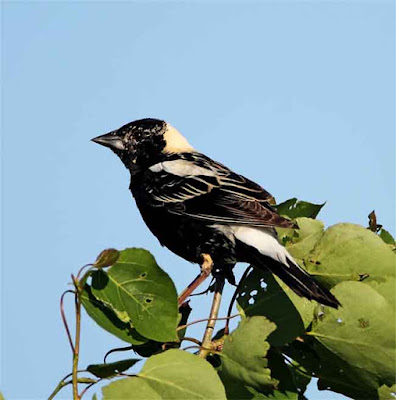
The distinctive Bobolink breeds across the northern states and southern Canada. It was a favorite of mine growing up in Ontario with his yellow patch across the back of the head. He also has a white rump and white wing patches. It can be seen in the Houston area late in migration (usually in May). I took this photo in northern Michigan.

Bobolink - male
Orioles are generally orange and black or yellow and black. One exception is the common Orchard Oriole where the male is chocolate brown and black. It nests in the eastern and central USA and can be readily seen in spring migration. It also breeds in the Houston area.

Orchard Oriole - male
There are 2 yellow and black orioles in the USA. The 9.5"  Audubon's Oriole can be found in south Texas.

Audubon's Oriole
The Bullock's Oriole is the western counterpart of the Baltimore Oriole. For a time in the 80's and 90's they were lumped together as Northern Oriole. It has a mostly orange head and extensive white on the wings.

Bullock's Oriole
Our largest oriole is the 10" Altamira Oriole. It is another bird of the Rio Grande Valley in Texas.

Altamira Oriole
The Black-vented Oriole is a resident of Mexico to Nicaragua. Periodically one will show up in south Texas. This was a lifer for me and it was photographed at Bentsen-Rio Grande State park in January 2012.

Black-vented Oriole
An unusual oriole for the USA is the Spot-breasted Oriole. It is a resident of western Central America, but a small population can be found in Miami where presumably they were released cage birds. This bird in Miami is the only one of the species I have seen.

Spot-breasted Oriole

The 11" Yellow-rumped Cacique is a resident from Panama to eastern South America. It has a pale yellow bill, blue eye and bright yellow rump.

Yellow-rumped Cacique
Happy birding and photography,

David McDonald

dkmmdpa@gmail.com

photos copyright 2006 - 2015 David McDonald

To have these trip reports sent to your email, please email me at the above address and ask to subscribe.

Sunday, May 11, 2014

Bulletin 197 - Migration #3 and Anahuac NWR book

It certainly was a strange year for migration. The best weekend was Easter weekend April 18-20. Generally,  the following two weekends are the peak of migration. However strong southerly breezes provided a good tail wind for the birds and they must have gone far inland before alighting. All the migrant traps on the coast were as quiet as any of us can ever remember. I hope it isn't an indication of a severe decline in bird numbers.

The Yellow-breasted Chat (Icteria virens) was formally considered a warbler, but now it is uncertain of its pedigree. It is larger (7.5") than the warblers. I usually only see 1 or 2 each spring. This one was at LaFitte's Cove in Galveston.

Yellow-breasted Chat
The Yellow-billed Cuckoo (Coccyzus americanus) is a common spring migrant, but I only saw a couple of them this year.


Yellow-billed Cuckoo

A late migrant that I was pleased to find was the Bobolink (Dolichonyx oryzivorus). This 7" member of the icterid or blackbird family usually comes through in early to mid May when most birders have stopped going to the coast. This was only the 3rd time in 25 years that I saw them in the spring. The beautiful male has a black breast, white on wings and back, and a prominent yellow patch on the back of his head and neck.The female is just streaked brown like a sparrow and I have yet to get a photo of her.
Bobolink - breeding male
Phalaropes are a group of 3 species of sandpipers that are unique in several ways. They often swim
and dab at the surface of the water to feed. There is one species we get here. Additional, unlike most birds, the female is the brightly colored bird and the males are duller. The one we have in spring is Wilson's Phalarope (Phalaropus tricolor). The female has black stripe down neck with red on the wings.

Wilson's Phalarope - female breeding
The male is considerably plainer. He is IDed by the thin bill and a hint of color on his face and neck.

Wilson's Phalarope - male breeding
Anahuac NWR had a rare spring sandpiper visitor this year, a female Ruff (Philomachus pugnax). This Eurasian sandpiper is an occasional visitor to the lower 48 states. But it seems to have become rather regular as I have seen one 3 times since 2008 in the Houston area. This was my first female in breeding plumage and she is IDed by the bright orange legs.


Ruff - breeding female
Here is another photo which also shows the banding on the wing feathers just like in the Sibley guide.


Ruff - breeding female
Anahuac NWR has always been a favorite place to visit for me. 2013 was their 50th anniversary of the establishment of the refuge. The volunteer group Friends of Anahuac Refuge decided to publish a book about the refuge in their 50th year and invited photographers to submit photos for possible inclusion in the book. I was fortunate to have had 3 photos selected for the book.

The first was a full page photo of a wildflower I took way back in 2006. It is known a False Indigo.

False Indigo
The second was my photo of a Striped Skunk (without stripes) taken in 2010. It was only 1/4 page in the book.

Striped Skunk

And lastly, I had a bird photo! This pair of Crested Caracaras on top of a bare tree was taken 2 days before the close of submissions last December. It was also published as a full page in the book.

Crested Caracaras

If any of you are interested in buying a copy of the book, it is only $20 plus tax and shipping. It can be purchased at the visitor center at Anahuac NWR or can be ordered online here.


Happy birding and photography,

David McDonald dkmmdpa@gmail.com

photos copyright 2006 - 2014 David McDonald

To have these trip reports sent to your email, please email me at the above address and ask to subscribe.


Sunday, June 30, 2013

Bulletin 177 - other birds, wildflowers, and butterflies in Michigan

I had a birding trip to northern Michigan in early June. I was accompanied by my stepson Seth for his first birding trip and we had a good time birding and photographing together. Also, we met some friends (Dutch and Bonnie Zonderman) from Northern Michigan and birded with them the first day to see the Kirtland's Warbler.

I employed a guide in the Upper Peninsula, Skye Haas. He doesn't have a web site yet, but his email is here. I would highly recommend him to anyone heading that way.

This bird was a lifer for me. I had spent probably 3 entire days looking for it previously, first in the Sierras of Northern California and then in Duluth, Minnesota in winter. Finally I got it. The third time was the charmer. This bird is the Black-backed Woodpecker (Picoides arcticus). This woodpecker prefers trees killed by forest fires. Fortunately for me, there had been a small fire last year, and Skye found several pairs nesting in the burned forest. So here is the male. It has an all black back, black head and white stripe below the eye.

Black-backed Woodpecker - male
And he then flew to the nest hole that was only about 4' off the ground. Notice how he chipped off the burned bark below the hole.

Black-backed Woodpecker - male
This bird has 2 features not seen in most of the North American woodpeckers. Can you find them?
The male has a yellow patch on his head rather than red. Also, there are 3 toes on each foot, rather than the usual 4. The female would be similar, but she lacks the yellow patch on the head.

Another lifer was the Winter Wren (Troglodytes hiemalis). This tiny (4") hyperactive bird stayed deep in the brush, frustrating our attempts to get any photos.Finally, he popped into a small clearing among the branches and was spotted by Seth. I got off a couple of photos. As you know, this bird was split into Winter Wren and Pacific Wren several years ago. I had only seen the Pacific form in California. Thus I needed to see the eastern form as it was now a full species. It is IDed by the brown overall color, whitish spots and the short cocked up tail.

Winter Wren
The Bobolink (Dolichonyx orizyvorus) is a (7") member of the icterid or blackbird family. Its range is southern Canada and northern USA, east of the Rockies. It migrates through eastern USA with Houston being on the extreme western edge of the route. I remember this attractive bird from my childhood in Canada, but had seen it only twice in 20 years in Houston. It tends to be a late migrant in early May.

The male shown here has a black body, white rump and wing patches and a distinctive yellow occipital patch. The female and winter males are streaked brown like a large sparrow. He still has a few brownish feathers on his face, so has not completely finished molting.

Bobolink - breeding male
Seth got a great photo of him flying which shows the field marks.

Bobolink - breeding male
Photo by Seth Kelly
 
We found several species of flycatchers. The first is the Olive-sided Flycatcher (Contopus cooperi). This is a medium sized (7.5") flycatcher of the northern woods. It likes to perch on the tops of trees. It has one a memorable song "Quick..3 beers" and that is exactly what it sounds like!
It is IDed by the dark vest, no eye ring and faint or no wing bars.

Olive-sided Flycatcher
The empids are small flycatchers that have both eye rings and wing bars. Many of them are difficult to ID by appearance and can only be IDed by voice. The Yellow-bellied Flycatcher (Empidonax flaviventris) has yellow underparts.

Yellow-bellied Flycatcher
Two closely related species were formerly lumped together as Traill's Flycatcher until split about a decade ago. The Alder Flycatcher (Empidonax alnorum) is a small (5.75") flycatcher of the north woods of Canada and eastern USA, preferring alders as its name suggests. I had seen this bird in Houston in fall migration.

Alder Flycatcher
The second one is the Willow Flycatcher (Empidonax traillii). It is the same size as the alder, but it range is south of the Alder above, but ovelap occurs. It likes to be near water in willows. Our guide, Skye Haas, said this bird didn't occur on the Upper Peninsula, but told us of a place to check on our way back to the airport.

This location was Shiawassee NWR outside Saginaw Michigan. So Seth and I got up early and were able to take the 1 hour driving tour through the refuge. At the first group of willows we came to, we stopped and played the tape. Out popped several of the birds. This was another lifer for me. How easy to find the birds in the right location! Notice he has almost no eye ring, compared to the two empids above.

Willow Flycatcher
Other flycatchers seen were Eastern Kingbird, and Great-crested Flycatcher.

As this was spring in the north woods, there was a profusion of butterflies, wildflowers etc, all awakening from the long winter. We saw 2 species of wild orchids.

The first is the Pink Lady's-Slipper or Moccasin-Flower (Cypripedium acaule).

Pink Lady's-Slipper
There was also a similar yellow orchid, but I wasn't able to find the ID on line.


Yellow Orchid - upper peninsula Michigan

 
Several interesting butterflies were seen. The first is the Canadian Tiger Swallowtail (Papilio canadensis). The range is Alaska, Canada and USA along the Canadian border.

Canadian Tiger Swallowtail

The next one occurs all over the USA and Canada, althought I don't recall ever seeing it before.
It is the Mourning Cloak (Nymphalis antiopa).

Mourning Cloak
The Eastern Comma (Polygonia satyrus) has very indented wings.

Eastern Comma
Lastly a tiny. thumbnail sized butterfly, the Spring Azure (Celastrina ladon). This tiny butterfly has azure blue upper wings, but when perched has its wings closed, so only the spotted underside is visible.

Spring Azure

Happy birding and photography,

David McDonald davidkmcd@ymail.com

Lisa Kelly-McDonald lisajanekelly67@yahoo.com

photos copyright 2013 David McDonald and Lisa Kelly-McDonald

To have these trip reports sent to your email, please email me at the above address and ask to subscribe.