Showing posts with label Yellow-rumped Cacique. Show all posts

Sunday, September 26, 2021

Bulletin 385 - Colombia 2021 #2 - Icterids

 I finally made it back to Colombia for my second visit and again used the guide services of Pablo Florez. I went with my friend Martin Jackson. We visited Inirida on the Orinoco, Santa Marta of course, Guajira Peninsula on the Caribbean coast, and a couple of National Parks around Bogota.

First a correction on the ID of Scaled Piculet on the previous bulletin. It is actually the Golden-spangled Piculet. Thanks to Pablo Florez for the correct ID. 

Icterids are the New World blackbirds such as orioles, grackles and meadowlarks. Orioles are obviously the most colorful and we had 2 lifers for me - both on the Caribbean coast in extreme northeast Colombia.

The 8" Yellow Oriole (Icterus nigrogularis) was admiring his reflection in our vehicle window. He looks more orange than yellow to me but I am not the person who named the bird.

Yellow Oriole

The other was the shy 8" Orange-crowned Oriole (Icterus auricapillus). He has more black than the first one - but the orange/yellow looks the same??

Orange-crowned Oriole

I also had 2 lifer grackles. The first was the peculiarly named 7" Velvet-fronted Grackle (Lampropsar tanagrinus). Here is where the name comes from. The feathers at the front of the crown are very short and dense, giving a velvet-like appearance at close quarters.

Velvet-fronted Grackle


The other is the 10.5" Carib Grackle (Quiscalus lugubris). It is similar to the Great-tailed Grackle but considerably smaller.

Carib Grackle


Caciques are larger then orioles. Both the species we saw were not new for me. The 11" Yellow-rumped Cacique (Cacicus cela) is black with a yellow bill, rump and undertail.
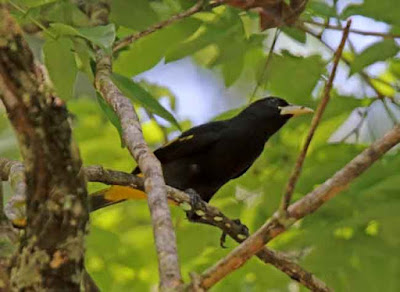

Yellow-rumped Cacique


The Solitary Cacique (Cacicus solitarius) is all black with a yellow bill.


Solitary Cacique

Oropendolas are larger still. I photographed 2 species and 1 was a lifer. The 21" Olive Oropendola (Psarocolius bifasciatus) was the lifer. He has an olive green body, ruflos wings, yellow tail and red tip on the bill. But the easiest ID mark is the pink cheeks.

Olive Oropendola


The other was the 18" Crested Oropendola (Psarocolius decumanus). It is black with an ivory bill and yellow tail.

Crested Oropendola


The last was a surprise for me to find the 9.5" Eastern Meadowlark (Sturnella magna) as a resident bird in mountains around Bogota. I had no idea that they had such an extensive range.

Eastern Meadowlark

So you may be wondering why I photograph the birds that I already have seen and photographed before. Well there are several reasons.

First is I always want to upgrade the photos. The Solitary Cacique here was much better than the other photo I had.

Second, is the possibility of the bird being split by subspecies in 2 or more species. If I have several photos from different locations, if a split occurs, I may already have the photos of both. The Eastern Meadowlark has 16 subspecies from eastern Canada to Brazil and Cuba.

I put the different bird/mammal families in single folders for easy viewing

I have photos of 50 of the 109 species of icterids

Happy birding and photography,

David McDonald


dkmmdpa@gmail.com

photos copyright 2006 - 2021 David McDonald

To have these trip reports sent to your email, please email me at the above address and ask to subscribe.

Saturday, August 1, 2015

Bulletin 229 - Best of 10 years #6 - Icterids

The Icterids are a New World family of 109 species popularly called 'blackbirds'. They include blackbirds, cowbirds, and grackles. But many brightly colored birds are icterids such as orioles, meadowlarks, and the large tropical species of caciques and oropendolas.

The Tricolored Blackbird is an endangered bird of coastal California. Although it is not particularly colorful, it is distinguished from the more common Red-winged Blackbird by the white wing stripe. This bird also has a red wing patch above the white, but mostly it is hidden except when displaying. The best place to see this bird in the central California coast is the famous Moonglow Dairy north of Monterey, where this photo was taken.


Tricolored Blackbird - male
His cousin the very common Red-winged Blackbird can be found all across North America in marshes. As above, the red patch is usually hidden except when displaying such as this one.


Red-winged Blackbird - male

The Yellow-headed Blackbird breeds across western and central USA and western Canada. It can be found in winter in the Houston area in huge mixed blackbird flocks.
The male as a yellow head and breast with a white wing patch.


Yellow-headed Blackbird - male

The Red-breasted Blackbird is actually the same genus as our meadowlarks. It is a resident from Costa Rica to central South America. The bright red underparts and black back are stunning.


Red-breasted Blackbird
The distinctive Bobolink breeds across the northern states and southern Canada. It was a favorite of mine growing up in Ontario with his yellow patch across the back of the head. He also has a white rump and white wing patches. It can be seen in the Houston area late in migration (usually in May). I took this photo in northern Michigan.

Bobolink - male
Orioles are generally orange and black or yellow and black. One exception is the common Orchard Oriole where the male is chocolate brown and black. It nests in the eastern and central USA and can be readily seen in spring migration. It also breeds in the Houston area.

Orchard Oriole - male
There are 2 yellow and black orioles in the USA. The 9.5"  Audubon's Oriole can be found in south Texas.

Audubon's Oriole
The Bullock's Oriole is the western counterpart of the Baltimore Oriole. For a time in the 80's and 90's they were lumped together as Northern Oriole. It has a mostly orange head and extensive white on the wings.

Bullock's Oriole
Our largest oriole is the 10" Altamira Oriole. It is another bird of the Rio Grande Valley in Texas.

Altamira Oriole
The Black-vented Oriole is a resident of Mexico to Nicaragua. Periodically one will show up in south Texas. This was a lifer for me and it was photographed at Bentsen-Rio Grande State park in January 2012.

Black-vented Oriole
An unusual oriole for the USA is the Spot-breasted Oriole. It is a resident of western Central America, but a small population can be found in Miami where presumably they were released cage birds. This bird in Miami is the only one of the species I have seen.

Spot-breasted Oriole

The 11" Yellow-rumped Cacique is a resident from Panama to eastern South America. It has a pale yellow bill, blue eye and bright yellow rump.

Yellow-rumped Cacique
Happy birding and photography,

David McDonald

dkmmdpa@gmail.com

photos copyright 2006 - 2015 David McDonald

To have these trip reports sent to your email, please email me at the above address and ask to subscribe.

Sunday, March 30, 2014

Bulletin 194 - Panama #5 - blackbirds and howlers

The icterids are a new world family of birds, popularly called the blackbirds. They include many familiar species including blackbirds, grackles, orioles, cowbirds and meadowlarks. However, crows are not in that family.

The Shiny Cowbird (Molothrus bonariensis) is a 9" cowbird that has a range from southeast USA to South America. The male is glossy black with a dark eye. The female is dull brownish.

Shiny Cowbird - male
Caciques are larger birds who build long hanging nests like orioles. The Yellow-rumped Cacique (Cacicus cela) is 11" long. The sexes are similar. It is unmistakable with its pale bill, blue eye, yellow rump and vent and black body.

Yellow-rumped Cacique

Oropendolas are larger cousins of the caciques and build even longer hanging nests, some may be 3 feet long. The Chestnut-headed Oropendola (Psarocolius wagleri) is 14" long with brown head, and rump, black body, yellow tail and large pale bill and a blue eye.


Chestnut-headed Oropendola
The Crested Oropendola (Psarocolius decumanus) is much larger at 17" long. The head and body are all black except for the brown vent and rump. The tail is yellow. The bill is whitish. He has a wispy crest.
Crested Oropendola

Here is a bird building the nest.

Crested Oropendola
The Yellow-backed Oriole (Icterus chrysater) is 7.5" long with a yellow body, black face and throat, wings and tail. The sexes are similar
.

Yellow-backed Oriole
Compare this to the Yellow-tailed Oriole (Icterus mesomelas) which is an inch longer. This bird has a black back and yellow tail.

Yellow-tailed Oriole
Most people in the USA and Canada are familiar with the Red-winged Blackbird. The male is black with a red shoulder patch that often is hidden. Well here is the stunning Red-breasted Blackbird (Sturnella militaris) of South America. It is a small bird at 6.5" long. The male is shown here and is not an ID problem. The female is streaked brownish. It is the same genus as our meadowlarks.

Red-breasted Blackbird

The Mantled Howler Monkey (Alouatta palliata) is the largest monkey in Panama. They weigh up to 22 pounds. We heard them several times and on one lucky day, a troop of about 30 animals crossed our path. Here is one just chilling out on a branch.

Mantled Howler Monkey
We saw several babies carried by the parents. Here are an adult and baby.

Mantled Howler Monkey

A moment later, the baby rolled over on his back and scratched his back on the tree. It was fun to watch.

Mantled Howler Monkey
We even saw a newborn. This little guy was less than 24 hours old according to our guide. His mother was upside down and he was clinging to her chest. He was struggling to get to her nipple to nurse.

Mantled Howler Monkey
Lastly, as a physician, if I can detect an injury or illness in wildlife, I find it fascinationg. This large male was one of the first of the monkeys we saw. He had a large 'hole' on his neck. I thought it was a bullet hole, as the indians do eat these monkeys but probably not in this area of Panama where we were. Anyway, the guide said it was caused from a worm. I did the research and it is botfly larvae burrowed into the skin. Looking at the rest of the photos, I saw several more lumps on other monkeys, but none had a gaping hole like this guy on the right side of his neck. If you look closely on the left side of his neck, it looks like a large lump that is probably another infestation.

Mantled Howler Monkey
with Botfly larva hole

Happy birding and photography,

David McDonald dkmmdpa@gmail.com

photos copyright 2014 David McDonald

To have these trip reports sent to your email, please email me at the above address and ask to subscribe.