Showing posts with label Black-fronted Nunbird. Show all posts

Sunday, June 9, 2024

Bulletin 436 - Brazil 2023 #17 - Puffbirds and Toucans

 After 3 trips to Colombia with diminishing returns, it was time to go further afield. Pablo Flores the guide in Colombia is now leading trips to Brazil as well. So my birding buddy Martin Jackson and my daughter Chantel and I decided to go there. We visited the Pantanal, the Atlantic forest in the Sao Paulo area and had 1 day in the Chapada. The Pantanal is the largest wetland in the world, so it is teeming with wildlife. The Atlantic Forest is a unique ecosystem from sea level to about 1 mile elevation. It contains 800 species of birds (225 endemic) and 26 species of primates. Unfortunately it also contains 2 mega cities - Sao Paulo and Rio de Janeiro and the resulting sprawl and clearing for agriculture since the Portuguese arrived 500 years ago, has wiped out 90%+ of the original forest. About 250 species of amphibians, birds and mammals have gone extinct in the past 400 years. The good news is that many preserves and parks have been set aside to try and preserve the remaining biodiversity.

Puffbirds are great for photography as they usually sit still while looking around for some large insects or lizards.

The 8" White-eared Puffbird (Nystalus chacuru) has a brown back, black face with white ear patch and white underside. His beak is orange. 

White-eared Puffbird

His cousin, the 7.5" Caatinga Puffbird (Nystalus maculatus) also stayed still, but unfortunately he was high in a tree. He is brown above with an orang breast and spotted flanks. It is endemic to Brazil.

Caatinga Puffbird

The 7.5" Crescent-chested Puffbird (Malacoptila striata) is an easy ID with the brown head and orange streaking. It is endemic to Brazil.

Crescent-chested Puffbird

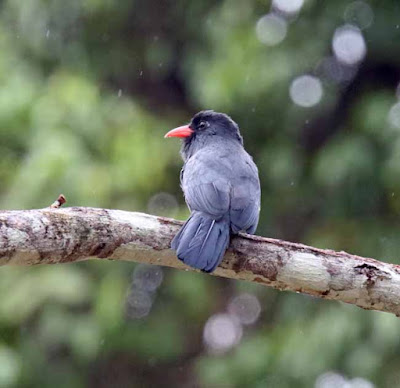
Lastly, the 10" Black-fronted Nunbird (Monasa nigrifrons) is dark gray with black around the red bill. This is a widespread bird in Latin America. I have seen it on many trips.

Black-fronted Nunbird

Now we turn to everyone's favorite - the toucans. I will describe them in order of size. All of them were life birds for me.

The 12.5" male Spot-billed Toucanet (Selenidera maculirostris) has a green back, black head and chest, green around the eye and a gray bill with black spots on the upper mandible.

Spot-billed Toucanet - male

Next is the amazing 13.5" Saffron Toucanet (Pteroglossus bailloni). He is an easy ID. At the lodge, they came to feeders and actually I was able to hand feed him a banana. 

Saffron Toucanet

The 16" Chestnut-eared Aracari (Pteroglossus castanotis) was high up on a dead snag. He has a greenish back, rusty neck and yellow belly with a single red band.

Chestnut-eared Aracari

The 18" Red-breasted Toucan (Ramphastos dicolorus) is an easy ID. 

Red-breasted Toucan

Lastly is the huge 24" Toco Toucan (Ramphastos toco). We only saw this one on the trip but wow what a spectacular bird with his huge orange bill. He is the largest member of the toucan family.

Toco Toucan

I put the different bird/mammal families in single folders for easy viewing

I have photos of 16 of the 38 species of Puffbirds

I have photos of 23 of the 43 species of Toucans

Happy birding and photography,

David McDonald

dkmmdpa@gmail.com

photos copyright 2006 - 2024 David McDonald

To have these trip reports sent to your email, please email me at the above address and ask to subscribe.

Sunday, July 10, 2022

Bulletin 398 - Colombia 2021 #15 - Puffbirds , vulture, motmot and boto

I finally made it back to Colombia for my second visit and again used the guide services of Pablo Florez. I went with my friend Martin Jackson. We visited Inirida on the Orinoco, Santa Marta of course, Guajira Peninsula on the Caribbean coast, and a couple of National Parks around Bogota.

Puffbirds are a small family of large headed and heavy-billed birds - usually brown or black in color. There are 38 species and 24 of them are in Colombia.

The 7" Chestnut-capped Puffbird (Bucco macrodactylus) is a brown puffbird with a plain breast and bright rufous cap.

Chestnut-capped Puffbird

His cousin the 7.5" Spotted Puffbird (Bucco tamatia) is similar but he has a rufous breast and heavy black spotting on his belly. Both these birds are listed as uncommon to rare in Amazonian Colombia.

Spotted Puffbird

The 8" Russet-throated Puffbird (Hypnelus ruficollis) is similar to the above but a different genus. He has a rufous throat but and a black chest band.

Russet-throated Puffbird


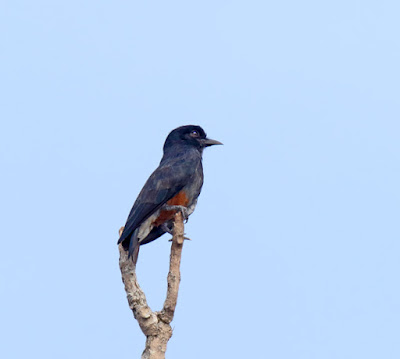
The 7" Swallow-winged Puffbird (Chelidoptera tenebrosa) looks and behaves more like a flycatcher. He is dark gray in color with a reddish belly.

Swallow-winged Puffbird

Lastly a small group of puffbirds are call nunbirds. The 9.5" Black-fronted Nunbird (Monasa nigrifrons) is a dark gray bird with a black face and red bill. It is an easy ID.

Black-fronted Nunbird

Motmots are colorful birds with long racquet tails. The only one for the trip was the 15" Whooping Motmot (Momotus subrufescens). What is distinctive is they swing their tails side-to-side rather than up and down.

Whooping Motmot

I finally got a photo of a 26" Lesser Yellow-headed Vulture (Cathartes burrovianus). I had seen this bird at a great distance soaring a few times, but now had one along the Caribbean coast. The head is actually yellow with a red forehead and red nape.

Lesser Yellow-headed Vulture

We also saw a juvenile King Vulture while we were having lunch one day. But I did not recognize what it was, so I missed the photo before the guide IDed it.

I love marine mammals, so I was excited that we might see a fresh water dolphin on the trip. The Amazon River Dolphin (Inia geoffrensis) is AKA Boto or Pink Dolphin. It is one of 2 species of fresh water dolphins in the Amazon basin. The first afternoon in Inirida we went to a small river that had a pod of maybe 20 dolphins and they were surfacing all around our boat.

Amazon River Dolphin

I put the different bird/mammal families in single folders for easy viewing

I have photos of 11 of the 38 species of puffbirds

I have photos of 10 of the 14 species of motmots

I have photos of 6 of the 7 species of New World vultures

Happy birding and photography,

David McDonald

dkmmdpa@gmail.com

photos copyright 2006 - 2022 David McDonald

To have these trip reports sent to your email, please email me at the above address and ask to subscribe.