Showing posts with label Russet-throated Puffbird. Show all posts

Sunday, July 10, 2022

Bulletin 398 - Colombia 2021 #15 - Puffbirds , vulture, motmot and boto

I finally made it back to Colombia for my second visit and again used the guide services of Pablo Florez. I went with my friend Martin Jackson. We visited Inirida on the Orinoco, Santa Marta of course, Guajira Peninsula on the Caribbean coast, and a couple of National Parks around Bogota.

Puffbirds are a small family of large headed and heavy-billed birds - usually brown or black in color. There are 38 species and 24 of them are in Colombia.

The 7" Chestnut-capped Puffbird (Bucco macrodactylus) is a brown puffbird with a plain breast and bright rufous cap.

Chestnut-capped Puffbird

His cousin the 7.5" Spotted Puffbird (Bucco tamatia) is similar but he has a rufous breast and heavy black spotting on his belly. Both these birds are listed as uncommon to rare in Amazonian Colombia.

Spotted Puffbird

The 8" Russet-throated Puffbird (Hypnelus ruficollis) is similar to the above but a different genus. He has a rufous throat but and a black chest band.

Russet-throated Puffbird


The 7" Swallow-winged Puffbird (Chelidoptera tenebrosa) looks and behaves more like a flycatcher. He is dark gray in color with a reddish belly.
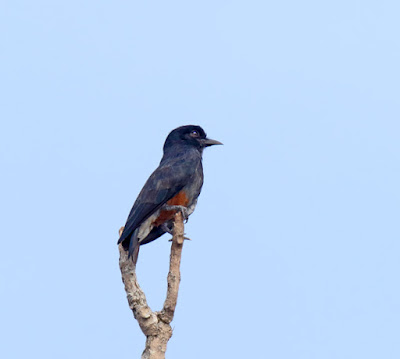
Swallow-winged Puffbird

Lastly a small group of puffbirds are call nunbirds. The 9.5" Black-fronted Nunbird (Monasa nigrifrons) is a dark gray bird with a black face and red bill. It is an easy ID.
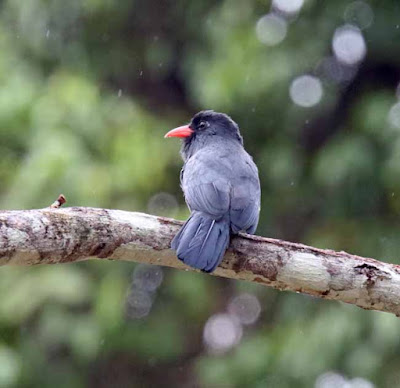
Black-fronted Nunbird

Motmots are colorful birds with long racquet tails. The only one for the trip was the 15" Whooping Motmot (Momotus subrufescens). What is distinctive is they swing their tails side-to-side rather than up and down.

Whooping Motmot

I finally got a photo of a 26" Lesser Yellow-headed Vulture (Cathartes burrovianus). I had seen this bird at a great distance soaring a few times, but now had one along the Caribbean coast. The head is actually yellow with a red forehead and red nape.

Lesser Yellow-headed Vulture

We also saw a juvenile King Vulture while we were having lunch one day. But I did not recognize what it was, so I missed the photo before the guide IDed it.

I love marine mammals, so I was excited that we might see a fresh water dolphin on the trip. The Amazon River Dolphin (Inia geoffrensis) is AKA Boto or Pink Dolphin. It is one of 2 species of fresh water dolphins in the Amazon basin. The first afternoon in Inirida we went to a small river that had a pod of maybe 20 dolphins and they were surfacing all around our boat.

Amazon River Dolphin

I put the different bird/mammal families in single folders for easy viewing

I have photos of 11 of the 38 species of puffbirds

I have photos of 10 of the 14 species of motmots

I have photos of 6 of the 7 species of New World vultures

Happy birding and photography,

David McDonald

dkmmdpa@gmail.com

photos copyright 2006 - 2022 David McDonald

To have these trip reports sent to your email, please email me at the above address and ask to subscribe.

Sunday, April 2, 2017

Bulletin 289 - Colombia #12 - Miscellanous

Pablo Florez, the main guide, has co-written a book where to bird in Colombia. In it, he has a list of the Top 30 Most Sought-after Birds by a group of 40 birders visiting Colombia. I saw 12 of them on the trip and got photos of 10. When I show one of these birds,  I will mention its placement on the list.

I am nearing the end of the amazing birds on my Colombia trip last fall. Here are the remaining non-passerines that I have not discussed earlier.

The puffbirds are a small (38 species) New World family. 24 of them are in Colombia. Puffbirds appear to be large headed birds with heavy  bills. They tend to sit motionless and then fly out to grab an insect or lizard. I saw and photographed 3 species on this trip, 2 of which were lifers. The one I had photographed before is the 7" White-whiskered Puffbird (Malacoptila panamensis). This bird is rufous and white and a streaked belly.


White-whiskered Puffbird
 His cousin the almost identical 8.5" Moustached Puffbird (Malacoptila mystacalis) is darker brown in color and has a handlebars mustache. He was a lifer.


Moustached Puffbird
The other lifer was unexpected as we had stopped to photograph the Savannah Hawk, and this bird was perched right in front of us. This is the 8" Russet-throated Puffbird (Hypnelus ruficollis). 


Russet-throated Puffbird

The new World Barbets are another small (15 species) New World family.  The 7" White-mantled Barbet (Capito hypoleucus) is endemic to Colombia and obviously was a lifer as this was my first trip to that country.


White-mantled Barbet
The barbets are related to toucans and in between these families is a 2 species family, one of which is the colorful 9" Toucan Barbet (Semnormis ramphastinus). This multicolored bird is an easy ID. It is number 26 on the top 30 birds list above. I had seen this bird in Ecuador, but it was always nice to see again.


Toucan Barbet
Next is the 19" long tailed Andean Motmot (Momotus aequatoralis). These birds have a racquet tail in which there is a length of bare shaft on the long tail feathers. 


Andean Motmot


What was interesting to me with this bird which was coming to a feeder. was he did not have the bare shaft. The guide had not seen a bird without the raquet tail before. 

Here is a close up of his tail feathers. and they look perfectly normal. There has been some discussion as to how the bird gets the bare shaft. It was presumed that the bird stripped the shaft bare himself. But the latest I read, that the thinking now is the shaft just drops off the bristles. You can certainly see the tip of the 2 longest feathers are wider than the rest of the feather.


For comparison, here is another Andean Motmot I photographed in Ecuador. The bare shafts are readily seen below the branch.


Andean Motmot
I was surprised to only see 2 mammals on the whole trip. One was a squirrel, but the other was a monkey, the White-footed Tamarin (Saguinus leucopus). This small monkey has a very long tail. It is endangered due to habitat loss and is endemic to Colombia


White-footed Tamarin
And another of this cute monkey.


White-footed Tamarin
Happy birding and photography,

David McDonald

dkmmdpa@gmail.com

photos copyright 2006 - 2017 David McDonald

To have these trip reports sent to your email, please email me at the above address and ask to subscribe.