Sunday, August 23, 2015

Bulletin 232 - Costa Rica #11 - cotinga, flycatchers, antbirds, ovenbirds, reptiles

Cotingas are a  small (66 species) New World family of often showy birds. The 8" Snowy Cotinga (Carpodectes nitidus) male all white with a black bill and eye. The female is grayish.
Snowy Cotinga - male
The tyrant flycatchers, family tyrannidae, is the largest family of birds with more 400 species, all in the New World. We have seen many in the Panama bulletin last year, and many are dull colored, so I will just show a few of the more interesting from my Costa Rica trip.

Empids are small flycatchers and the half dozen species in North America are an ID challenge and best confirmed by voice. This bird however, is an easy ID. The 4" Black-capped Flycatcher (Empidonax atriceps) is gray with a black head and elliptical eye ring. It is found above 7200 feet elevation. It is endemic to Costa Rica and western Panama.


Black-capped Flycatcher
The 7" Dark Pewee (Contopus lugubris) has a crest and no eye ring or wing bars. It occurs in the mountains, as well, but at lower elevations from 4000 - 7000 feet. It is endemic to Costa Rica and western Panama.
Dark Pewee
The 5" Tufted Flycatcher (Mitrephanes phaeocercus) is a cute brown bird with a bright rufous breast and a crest.


Tufted Flycatcher
Lastly, the 4" Torrent Tyrannulet (Serpophaga cinerea) is a gray bird with pale breast. It is found along mountain streams.


Torrent Tyrannulet
I was able to photograph 2 antbirds on this trip. There was a cooperative pair of Black-crowned Antshrikes (Thamnophilus atrinucha) who posed so close that I had to back away to get them in the camera. The male is gray with white spots on the wings and a black cap. The female is brown and can be seen here.


Black-crowned Antshrike - male
The male 7" Fasciated Antshrike (Cymbilaimus lineatus) is finely barred black and white with a bright red eye. The female is brown and white.


Fasciated Antshrike - male
The ovenbird family is a huge (312 species) New World family of mostly small brown birds. I will just show a couple of interesting ones from this trip. The 6" Ruddy Treerunner (Margarornis rubiginosus) is rufous with a white throat and eye stripe. This one was preening after bathing in a stream. It is found in the mountains above 5000 feet and is endemic to Costa Rica and western Panama


Ruddy Treerunner
The 7" Buffy Tuftedcheek (Pseudocolaptes lawrencii) is named for its flared cheek feathers. It is also the only ovenbird in Costa Rica with wing bars. It is found above 5200' elevation.


Buffy Tuftedcheek

I photographed 5 reptiles on the trip..3 lizards, a turtle and a snake. Many people are afraid of snakes, but I have had many trips to the rain forest and only have seen 5 in all the time.

The Green Spiny Lizard (Sceloporus malachiticus)  is a 7" lizard that changes color readily from green to almost black to match the surface he is on. This one was found above the tree line at about 11,000 feet elevation.


Green Spiny Lizard

There are 4 species of basilisk lizards. I had photographed the Common or Brown Basilisk in Panama last year. The Striped Basilisk (Basilicus vittatus) is only about 20" when full grown. It is found on the Caribbean slope of Costa Rica. It is brown with two yellow lateral stripes.


Striped Basilisk Lizard

The Helmeted Basilisk Lizard (Corytophanes cristatus) is smaller and only 14" when full grown. It is rare to see it as it usually is motionless on a tree trunk or vertical branch. We just happened to see this one on the path at La Selva. It is brown with a large hood on it head and neck.


Helmeted Basilisk Lizard

The largest snake in Costa Rica is of course the Boa Constrictor (Boa constrictor). This snake can grow to 14 feet in length. This one was found at La Selva by another guide at dusk as it was crossing a path and they watched it climb into a tree. We refound it the next day. They estimated it at about 7 feet long. I think if you look closely you can see its eye about the exact center of the photo. This was a life reptile for me.


Boa Constrictor
The Black River Turtle (Rhinoclemmys funerea) grows to 14". This one crawled out of the river at la Selva dragging a fish and was eating it. My guide said he had never seen this species of turtle eating a fish previously.

Black River Turtle - eating fish


Happy birding and photography,

David McDonald

dkmmdpa@gmail.com

photos copyright 2006 - 2015 David McDonald

To have these trip reports sent to your email, please email me at the above address and ask to subscribe.

Sunday, August 16, 2015

Bulletin 231 - Costa Rica #10 - Parrots, Pigeons, night birds

There are 17 species of parrots in Costa Rica. I have always found parrots to be 'cool' birds as many are kept for pets, some talk, and many are brightly colored. However, photographing them is another story. They usually stay in the tree tops are are often seen flying way above the canopy of the forest. Then you just hope they land in a tree near you and are in the open to so you can see them. I was able to get photos of 4 species.

The 9" Sulphur-winged Parakeet (Pyrrhura hoffmanni) is a resident of the mountains above 5200 feet. It is green with a red ear patch and yellow on the wings. It is endemic to Costa Rica and western Panama.

Sulphur-winged Parakeet
The next larger is the 10" White-crowned Parrot (Pionus senilis). This was a case where a group of birds were flying over and landed on top of a tree about 50 yards away. The bird is green with a white face and chin.

White-crowned Parrot
The 15" Mealy Parrot (Amazona farinosa) is all green except for a red patch on its wings. In this case, you can see how hard it would be to pick this bird out in a tree. Fortunately a pair of them were eating fruit in a tree along the path and about 15 feet up.

Mealy Parrot
Lastly, I got my first photo of a macaw. This bird was a lifer for me, the 33" Great Green Macaw (Ara anbiguus). It would not be a hard bird to ID as there are just 2 macaws in Costa Rica and this is the only green one. It is resident on the Caribbean slope.

Great Green Macaw
Almost as difficult to photograph as parrots are the large arboreal pigeons of the genus patagieonas. They are seen flying over the canopy and you hope they will land close enough for a photo. There are 6 species in Costa Rica, one of which is also in the USA and I had photographs already. I got photos of 4 of the other 5, so I was very pleased.

The Red-billed Pigeon (Patagieonas flavirostris) actually has a mostly white bill with just some red at the base. This bird occurs in the USA along the Rio Grande at Salineno. I had seen it there, but it was too far for a photo. This one was on a wire along the road.

Red-billed Pigeon
The Short-billed Pigeon (Patagieonas nigrirostris) was also on a wire one morning at La Selva. It is IDed by the short black bill.

Short-billed Pigeon
The Pale-vented Pigeon (Patagieonas cayennensis) has whitish belly. Obviously, this bird was very close for a change.

Pale-vented Pigeon
The last is the Ruddy Pigeon (Patagieonas subvinacea). It is reddish all over and a resident of the central mountains above 4600 feet.

Ruddy Pigeon

Birds of the night like nightjars and owls are difficult to photograph as they are hard to find, unless you get lucky and stumble upon one roosting in the daytime. 

The 11" Common Pauraque (Nyctidromus albicollis) normally stays on the ground and flies up to catch insects. This is the first time I have seen this bird in the open on a fence post. He was under a rare street light and took advantage of the bugs attracted to the light. We saw him several nights in a row at La Selva. It aoccurs throughout Costa Rica and also in the USA in the Rio Grande Valley.

Common Pauraque

The 9" Dusky Nightjar (Antrostomus saturatus) is a bird of the mountains above 6000'. He was also taking advantage of a rare streetlight, by sitting on the wires adjacent to the light. I have spoken to several other Costa Rica birders and this streetlight near Savegre Lodge is the classic place to see this bird. This bird is endemic to Costa Rica and western Panama.


Dusky Nightjar
The 6" Costa Rican Pygmy-Owl (Glaucidium costaricensis) like other pygmy owls is often active during the day. We tried to tape him lower out of this 100 foot tree, but the one time he did descend, we couldn't locate him in the dense tree where he landed.


Costa Rican Pygmy-Owl
I also saw a 19" Spectacled Owl (Pulsatrix perspicillata) roosting way up in the canopy. I had photographed a pair of them in Panama last year, so it was nice to see another. I never tire of owls.


Spectacled Owl

Happy birding and photography,

David McDonald

dkmmdpa@gmail.com

photos copyright 2006 - 2015 David McDonald

To have these trip reports sent to your email, please email me at the above address and ask to subscribe.

Sunday, August 9, 2015

Bulletin 230 - Costa Rica #9 - Thrushes, and Cardinals

Thrushes are a worldwide family of birds. The family name is turdidae. There are about 180 living species and several species have gone extinct in the past century (Hawaii, Grand Cayman). They are popular and well known with the American Robin being familiar to everybody in North America.

In general thrushes are beautiful singers and the sexes are similar. The catharus genus includes several North American species and I saw one migrant in Costa Rica, the 7" Swainson's Thrush (Catharus ustulatus). It is IDed by the spotted breast and prominent eye ring.


Swainson's Thrush
The 5 local catharus thrushes must be beautiful singers as they are called Nightingale-Thrushes and they all occur in the mountains. The Black-billed Nightingale-Thrush (Catharus gracilirostris) is a 6" gray and olive brown bird with a black bill.


Black-billed Nightingale-Thrush

The 6" Ruddy-capped Nightingale-Thrush (Catharus frantzii) is rufous above and unspotted gray below with a yellow beak.


Ruddy-caped Nightingale-Thrush
Myadestes thrushes are called Solitaires. There is one species in Costa Rica, the 7" Black-faced Solitaire (Myadestes melanops). It is endemic to Costa Rica and western Panama. It is found in mountain forests (3300 to 9000 feet elevation). It has an orange bill and legs and is uniformly gray with a black mask.


Black-faced Solitaire
The largest thrushes are the turdus genus like the American Robin. The 9" Clay-colored Thrush (Turdus grayi) is uniformly drab olive brown, with a yellow bill. It is a beautiful singer and occurs throughout Costa Rica and is their national bird. It occurs in south Texas and its range extends to Columbia.


Clay-colored Thrush
The 10" Mountain Thrush (Turdus plebejus) is plain gray and has a black bill.


Mountain Thrush
The last is the 10" Sooty Thrush (Turdus nigrescens). It is black with an orange bill and legs and a pale eye. It is endemic to Costa Rica and western Panama.


Sooty Thrush
The Cardinal family is another New World family of 65 colorful birds including cardinals, grosbeaks, buntings, saltators and some tanagers (recently reassigned to this family).
The Grayish Saltator (Saltator coerulescens) is an 8" gray bird with white throat and eye stripe.


Grayish Saltator
The 8" Buff-throated Saltator (Saltator maximus) is olive above and gray below with a buffy throat surrounded with a black border.


Buff-throated Saltator
The male Blue-black Grosbeak (Cyanocompsa cyanoides) is a 7" blue bird speckled with black and a large black bill. The female is brownish.


Blue-black Grosbeak - male
The Black-faced Grosbeak (Caryothraustes poliogaster) is a 7" yellowish bird with a black face and gray belly. The sexes are similar.


Black-faced Grosbeak
The next 2 species were formerly in the tanager family. The Flame-colored Tanager (Piranga bidentata) is a 7" bird that occasionally occurs in the USA. The male is bright orange with dark wings and a streaked back.


Flame-colored Tanager - male
The female is dull yellow green.


Flame-colored Tanager - male

The male 7" Red-throated Ant-Tanager (Habia fuscicauda) is reddish with a bright red throat and the female, shown here, is olive with a bright yellow throat.


Red-throated Ant-Tanager - female

Happy birding and photography,

David McDonald

dkmmdpa@gmail.com

photos copyright 2006 - 2015 David McDonald

To have these trip reports sent to your email, please email me at the above address and ask to subscribe.

Saturday, August 1, 2015

Bulletin 229 - Best of 10 years #6 - Icterids

The Icterids are a New World family of 109 species popularly called 'blackbirds'. They include blackbirds, cowbirds, and grackles. But many brightly colored birds are icterids such as orioles, meadowlarks, and the large tropical species of caciques and oropendolas.

The Tricolored Blackbird is an endangered bird of coastal California. Although it is not particularly colorful, it is distinguished from the more common Red-winged Blackbird by the white wing stripe. This bird also has a red wing patch above the white, but mostly it is hidden except when displaying. The best place to see this bird in the central California coast is the famous Moonglow Dairy north of Monterey, where this photo was taken.


Tricolored Blackbird - male
His cousin the very common Red-winged Blackbird can be found all across North America in marshes. As above, the red patch is usually hidden except when displaying such as this one.


Red-winged Blackbird - male

The Yellow-headed Blackbird breeds across western and central USA and western Canada. It can be found in winter in the Houston area in huge mixed blackbird flocks.
The male as a yellow head and breast with a white wing patch.


Yellow-headed Blackbird - male

The Red-breasted Blackbird is actually the same genus as our meadowlarks. It is a resident from Costa Rica to central South America. The bright red underparts and black back are stunning.


Red-breasted Blackbird
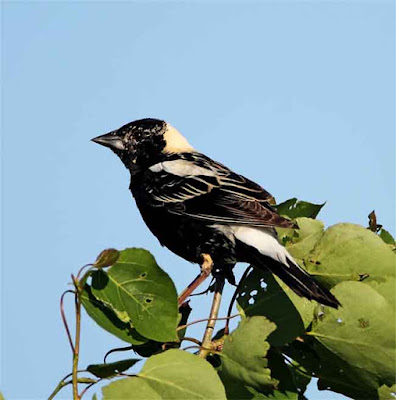
The distinctive Bobolink breeds across the northern states and southern Canada. It was a favorite of mine growing up in Ontario with his yellow patch across the back of the head. He also has a white rump and white wing patches. It can be seen in the Houston area late in migration (usually in May). I took this photo in northern Michigan.

Bobolink - male
Orioles are generally orange and black or yellow and black. One exception is the common Orchard Oriole where the male is chocolate brown and black. It nests in the eastern and central USA and can be readily seen in spring migration. It also breeds in the Houston area.

Orchard Oriole - male
There are 2 yellow and black orioles in the USA. The 9.5"  Audubon's Oriole can be found in south Texas.

Audubon's Oriole
The Bullock's Oriole is the western counterpart of the Baltimore Oriole. For a time in the 80's and 90's they were lumped together as Northern Oriole. It has a mostly orange head and extensive white on the wings.

Bullock's Oriole
Our largest oriole is the 10" Altamira Oriole. It is another bird of the Rio Grande Valley in Texas.

Altamira Oriole
The Black-vented Oriole is a resident of Mexico to Nicaragua. Periodically one will show up in south Texas. This was a lifer for me and it was photographed at Bentsen-Rio Grande State park in January 2012.

Black-vented Oriole
An unusual oriole for the USA is the Spot-breasted Oriole. It is a resident of western Central America, but a small population can be found in Miami where presumably they were released cage birds. This bird in Miami is the only one of the species I have seen.

Spot-breasted Oriole

The 11" Yellow-rumped Cacique is a resident from Panama to eastern South America. It has a pale yellow bill, blue eye and bright yellow rump.

Yellow-rumped Cacique
Happy birding and photography,

David McDonald

dkmmdpa@gmail.com

photos copyright 2006 - 2015 David McDonald

To have these trip reports sent to your email, please email me at the above address and ask to subscribe.

Saturday, July 18, 2015

Bulletin 228 - Costa Rica #8 - mammals

This is my first trip since Alaska in 2010, that I had enough different mammals to make their own bulletin. A few I had already seen, but a couple were fantastic. 

As you know, I like squirrels as often they are the only mammals seen because they are diurnal. The Variegated Squirrel (Sciurus variegatus) at 24" is the largest squirrel in Costa Rica. I have photographed it in Panama last year as well. It comes in several different body colors, red, black, white or a mixture. The tail is salt and pepper.


Variegated Squirrel
The Red-tailed Squirrel (Sciurus granatensis) is smaller at 17" is red bodied with a red tail. This was a new species for me to photograph.


Red-tailed Squirrel
The White-nosed Coati (Nasua narica) is a 42" member of the raccoon family. I had seen this animal in Panama as well, but I saw 3 or 4 in Costa Rica. This one was on the side of the road. He has a bald spot on his tail where he might have gotten to close to a predator. 


White-nosed Coati
The Collared Peccary (Pecari tajacu) is a 36" mammal related to pigs, that is familiar to many of us in the USA as it occurs in south Texas. It is gray with a white collar. They were common at La Selva and used to people. They would walk around the cabins and it was funny to watch them when it rained. They would all gather under the eaves of the cabins to stay dry.


Collared Peccary
The Mantled Howler Monkey (Alouatta palliata) is the largest primate in Costa Rica. I had also been treated to a troop of them in Panama. This time they were higher in the forest and they moved rapidly across the trail.


Mantled Howler Monkey
The next 2 mammals are sloths. Sloths are mammals confined to the New World. There are 6 species still alive, but many huge ground sloths went extinct with the arrival on humans in the New World. Some were as large as elephants! See wikipedia for a complete account, it is amazing.

The surviving sloths are actually in 2 families (2-toed and 3-toed). One of each is in Costa Rica. Although they are superficially similar, I thought a person would have to count toes to differentiate them, but their faces are distinctive and diagnostic. Also all of them have 3 claws on the rear foot, it is only the forefoot where they differ! Some have called for them to be renamed as 2 or 3 fingered sloths.

Here is the Brown-throated Three-toed Sloth (Bradypus variegatus). His face is distinctive and he looks like he is smiling. This was my first photo of this species. The greenish cast on his fur is an algae species that is unique to this animal. There is also a sloth moth that feeds on the algae! Note the bare black stripe down his back. This is a display patch males use to warn other males of their territory. Also his nose is black.


Brown-throated Three-toed Sloth

Here is another photo where one can see the three claws on the forefoot.


Brown-throated Three-toed Sloth
The Hoffmann's Two-toed Sloth (Choloepus hoffmanni) I had already photographed in Panama last year and I almost didn't take a photo of this one as it was high in a tree and I had to take my camera off the tripod and look straight up. However, I was sure glad I did as you can see. There is a baby sleeping on the mothers stomach! Notice the white fur completely around the face and the large 'pig snout'. 


Hoffmann's Two-toed Sloth with baby
Finally, the absolute highlight of my trip was a Cougar (aka Puma, Mountain Lion) (Puma concolor). They are the 4th largest cat in the world. This is a common predator from Alaska to southern South America but it is extremely secretive and seldom seen. This was my first ever sighting as well as for my guide!  At La Selva, on my second day birding, one was spotted close to a path and we hurried there to see it. It was about 60 feet away and just lay there for a couple of hours! Perhaps 100 people there that day got to see it. It is rare to see even at La Selva as the scientists say they spot one 3-4 times per year and mostly just running across a trail, not posing for photos. My guide and I watched him for 20 minutes. I should have taken some video as he was yawning and stretching etc, but I was so excited I didn't even think of that. What a magnificent animal!


Cougar

Cougar


In addition I saw another raccoon family mammal called a Cacomistle and also a Dice's Rabbit. Both were life mammals, but we found them at night and I wasn't able to get any photos.

Happy birding and photography,

David McDonald

dkmmdpa@gmail.com

photos copyright 2006 - 2015 David McDonald

To have these trip reports sent to your email, please email me at the above address and ask to subscribe.