Friday, May 8, 2009

Bulletin #78 – West Texas – Davis Mountains #2

David McDonald Photography
Friendswood Texas
May 8, 2009

Bulletin #78 – West Texas – Davis Mountains #2

Hello friends,

I had my first trip to west Texas. I went with Ed Arenson from Denver and we used Darrell Vollert as our guide. His web site is
http://www.darrellvollertnaturetours.com/

We spent the first day and a half in the Davis Mountains near Alpine Texas. There were 2 areas we visited – Davis Mountains State Park and TNC Davis Mountain Preserve.


There were several species of warblers in the area. The most important is Grace’s Warbler (Dendroica graciae). This was a lifer for me. It is very similar to the Yellow-throated Warbler of the east, but has a yellow stripe over the eye rather than white. The Grace’s does not have the vertical white stripe behind the cheek that is seen on the Yellow-throated. Here is a second photo of the bird.


The Yellow-rumped Warbler (Dendroica coronata) exists in two forms that used to be considered separate species. The eastern (Myrtle) form has a white throat. The western (Audubon’s) has a yellow throat. Both these birds were at the feeding station in Davis Mountains State Park and allowed nice comparisons of the plumage distinction. Here are the 2 birds with Myrtle the first photo and Audubon’s the second.


A new bird photo for me was the Plumbeous Vireo (Vireo plumbeus). This is a bird of the western mountains. It is a split from the old Solitary Vireo and thus has the grayish head and white ‘spectacles’. They are generally mostly gray and may have a slight yellow wash on the flanks as does this bird. It was IDed by voice by our guide. The hooked upper mandible typical of vireos is plainly seen.


Here is a Western Scrub-Jay (Aphelecoma californica). This species may be split once again, according to Sibley, as the Pacific coast birds are quite different from the interior birds – voice and some plumage.


Here is the female Hepatic Tanager (Piranga flava). She is mostly yellow with grayish cheeks.


Next is a female Phainopepla (Phainopepla nitens). This nifty looking bird is all gray with 2 wing bars, a bushy crest and a bright red eye. The male is all glossy black without any wing bars.


Here is a female Lazuli Bunting (Passerina amoena). She is grayish with pale rusty breast, 2 white wing bars and a faint blue wash on the wings and tail. Here is a second photo.


Lastly is an up close and personal look at a male Bronzed Cowbird (Molothrus aeneus). He was so close that I couldn’t get him all in the photo. He is all black with a bright red eye.


Happy birding and photography,

David McDonald

email: davidkmcd@comcast.net


photos copyright 2009 David McDonald


To have these trip reports sent to your email, please email me at the above address and ask for subscribe.

Wednesday, May 6, 2009

Bulletin #77 – West Texas – Davis Mountains #1

David McDonald Photography
Friendswood Texas
May 6, 2009

Hello friends,

I had my first trip to west Texas. I went with Ed Arenson from Denver and we used Darrell Vollert as our guide. His web site is http://www.darrellvollertnaturetours.com/

We spent the first day and a half in the Davis Mountains near Alpine Texas. There were 2 areas we visited – Davis Mountains State Park and TNC Davis Mountain Preserve.

The state park is the premier location in the USA to see Montezuma Quail as they feed them. Unfortunately, despite about 8 hours there, we didn’t see it. However, with the food and water, many other species were close at hand.


The Black-headed Grosbeak (Pheucticus melanocephalus) was there in all plumages. The male (left) has an all black head and rufous breast. The female has a streaked breast and striped face. The first year male with rufous breast but striped face.


The next bird was a lifer for me, the Scott’s Oriole (Icterus parisorum). This is a yellow and black oriole. Again, there were several plumages seen with male (solid black head – 2nd photo), female (a little black on throat) and first year male with a partial black head.


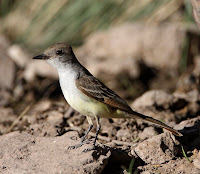
This Ash-throated Flycatcher (Myiarchus cinerascens) was seen on the ground at the drip. It is unusual to find flycatchers on the ground. The yellow belly is quite pale on this bird compared to other USA myiarchus species.


The next bird is another flycatcher – Cassin’s Kingbird (Tyrannus vociferans). It has a dark gray breast and yellow belly. Of the similar species Tropical, Cassin’s, Western and Couch’s Kingbirds, the Cassin’s has the darkest gray on throat and breast.


The Rufous-crowned Sparrow (Aimophila ruficeps) is a western USA sparrow found on rocky hillsides. As the name implies, it has a bright rufous top of head. It is IDed by the white eye-ring and black whiskers at the border of the white throat. The breast is not streaked.


The last bird was another lifer for me, the Zone-tailed Hawk (Buteo albonotatus). This is a bird of the southwestern USA-Mexico border region. It is black with 2 white tail stripes, one wider than the other. A pair of these birds flew over and I was able to get this photo.


All comments and suggestions are welcomed and appreciated.

Happy birding and photography,
David McDonald
email:
davidkmcd@comcast.net

photos copyright 2009 David McDonald
To have these trip reports sent to your email, please email me at the above address and ask for subscribe.

Sunday, April 26, 2009

David McDonald Photography
Friendswood Texas
April 26, 2009

Bulletin #76 – Upper Texas Coast spring migration #2
Hello friends,

(Note - click on the images to see a full size photo)
(Also - see all of my photos on my Pbase photo site)

I have been out several times so far looking for the spring birds.I have found several warblers and managed to get some improved photos.


One of my target warblers for this spring was the male Cerulean Warbler (Dendroica cerulea). I found a female last year, but have not seen a male in 3 years of doing photography. Well High Island came through for me. Here are 2 photos of the same bird. I used the first photo on my blog header. The ID mark for this bird is the blue back, wing bars and white underparts with the black throat stripe.


Here is my favorite warbler, the male Blackburnian Warbler (Dendroica fusca). This black and white bird with a fiery orange throat is a stunner.


Here is a male Blackpoll Warbler (Dendroica striata). He is black and white with white face and solid black top of head. He has a slight wash of yellow on the wing edges, so maybe not finished molting yet.


To show the comparison between the above bird and the Black-and-white Warbler (Mniotilta varia), here is a male of this species. Notice the striped crown and black across the face.


In the mulberries at High Island, Rose-breasted Grosbeaks (Pheucticus ludovicianus) were gorging themselves after their trans Gulf of Mexico flight. Here are the male (below right) and female.


Here is a breeding male Summer Tanager (Piranga rubra) taken at LaFitte’s Cove in Galveston.


Here is his cousin, the Scarlet Tanager (Piranga olivacea) who has black wings and tail.


Here is a male Orchard Oriole (Icterus spurius). He is a small oriole at 7.25” in length. The ID is easy with the chocolate brown body, black wings, head and tail.


Lastly, is a Gray Catbird (Dumetella carolinensis). This all gray bird with a black cap is an easy ID and a common bird. However, he is hard to photograph as he is very skittish and tends to stay in deep brush. He also has rufous undertail feathers that don’t show in this photo from High Island.


All comments and suggestions are welcomed and appreciated.

Happy birding and photography,

David McDonald
photos copyright 2009 David McDonald

To have these trip reports sent to your email, please email me at the above address and ask for subscribe.

Friday, April 17, 2009

Bulletin 75 - Upper Texas Coast spring migration #1

David McDonald Photography
Friendswood Texas
April 18, 2009

Bulletin #75 – Upper Texas Coast spring migration #1
Hello friends,

(Note - click on the images to see a full size photo)
(Also - see all of my photos on my Pbase photo site)


I have been out several times so far looking for the spring birds.

I have found several warblers and managed to get some improved photos.

Here is a male Hooded Warbler in 2 poses. The black hood around the yellow face is the easy ID for this bird.


The next is a male Northern Parula. He has a blue-gray back with green patch and yellow throat and breast with gray and rufous bands. There is also a broken white eye-ring.


Here is a male Black-throated Green Warbler.


The next is the beautiful Chestnut-sided Warbler. He has a yellow crown and chestnut racing stripes down the flanks.


In this photo, it looks like his stripes are about to peel off.


This is my best photo ever of a Tennessee Warbler. He is plain gray with a green back and a white line over the eye.


The last warbler is the Worm-eating Warbler. He is olive brown, but has a distinctively striped head. This is the ID mark to look for.

Here are 2 photos of the same bird.


This Common Nighthawk (Chordelis minor) was found at the Quintana sanctuary and sat on a branch in broad daylight. Every photographer got nice shots of the bird that day. The white throat stripe and wing patches ID this bird.


All comments and suggestions are welcomed and appreciated.

Happy birding and photography,

David McDonald
davidkmcd@comcast.net

photos copyright 2009 David McDonald

To have these trip reports sent to your email, please email me at the above address and ask for subscribe.
Sunday, April 5, 2009

Bulletin 74 - Rio Grande Valley TX birds #2

David McDonald Photography
Friendswood Texas
April 5, 2009

Bulletin #74 – Rio Grande Valley, Texas – part 2

Hello friends,

(Note - click on the images to see a full size photo)
(Also - see all of my photos on my
Pbase photo site)

There were a number of Mexican species in the RGV this winter, so I had to make a trip to see them. Also, there is an owl in the valley that I missed last summer, so it was a target of my trip as well.


Saturday afternoon, I went to the Frontera Audubon location in Weslcao, where 2 rare birds were reported. I missed the female Blue Bunting, but finally just before dark, with the help of the director Wayne Bartholomew, I managed to see and photograph the female Crimson-collared Grosbeak (Rhodothraupis celaeno). This was a lifer for me.


Interestingly, she was with this male Rose-breasted Grosbeak (Pheucticus ludovicianus).


Other birds photographed there were Inca Doves (Columbina inca). Here is the best photo I have obtained of this species with the scaly looking plumage well seen. The Inca Dove has bright rufous wing linings that I was also able to finally capture in a photograph.


A Buff-bellied Hummingbird (Amazilla yucatanensis) was very tame and came to feeders within 10-15 feet, as I sat on a bench. This is the same species that spent the winter in my backyard, but this is the best photo.


Sunday morning, I went to Salineno to try and photograph the Muscovy Ducks and Red-billed Pigeons. They were just too far away across the river for a good photo. Then I went to Falcon State Park as 2 species of quail were coming to the photo blind, but I was ½ hour too late.


However, I did get this photo of a male Brown-headed Cowbird (Molothrus ater) showing his iridescent plumage in the sun.


I went back to Salineno to the GCBO site where they feed the birds just back from the Rio Grande. What a treat that was! I had the place to myself and the birds were numerous and very active coming to seed feeders, fruit, water etc.


Here is an Altamira Oriole (Icterus gularis). He was too close to get him all in!


The next bird is the Audubon’s Oriole (Icterus graduacauda). This was only my second view ever of this species.


A Great Kiskadee (Pitangus sulphuratus) in the sun is always worth a photo.


Here is my best photo ever of a male Golden-fronted Woodpecker (Melanerpes aurifrons). The colors on the head with the yellow above the beak, red crown patch and yellow on the back of the neck are clearly seen. The female (below right) is lacking the red patch.


---------------------------------------------------------------------------------------------

Lastly, I photographed a Long-billed Thrasher (Toxostoma longirostre).


From there, I drove all the way back to the coast to Laguna Atascosa again to try and find the Blue Bunting (Cyanocompsa parellina). I saw both the male and female, but was only able to get a shot of the male. What a stunning bird he is with a dark blue body and sky blue head! He was a lifer.


Another bird at Laguna Atascosa was the Olive Sparrow (Arremonops rufivirgatus). This is my best photo yet of this species. The olive back is obvious.


The last bird was a Blue-headed Vireo (Vireo solitarius). The hooked beak of a vireo can be seen.

-----------------------------------------------------------------------------

I spent at least another 2 hours in the area looking for an Aplomado Falcon, but was once again skunked.

--------------------------------------------------------------
All comments and suggestions are welcomed and appreciated.

Happy birding and photography,
David McDonald
davidkmcd@comcast.net
photos copyright 2009 David McDonald
To have these trip reports sent to your email, please email me at the above address and ask for subscribe.