Sunday, June 21, 2009

Bulletin #82 – Monterey California

David McDonald Photography
Friendswood Texas
June 21, 2009

Hello friends,


I had a vacation in the Monterey California area last month. I have photos of most pf the land birds to be found there, but needed to improve on some of them, so these were the birds I was searching for this trip.


The first of the birds is the Chestnut-backed Chickadee (Poecile rufescens). This is our smallest chickadee at 4.75”. It has the typical black cap and throat, however the afternoon sun gives this bird a brownish looking cap. The rufous back in unique. The birds along the coast south from San Francisco have gray flanks as does this bird. Birds from further north have rufous flanks.


His cousin there is the Oak Titmouse (Baeolophus inornatus). This small plain gray crested bird is an easy ID. Here are a couple of views of this bird.


The next tiny (4.25”) bird is the Pygmy Nuthatch (Sitta pygmaea). As its name implies, it is our smallest nuthatch. It is normally found at elevation in mountains of the west, but does occur along the coast of central and northern California. It is usually found in pine trees. It has a dark gray back, light gray head with faint light spot on the nape of the neck. The breast is white with a tan wash. There is a black stripe through the eye.


The Wrentit (Chaemaea fasciata) is a bird of scrubby brush in California. It is small and gray-brown in color. The iris of the eye is white. It is difficult to see as it stays hidden in the brush, but it has a unique call like a bouncing ball. It is more often heard then seen. I was able to coax this bird into the open with a tape.


I was there in mid-May and migration seemed to have passed. I only found a few shorebirds. However, I did get some nice photos of a Whimbrel (Numensis phaeopus). This bird is brown with a long down-curved bill and central stripe on top of the head.


The most difficult birds for me to photograph are the swifts. They are common and easy to see flying around, but they do not perch except on vertical surfaces like cliffs or inside chimneys. Thus, one is left trying to take aim at a rapidly flying bird and hope to get it somewhat in focus.

The local swift in the southwest is the White-throated Swift (Aeronautes saxatalis). There was a flock of swallows along with a few swifts flying above a 50’ cliff. I focused the camera on a tree on top of the cliff and started snapping pictures as birds flew into the viewfinder. I spent about 15 minutes with mostly blurry photos and many were the swallows rather than a swift.

So here are 2 reasonable photos of this bird. It is dark with a white throat and white rump. A swift has much narrower wings than a swallow and they almost appear sickle shaped as in the second photo.


A small flock of Bonaparte’s Gulls (Larus philadelphia) flew into the lagoon at Carmel River mouth. These small (13.5”) dainty gulls feed in an unusual way. They stand in very shallow water and stomp their feet up and down several times to stir up the algae etc and then they pick up the food on the water’s surface. Here is an almost completely molted breeding adult plumaged bird. The head is almost entirely black. You can see the movement of the water around his feet.


Here is a 1st winter bird with the black on the tail and also notice the black wing tips.


Here is another bird bathing vigorously. It is hard to make out which feathers are wing and which are tail, as the water droplets fly everywhere.


Lastly are some seals. There are 2 broad groups of ‘seals’. The first are the fur seals or eared seals. They have back flippers that can rotate frontwards allowing the animal to ‘walk’ on land. In California, the familiar California Sea Lion (Zalophus californianus) belongs to the eared seals. They have a small externa ear or pinna. This pup I photographed close up at Moss Landing shows the tiny ear.


The so-called true seals or earless seals have fixed hind flippers, so they just wiggle to move on land. They don’t have external ears, only openings in the skin. The common Harbor Seal (Phoca vitulina) shown here with brownish adult and gray pup both are spotted. The external ear opening is seen on the adult.


Here is another pup swimming in shallow water.


Happy birding and photography,

David McDonald

photos copyright 2009 David McDonald

To have these trip reports sent to your email, please email me at the above address and ask for subscribe.

Sunday, June 14, 2009

Bulletin #81 – West Texas – Big Bend Nat’l Park #3

David McDonald Photography
Friendswood Texas
June 14, 2009


Bulletin #81 – West Texas – Big Bend Nat’l Park #3

Hello friends,

I had my first trip to west Texas. I went with Ed Arenson from Denver and we used Darrell Vollert as our guide. His web site is here.

We spent 2 days in Big Bend National Park and the adjacent Christmas Mountains.


It is always fun to find birds on their nests to photograph. Besides the Black-chinned Hummingbird nest with babies in Bulletin #79, we found 2 others.

The first was also a life bird for me, the Common Black Hawk (Buteogallus anthracinus). This bird was in the cottonwood trees along the river in Rio Grande Village campground.


The other was a male Black-tailed Gnatcatcher (Polioptila melanura). Here he is bringing additional nesting material to the nest. It is a male because he has the black cap.


We also found a pair of Elf Owls (Micrathene whitneyi). This is the smallest ABA owl at only 5 3/4” long. He was high up in a tree, but I did get a fair picture of him. This was another life bird and I’ll try to get a better picture of him in Arizona later this month.


Sometimes when waiting for a photo opportunity, you can find something interesting and unexpected. Such was the case of this Roadrunner (Geococcyx californianus). I was attempting to photography some sparrows in the grass, when the Roadrunner started to hunt the same sparrows.

In the first photo he walked out onto the grass area where the sparrows were feeding. In the second, he spotted the sparrows and walked into some longer grass to hide as he stalked them.


The next 2 photos he gets closer and closer to the flock of sparrows. In the second of these photos he was only about 20’ from me as I was photographing him and he was intent on his next meal.


He then ran the 5 feet to the sparrows, but just missed catching one of them.

This was my first time to see a Roadrunner hunting other birds.

A moment later, he was back in the short grass and raised his crest and tail for a final photo.


The last photo is a reptile, a male Greater Earless Lizard (Cophosaurus texanus). He is quite attractive with his orange and turquoise belly. He has a piece of grass in his mouth – looks like a cigarette dangling form his mouth.


Happy birding and photography,

David McDonald

photos copyright 2009 David McDonald

To have these trip reports sent to your email, please email me at the above address and ask for subscribe.

Tuesday, June 2, 2009


David McDonald Photography
Friendswood Texas
June 2, 2009


Bulletin #80 – West Texas – Big Bend Nat’l Park #2
I had my first trip to west Texas. I went with Ed Arenson from Denver and we used Darrell Vollert as our guide. His web site is here.

We spent 2 days in Big Bend National Park and the adjacent Christmas Mountains.


There were several flycatchers that I photographed. Most interesting were the many Vermilion Flycatchers (Pyrocephalus rubinus). In fact Kutac in his book of birding locations in Texas said that Rio Grande Village in Big Bend NP had the most of this species he had ever seen. I had good photos of the beautiful male already, so was interested in other plumages.

Here is an adult female with a large caterpillar in her mouth. She has a pink wash on her belly. These are small birds at 6” in length.


Here is a first year female Vermilion Flycatcher. She has a yellow wash on her belly.


And here is a juvenile being fed by its mother. The second photo is by itself. It really has no distinguishing features and we might not have known what it was until the mother returned to feed it.


Here is another flycatcher that resembles the female Vermilion above. This is the Say’s Phoebe (Sayornis saya). It is larger at 7.5”, but has the tan wash on the belly.


We heard this Great Crested Flycatcher (Myiarchus crinitus) call in the trees and located him. This is one of the few bird songs I know, as we had pairs of these birds nest in a bird house over many years when I was growing up in Canada. His back is to us in this photo, but the typical coloration of a myiarchus genus bird, with brown back, rufous on the wings and yellow
belly is obvious. The bushy crest is also nicely seen.


Lastly is a Tropical Kingbird (Tyrannus melancholicus). This bird can only be IDed by voice as several other species are so similar. There were several birds flying around in the tops of the cottonwood trees along the Rio Grande, but I was only able to get a back view once again.


Also in Big Bend NP is the Mexican Jay (Aphelocoma ultramarina). Sibley suggests that the populations in Big Bend and Arizona might ultimately be different species, so I wanted to get photos of these birds as I already had the AZ birds. He states that the Texas birds have ‘richer blue’ heads than the AZ birds. Here is the AZ subspecies for comparison. It is much paler


The next bird is an American Pipit (Anthus rubescens). I have several photos of this bird in basic (non-breeding) plumage as they winter in the Houston TX area. However in alternate (breeding) plumage, they develop a rufous wash on the breast. So here is an alternate plumaged bird.


On the drive to the park from Alpine Texas, we found some Eastern Meadowlarks (Sturnella magna) on fence posts, a typical perch. These western range birds are quite different and are another likely split as Lillian’s Meadowlark. The guide said that the song was different from that of the eastern birds.


We also found several Pronghorn Antelopes in fields along the road. This was only my second time to see these beautiful animals and never so close to the road. It was especially a treat to find them in a field of verbena wildflowers in the middle of the desert.


Happy birding and photography,
David McDonald
photos copyright 2009 David McDonald
To have these trip reports sent to your email, please email me at the above address and ask for subscribe.

Wednesday, May 20, 2009

David McDonald Photography
Friendswood Texas
May 20, 2009

Bulletin #79 – West Texas – Big Bend Nat’l Park #2

Hello friends,

I had my first trip to west Texas. I went with Ed Arenson from Denver and we used Darrell Vollert as our guide. His web site is http://www.darrellvollertnaturetours.com/

We spent the 2 days in Big Bend National Park.


There were several species of warblers in the park. The most important is the Colima Warbler (Vermivora crissalis). This was a lifer for me. It can only be found in the Chisos Mountains in the park and requires a vigorous hike into the mountains to find them (8 hours and elevation from 5400 to 7200 feet). I hauled the camera and tripod all the way around and was rewarded with a few good photos from the 10 different birds we found. Here is the first one we found. This warbler is gray with brownish back and flanks and yellow undertail.


Finally with the last one, he stayed close for a decent photo. I didn’t want to have to do that hike over again.


We also saw several Lucy’s Warblers (Vermivora luciae) and had one feeding a fledgling, but I was unable to get any photos as they stayed hidden in the mesquite trees. This was another lifer however.


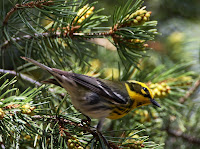
I was surprised that we found a female Townsend’s Warbler (Dendroica townsendi). They usually winter on the west coast of Mexico. She stayed about 15 feet away and worked in the pine branches.


Just outside the park, we also found a Virginia’s Warbler (Vermivora virginiae). This female is somewhat similar to the Colima, but is all gray and doesn’t have the brownish wash on the back and flanks. They have yellow above the tail and below the tail. The male would have a yellow area on the breast. The female here doesn’t. This was another life bird for me. Here is a second photo showing the yellow under tail.


I also got photos of 2 new vireo species. The first was the Bell’s Vireo (Vireo bellii). This bird was seen at both campgrounds along the Rio Grande in the park. He is IDed by the wing bars, yellowish flanks and dark line through the eye.


The other was Hutton’s Vireo (Vireo huttoni). This bird is drab gray, with 2 wing bars and pale lores. Perhaps it is best IDed by its voice.


The most beautiful bird found in the park was the Varied Bunting (Passerina versicolor). The male is multicolored with a blue head, red nape of neck and purple breast. This was another lifer for me and the last of the 5 bunting species for me to photograph.


In the Christmas Mountains just outside Big Bend Park, I picked up 2 hummingbirds. The first was a male Lucifer Hummingbird (Calothorax lucifer). This was another life bird and it can only be found along the Mexican border, with this area the most reliable place to find it. The male has a purple throat and curved bill.


The other was the male Black-chinned Hummingbird (Archilochus alexandri). It also has a purple throat, but there is a black chin between the straight bill and the purple.


Here is a nest of the Black-chinned Hummingbird with 2 babies. I waited for ½ hour to try to get a photo of an adult feeding the babies, but they wouldn’t come to the nest when I was near it.


Happy birding and photography,

David McDonald

email: davidkmcd@comcast.net

photos copyright 2009 David McDonald

To have these trip reports sent to your email, please email me at the above address and ask for subscribe.

Friday, May 8, 2009

Bulletin #78 – West Texas – Davis Mountains #2

David McDonald Photography
Friendswood Texas
May 8, 2009

Bulletin #78 – West Texas – Davis Mountains #2

Hello friends,

I had my first trip to west Texas. I went with Ed Arenson from Denver and we used Darrell Vollert as our guide. His web site is
http://www.darrellvollertnaturetours.com/

We spent the first day and a half in the Davis Mountains near Alpine Texas. There were 2 areas we visited – Davis Mountains State Park and TNC Davis Mountain Preserve.


There were several species of warblers in the area. The most important is Grace’s Warbler (Dendroica graciae). This was a lifer for me. It is very similar to the Yellow-throated Warbler of the east, but has a yellow stripe over the eye rather than white. The Grace’s does not have the vertical white stripe behind the cheek that is seen on the Yellow-throated. Here is a second photo of the bird.


The Yellow-rumped Warbler (Dendroica coronata) exists in two forms that used to be considered separate species. The eastern (Myrtle) form has a white throat. The western (Audubon’s) has a yellow throat. Both these birds were at the feeding station in Davis Mountains State Park and allowed nice comparisons of the plumage distinction. Here are the 2 birds with Myrtle the first photo and Audubon’s the second.


A new bird photo for me was the Plumbeous Vireo (Vireo plumbeus). This is a bird of the western mountains. It is a split from the old Solitary Vireo and thus has the grayish head and white ‘spectacles’. They are generally mostly gray and may have a slight yellow wash on the flanks as does this bird. It was IDed by voice by our guide. The hooked upper mandible typical of vireos is plainly seen.


Here is a Western Scrub-Jay (Aphelecoma californica). This species may be split once again, according to Sibley, as the Pacific coast birds are quite different from the interior birds – voice and some plumage.


Here is the female Hepatic Tanager (Piranga flava). She is mostly yellow with grayish cheeks.


Next is a female Phainopepla (Phainopepla nitens). This nifty looking bird is all gray with 2 wing bars, a bushy crest and a bright red eye. The male is all glossy black without any wing bars.


Here is a female Lazuli Bunting (Passerina amoena). She is grayish with pale rusty breast, 2 white wing bars and a faint blue wash on the wings and tail. Here is a second photo.


Lastly is an up close and personal look at a male Bronzed Cowbird (Molothrus aeneus). He was so close that I couldn’t get him all in the photo. He is all black with a bright red eye.


Happy birding and photography,

David McDonald

email: davidkmcd@comcast.net


photos copyright 2009 David McDonald


To have these trip reports sent to your email, please email me at the above address and ask for subscribe.

Wednesday, May 6, 2009

Bulletin #77 – West Texas – Davis Mountains #1

David McDonald Photography
Friendswood Texas
May 6, 2009

Hello friends,

I had my first trip to west Texas. I went with Ed Arenson from Denver and we used Darrell Vollert as our guide. His web site is http://www.darrellvollertnaturetours.com/

We spent the first day and a half in the Davis Mountains near Alpine Texas. There were 2 areas we visited – Davis Mountains State Park and TNC Davis Mountain Preserve.

The state park is the premier location in the USA to see Montezuma Quail as they feed them. Unfortunately, despite about 8 hours there, we didn’t see it. However, with the food and water, many other species were close at hand.


The Black-headed Grosbeak (Pheucticus melanocephalus) was there in all plumages. The male (left) has an all black head and rufous breast. The female has a streaked breast and striped face. The first year male with rufous breast but striped face.


The next bird was a lifer for me, the Scott’s Oriole (Icterus parisorum). This is a yellow and black oriole. Again, there were several plumages seen with male (solid black head – 2nd photo), female (a little black on throat) and first year male with a partial black head.


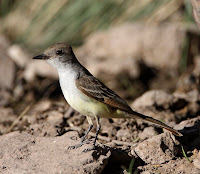
This Ash-throated Flycatcher (Myiarchus cinerascens) was seen on the ground at the drip. It is unusual to find flycatchers on the ground. The yellow belly is quite pale on this bird compared to other USA myiarchus species.


The next bird is another flycatcher – Cassin’s Kingbird (Tyrannus vociferans). It has a dark gray breast and yellow belly. Of the similar species Tropical, Cassin’s, Western and Couch’s Kingbirds, the Cassin’s has the darkest gray on throat and breast.


The Rufous-crowned Sparrow (Aimophila ruficeps) is a western USA sparrow found on rocky hillsides. As the name implies, it has a bright rufous top of head. It is IDed by the white eye-ring and black whiskers at the border of the white throat. The breast is not streaked.


The last bird was another lifer for me, the Zone-tailed Hawk (Buteo albonotatus). This is a bird of the southwestern USA-Mexico border region. It is black with 2 white tail stripes, one wider than the other. A pair of these birds flew over and I was able to get this photo.


All comments and suggestions are welcomed and appreciated.

Happy birding and photography,
David McDonald
email:
davidkmcd@comcast.net

photos copyright 2009 David McDonald
To have these trip reports sent to your email, please email me at the above address and ask for subscribe.