Monday, February 14, 2011

Bulletin #131 – Mexican Visitors and GBBC

David McDonald Photography
Friendswood Texas

February 14, 2011

Bulletin #131 – Mexican Visitors and GBBC

There have been a couple of Mexican vagrants in my area of Texas recently.

The first was a Fork-tailed Flycatcher (Tyrannus savana). This handsome bird looks like a cross between an Eastern Kingbird and a Scissor-tailed Flycatcher. It normally occurs from Mexico to South America. However, it turns up regularly in the USA along the Texas coast and east coast. This was the first one I had an opportunity to see in the USA and photograph. It was in Galveston Island State Park in January and it may still be there.


In this photo he landed with his back to the strong wind that day and his tail feathers blew over his back.  


The second bird was a Yellow-faced Grassquit (Tiaris olivacea). This is another bird that has an extensive range from Mexico to South America. It was at Goose Island State Park near Rockport TX. It is a small (4")sparrow like bird. The only US Field Guide that shows it, that I have, is National Geographic. In that field guide, it is listed in the same family as sparrows. However, the IOU (International Ornithologists Union) include it in Thraupidae family (Tanagers). This bird is a male. He IDed by the olive body and black face and breast with yellow stripes on the face.In the sunlight, he was beautiful and the book illustrations don't do him justice.


While waiting for the grassquit to appear, I photographed this Field Sparrow (Spizella pusilla). It is IDed by the reddish crown, plain face with distinct white eye-ring. The breast is unstreaked.


The Great Backyard Bird Count is an annual event in February, sponsored by National Audubon and Cornell University Ornithology to get people everywhere in North America to count the birds in their yards, local parks or anywhere else desired. The dates are Feb 18-21, 2011. All you have to do is count the most number of birds of each species that you see at any one time. Plan to spend at least 15 minutes in a location. Then you enter your data online. You can pick any time during those 4 days. Also, you can do several sightings in different locations or the same location on different days over those 4 days.


Hummingbirds are unusual in winter here in Houston, but I have been blessed to have several of these jewels in my yard, the last 3 winters. When I entered 3 different hummer species last year in the GBBC, I was queried by a screener to make sure I had identified them correctly. Currently I have just 3 of them, a female Black-chinned and this stunning Buff-bellied Hummingbird (Amazilia yucatanensis). I showed his photo before Christmas when he first showed up. But he is still here and I took this photo of him last week hunkered down near the house to avoid the wind and 30 degree temperature. For a tropical species, he is quite cold tolerant. 


This 1st winter male Rufous Hummingbird (Selasphorus rufus) showed up this weekend. 

Other birds at my feeders that I hope to find and enter on the GBBC next weekend are the Orange-crowned Warbler (Vermivora celata). This drab olive bird has grayish head and no distinguishing features other than the faintly streaked breast shown here. All these photos are taken out my kitchen window. 


The male Pine Warbler (Dendroica pinus) is the brightest winter warbler I have at my house. I have several pine trees to attract them and they readily come to the peanut butter mix on this feeder.


The female is less brightly colored with the yellow just on the breast. 


The peanut butter mix even attracts the Ruby-crowned Kinglets (Regulus calendula) in my yard. This is the only feeder I have found that will attract the kinglets that normally eat insects. 


So, if the Great Backyard Bird Count interests you, I hope that you will participate next weekend and survey your yard or a local park etc.

Happy birding and photography,

David McDonald

email: davidkmcdmd@yahoo.com

photos copyright 2011 David McDonald

To have these trip reports sent to your email, please email me at the above address and ask for subscribe.
For complete instructions, follow the GBBC link above. Last year, there were almost 100,000 lists submitted totaling 603 species and 11.2 million individual birds reported.

Monday, January 31, 2011

Bulletin #130 – local birds

David McDonald Photography
Friendswood Texas
January 31, 2011

Bulletin #130 – local birds


In the 2010 year summary last bulletin, I omitted another guide who I had used last year. My apologies to him.

Darrell Vollert led a trip to east Texas for the elusive Bachman's Sparrow.

There have been a number of interesting birds in the local area recently.

The best one is a male Prairie Warbler (Dendroica discolor) at Corps Woods in Galveston. This species remains in breeding plumage all year, so this male shows all his stripes and color. This was only the 3rd of this species I have ever seen and the second in Texas. Here are 2 photos of this beautiful little bird.


This has been a great winter for Golden-crowned Kinglets (Regulus satrapa). They seem to be everywhere. I have seen about a dozen this year so far, when in most winters I may see 2-3 in total.

This bird was at Brazos Bend State Park. He is IDed by the white eye stripe and the gold median crown stripe.


Also at Brazos Bend SP was this cooperative American Pipit (Anthus rubescens) who perched on the end of a stump.  


An unusual bird for December was this Barn Swallow (Hirundo rustica) still hanging around. It was a cold morning and he repeatedly rested on the dike at Brazos Bend SP. Notice that he also is leucistic, which means he has several white feathers.


Perhaps the best photo I have ever obtained of a flying Northern Harrier (Circus cyaneus) was this female at Anahuac NWR. One can see the white eye line as well as the diagnostic white rump.  


The most unusual bird in a long time in my bird bath was a female Pileated Woodpecker (Drycopus pileatus). I was watching out the kitchen window when a huge bird flew in and landed on an oak tree beside the bird bath. I watched as she looked down at the water. Sure enough, she flew down and landed on the bird bath and drank some water. Fortunately my camera was close by and I got a few photos, through the window, before she flew off. 


Happy birding and photography,

David McDonald

email: davidkmcdmd@yahoo.com

photos copyright 2010 David McDonald

To have these trip reports sent to your email, please email me at the above address and ask for subscribe.

Wednesday, January 5, 2011

Bulletin #129 – 2010 in review

David McDonald Photography
Friendswood Texas
January 5, 2011

Bulletin #129 – 2010 in review

2010 was a spectacular year for me birding. As many of you know, I'm trying to photograph all the birds in North America. There are about 700 birds possible and this year I finished at 601 in total. I added 70 species this year compared to 80 in 2009. However, as I get closer to the end, it becomes harder to find new birds.


To get to 601 in 2010, I had trips to Alaska (30 species), Scandia Crest New Mexico (6 species), Monterey CA pelagic trip, and both Duluth MN in winter and Niagara Falls ON in winter for more northern species. Also within Texas locally, I added some neat birds - Bobwhite, Sooty Tern, and Black-billed Cuckoo that I had not found in the previous 4 years.


On my Pbase photo web site, I have 2200 photos posted, and am closing in on 1/3 million hits after 3 years. On the blog, where I post these bulletins, I had hits from 33 new countries in 2010 for a total of 79 in 2 years. I'm starting to get the South American countries now (Brazil, Peru, Venezuela, Columbia, Argentina and Chile all in 2010). But many smaller countries showed up this year - Barbados, Armenia, Algeria, Dubai and Abu Dhabi (?US forces), Estonia, Latvia, Lithuania, Iceland, Sri Lanka and Bangladesh to name a few. The power of the Internet is amazing!

A special thank you to the guides I used this year on my trips. You guys were a big help finding the birds for me and getting them in close enough to be photographed.


Sparky Stensaas in Duluth MN.


Geoff Carpentier in Toronto ON


Rick Fournier in Monterey CA


Jim Hailey - the volunteer leader for the Texas Ornithological Society Alaska trip. Jim leads these TOS trips as a fund raiser for TOS.

At the year end, I like to review and post my 10 favorite photos for the year.


Hands down, my favorite photo was this displaying, breeding plumaged Ruff sandpiper. This photo was taken through the window of the van in Barrow Alaska last June.


I got super photos of a number of warblers this year. Perhaps it was due to the new camera, a Canon 7D. But the major part of my success was the new water feature at LaFitte's Cove Nature Preserve on west Galveston Island. These are all photos that I have framed for display, as they have nice clean uncluttered backgrounds.


My favorite warbler is the stunning Blackburnian Warbler. The male with his black and white body with flaming orange head and throat will amaze even the most jaded non-birder. In fact, in reading the life story of Phoebe Snetzinger, a women who saw the more bird species in the world than anyone else, it was this bird that launched her quest.


Another warbler that eluded me before to get a good photo was the Yellow-throated Warbler. It is usually an early spring migrant in late March or early April. I didn't see a single bird until this one showed up at the end of April. It was only the second bird of this species I found, in the 5 years I have been doing photography. 


The next one is the Cerulean Warbler. This is a very uncommon warbler in Texas. The total estimated population has fallen 70% over the last 30 years through loss of habitat. I saw 2 males this year at LaFitte's Cove and this one posed nicely.


The male Bay-breasted Warbler is another beautiful bird. I see several of these each spring, but this is my best ever photo of this species. 


The Alaska trip also produced some rare bird sightings. These aren't photos that I would frame for their artistic beauty, but for birders, they are great finds.


Here is the Great Gray Owl. This is the largest owl in North America. It is difficult to even see it, but to have it on the nest is extra special.


The December trip to Sandia Crest in New Mexico had this male Black Rosy-Finch. I wish the stick wasn't in the middle, but the black background, black and pink bird highlighted with flash is special. In fact, it was one of those flukes that happens. I was outside on the deck by the feeder when the flock of birds flew in to feed. My camera had been turned off. I had gloves on my hands to keep warm and when I turned the camera on, it must have rotated the dial from Av to Manual setting. All the exposures without flash were totally underexposed and black. But when the flash went off, I got this cool photo. There was no black backdrop to the photo!  


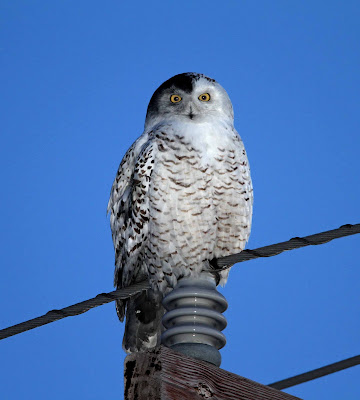
The trip to Duluth MN in mid-winter with temperatures well below zero degrees found my lifer Snowy Owl. 


2 mammal photos from Alaska were special as well.


This breaching Humpback Whale was so close that the barnacles on his jaw can be seen. I had been on several other pelagic trips, but only managed to get photographs of the splash as the huge beasts flopped back into the sea.


This Grizzly Bear came to within 50 feet of our van. This photo was taken through the window. What an experience to be that close to such a majestic creature.  


Thanks to all who submitted comments in 2010. I appreciate the feedback.


I wish everyone a happy, healthy and prosperous New Year.


Happy birding and photography,

David McDonald

email: davidkmcd@comcast.net


photos copyright 2010 David McDonald


To have these trip reports sent to your email, please email me at the above address and ask for subscribe.

Tuesday, December 21, 2010

Bulletin #128 – Sandia Crest NM other birds

David McDonald Photography
Friendswood Texas
December 20, 2010


Bulletin #128 – Sandia Crest NM other birds

Thank you to all who sent me responses to last weeks bulletin on the finches at Sandia Peak NM. As I assumed, these birds are not well known to most birders and certainly not known among non-birders. I received more responses than for any other bulletin, so I wasn't able to reply to everyone individually as I like to try to do.


I was asked for further info on the area, so here is the unofficial web site for Sandia Crest Rosy-Finches. This site tells you when the Rosies are present by the waving flag in the upper right corner. There is also a mile-by-mile guide to spots on the way to the summit where different birds can be found. I didn't find it particularly helpful, as it is historical information. The best web site is the New Mexico bird alert. It is up to date.


Also, they catch and band the rosy-finches on Sundays at the crest lodge from 9:30am to 1pm. You have an opportunity to see the birds in hand and have the experts show you the plumage differences etc.

There were other birds on the mountain that I found. The first is the Juniper Titmouse (Baelophus ridgewayi). This plain gray bird with a crest is found in juniper forests in the interior southwest. Formerly it was known as Plain Titmouse, but the populations were split into coastal Oak Titmouse and this one in the interior. The sexes are similar.


I found him at the base of the mountain and brought him into photo range by tape.


His cousin on top of the mountain is appropriately called Mountain Chickadee (Poecile gambeli). He was coming to the feeder at the lodge. This typical chickadee has a black cap and bib, but is IDed by the additional white line through the eye. 


The Dark-eyed Junco (Junco hyemalis) is a member of the sparrow family. Sibley list 6 color variations. This is the 4th I have seen a photographed, the Gray-headed form. This one is all gray except for white belly and reddish patch on the back. 


The White-breasted Nuthatch (Sitta carolinensis) was also frequenting the feeder at the lodge. I captured him in the typical head down on the tree trunk pose.


Next is the beautiful Steller's Jay (Cyanocitta stelleri). This crested jay has gray head, back and breast, with blue wings, belly and tail. These birds in the interior have white on the face and around the eye. He was also seen at the feeder at the summit lodge.  Here are 2 photos with the second, a close-up of the facial pattern.  


Finally, there were several Common Ravens (Corvus corax) who were riding the thermals up the mountain. They passed close to the lodge at eye level. One can really see the wedge-shaped tail of the raven.


The only mammal I found was the beautiful Abert's Squirrel (Sciurus aberti). This is a large squirrel with 12" body and 9" tail. It has tassels on its ears and is also known as Tassel-eared Squirrel. It is gray bodied with brown on the back and black belly. The tail is white underneath and gray on top. As most squirrels, it was at the feeder as in the second photo. The bird banders were not impressed as they kept going into the traps and scaring off the rosy-finches.  


All comments and suggestions are welcomed and appreciated.


Happy birding and photography,
David McDonald


email: davidkmcd@comcast.net


photos copyright 2010 David McDonald


To have these trip reports sent to your email, please email me at the above address and ask for subscribe.

Sunday, December 12, 2010

Bulletin #127 – Sandia Crest NM finches


David McDonald Photography
Friendswood Texas

December 12, 2010


Bulletin #127 – Sandia Crest NM finches

The Houston Texas area is a great location for birds, as with migrations and wintering northern birds, we can see at least 60% or more of all the birds in North America.


However, one family that we are deficient in is the finches. There are 16 species in North America, but only 5 occur here regularly. These are the Purple and House Finches of genus Carpodacus and American and Lesser Goldfinches and Pine Siskin, all in the genus Carduelis.


The other finches are almost mythical as they are so hard to find. Their preferred habitats are the arctic tundra, boreal forests and high mountain peaks. These include the Redpolls, Crossbills, Rosy-Finches and Pine and Evening Grosbeaks.


In 2010, I made trips to Duluth MN, Alaska and then last weekend to Sandia Crest outside Albuquerque NM and have been able to finally find all of these birds.

The 3 species of Rosy-Finch were once all combined, but then they were resplit. The Brown-capped Rosy-Finch summers high in the Rockies in Colorado. The Black Rosy-Finch summers at elevation in Wyoming and Montana. The Gray-crowned Rosy-Finch summers in the mountains of southern Alaska, but we didn't look for it in Alaska as it is too high in the mountains. Fortunately, in winter they come south, but stay in the mountains. All 3 species can be seen at the lodge at the top of Sandia Crest (10,700' elevation) where they have feeders out for them.


In all the 3 species, the males have pink rumps, pink on the wings and varying amounts of pink on the bellies. The females are always duller.

 
The Black Rosy-Finch (Leucosticte atrata) is the easiest to ID. The body is black with a gray crown patch. The bills in winter are yellow, but turn black in breeding plumage. Here are the male and female.


The Gray-crowned Rosy-Finch (Leucosticte tephrocotis) has a cinnamon brown body with the gray crown patch. There is a black forehead, but the black doesn't extend beyond the top of the head.  Here are the male and female. 


The last one is the Brown-capped Rosy-Finch (Leucosticte australis). It also has a brown body, but not cinnamon brown. It has either a dark cap or a gray cap with dark brown all through it. These 2 brown bodied birds can be confusing to ID sometimes.  Here are the male and female.   


The other finch was the Red Crossbill (Loxia curvirostra). Both species of crossbill use their peculiar beaks to pry open cones on fir and pine trees to get at the seeds inside. They travel in small flocks and are highly nomadic as they cover wide areas looking for unopened cones. I found a flock just below the top of the mountain at the 10,000' level and was able to get some great photos as they came down to the edge of the road to eat some grit for their crops. A crossbill is IDed by the beak, and the Red Crossbill doesn't have any white wing bars. The males are red and the females yellow olive. They both have darker wings than the body color. Here is a male in a spruce tree. 


And here is one on the road 15 feet from me as I stood still and let the flock walk towards me.


This 1st year male has red and yellow, but notice the two wing bars. Both Sibley and National Geographic field guides show this rare variant with the narrow wing bars. I was fortunate to get a photo of this unusual plumage. I didn't know that it had the wing bars until I developed the photos at home.   


The female is yellow to olive colored.   


This is likely a 1st year female as there is only a small amount of yellow on the head and chest. Notice how she hangs upside down to get at the cones. 


There is a wide variation in bill sizes in the Red Crossbill and this seems to depend on which tree and cones are utilized. There are 9 subspecies recognized by bill size and the voices are also different. So there is some discussion that perhaps there may be 9 separate species involved. Sibley discusses this on his web site among possible splits. But he thinks it would be highly unlikely to carve 1 species into 9 others as the work involved in DNA, voice recording and potential hybrids where ranges overlap would make a daunting task.
For people like me, who have trouble with altitude, there is a medication that can be taken before you leave to prevent the altitude sickness. I live at sea level on the Gulf Coast, and used to get very light-headed and nauseated when I went to Colorado, especially Aspen at over 8000 feet. It would take me 2-3 days to adjust, and I ruined half my vacation. Now with premedication, I was able to leave Houston at sea-level, fly to Albuquerque in 2 hours and drive another hour to the top of the mountain (10,700 feet) without a problem.


For those who don't know about this, the drug is Diamox. It comes in Diamox Sequels 500mg to be taken once daily starting 2 days before leaving and continuing for several days. As I was just there for the weekend, I took one each day. This is a prescription medication, but your family doctor should be able to write you a prescription for it.

All comments and suggestions are welcomed and appreciated.


Happy birding and photography,


David McDonald
email:
davidkmcd@comcast.net

photos copyright 2010 David McDonald

To have these trip reports sent to your email, please email me at the above address and ask for subscribe.