Saturday, January 25, 2014

Bulletin 189 - winter birds

The Swamp Sparrow (Melospiza georgiana) is a winter visitor to Anahuac NWR. The gray face and rufous wings ID this 5.75" sparrow.

Swamp Sparrow
This Pied-billed Grebe (Podilymbus podiceps) posed in the early morning sunlight to give a beautiful reflection.

Pied-billed Grebe
Anahuac NWR hosts thousands of wintering Snow Geese (Chen caerulescens). I noticed the juvenile plumaged birds for the first time. They have brownish heads and necks and gray backs and wings.


Snow Goose - juvenile light phase
Ruddy Ducks (Oxyura jamaicensis) are also winter visitors to Anahuac, but I cannot recall seeing them before. One other birder posted that he saw several at the refuge, and then I found about 12-15. I guess I just missed them for 20 years! They are 15" long and have stiff tails, that they often carry upright. The non-breeding males have a dark cap, white cheek and brown body.

Ruddy Duck - male non-breeding
The females are similar, but have a dark stripe across the face. She has her tail upright as well, an important field mark for this species.


Ruddy Duck - female

I also found a Canvasback (Aythya valisineria) at Anahuac, again my first time to see one in Texas. I looked at the Anahuac list and they are listed as common in winter. I guess my vision is improving with age? The reddish-brown head, white body and forehead sloping down to the bill ID this duck.


Canvasback
I watched a pair of Neotropic Cormorants (Phalacrocorax brasilianus) fishing at Anahuac and they each caught a catfish. This one struggled to move the fish around to be able to swallow it, but here he is with the fish in position to swallow it head first.


Neotropic Cormorant
A birder is northwest Houston had an Eastern Towhee in his yard that he posted on Texbirds. I have never seen this bird, despite looking extensively in Maine, Michigan and Florida with guides. I went to his house twice and waited for a total of 6 hours..still no luck.

However, I did photo some other birds at his feeders. Here is a Brown Thrasher (Toxostoma rufum). They are normally pretty shy, and I have never seen one on a feeder before. The rufous body, curved bill, streaked breast and bright yellow eye are the field marks.

Brown Thrasher
There was also a House Wren (Troglodytes aedon). This small (4.75") plain brown wren is a winter resident here. This is my best photo ever of this species.

House Wren
Happy birding and photography,

David McDonald dkmmdpa@gmail.com

photos copyright 2014 David McDonald

To have these trip reports sent to your email, please email me at the above address and ask to subscribe.

Wednesday, January 8, 2014

Bulletin 188 - Anahuac NWR winter birds

I have made several trips to Anahuac NWR recently and found some great birds.

A first for me was to see and photograph Krider's color morph Red-tailed Hawk (Buteo jamaicensis) Sibley lists the Krider's as a 'scarce' prairie variant. It is very pale, almost white. One was found at Anahuac and I went to see and found a second bird as well.

Here is the first one that was seen and photographed. It has a bit of brown on the cheeks. There is also a bit of reddish wash on the tail. The eye color is yellow. This is probably a sub-adult bird as adults have brown eyes and red tails.

Krider's Red-tailed Hawk - subadult
The second bird is definitely a juvenile as it has no red on its tail and a yellow eye. This one is almost pure white on its head.


Krider's Red-tailed Hawk - juvenile
Here he is from above. Notice how light the end of the wings are, and how they are sharply demarcated from the central wing. This is exactly like the illustration in Sibley of the juvenile.


Krider's Red-tailed Hawk - juvenile
Another hawk was this juvenile White-tailed Hawk  (Buteo albicaudatus). They are almost completely brown, but have a white spot on their chest. But from the back as in this photo, it is just a big brown hawk. So how do you know this species form the photo? It has very long wings that project beyond the tail.

White-tailed Hawk - juvenile
Merlins (Falco columbaris) have always been a tough bird for me to find and photograph, but I found 2 in the past week at Anahuac. This small (10") falcon has a gray to black colored back and streaked breast. This one was perched on a fence post.

Merlin
The second one I found first thing in the morning on a low branch. The sunlight at dawn gave it a brown coloration.


Merlin

A female American Kestrel (Falco sparverius) stayed perched in a tree long enough for photos. Usually they fly off as soon as the car stops beside them. Kestrels are our smallest falcon at 9" in length. The female is all rufous - wings, back and tail and has 2 vertical black facial stripes. She even fanned her tail for the photo.


American Kestrel - female

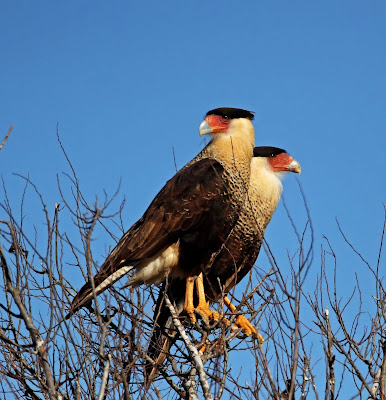
A pair of Crested Caracaras (Caracara cheriway) atop a bare tree completed a wonderful group of raptors.

Crested Caracara
An interesting sight was scores of migrating Tree Swallows (Tachycineta bicolor) perched on a fence.

Tree Swallows
A beautiful male Vermilion Flycatcher (Pyrocephalus rubinus) gave me some beautiful eye-level shots on 2 different days. These are the best ever for me of this species.

Vermilion Flycatcher - male


Vermilion Flycatcher - male


Happy birding and photography,

David McDonald dkmmdpa@gmail.com

photos copyright 2014 David McDonald

To have these trip reports sent to your email, please email me at the above address and ask to subscribe.


Thursday, December 19, 2013

Bulletin 187 - Puerto Rico #3 - other birds


There are 5 hummingbird species on Puerto Rico, 2 of which are endemics and we saw one of them, the Puerto Rican Emerald in Bulletin 185. However, we found all 3 of the other hummers. These were all life birds.

The most amazing is the tiny (3.5") Antillean Crested Hummingbird (Orthorhyncus cristatus). The male of this has a crest that flashes color as the gorget of other species does. His throat and underparts are gray. The crest feathers even appear to extend along the bill.


Antillean Crested Hummingbird - male
Here is another bird hovering. The feathers extending along the bill are clearly seen.


Antillean Crested Hummingbird - male

The Green-throated Carib (Eulampis holosericeus) is larger (5"). The back is dull green, the throat is bright green and the belly is blue. The bill in curved. The sexes are similar.


Green-throated Carib


The Smooth-billed Ani (Crotophaga ani) is a member of the cuckoo family. This species is a resident of south Florida as well, but now are almost gone. I saw them near the Ft Lauderdale airport in 2006, but could not get a photo. They are all black with a long tail and huge beak.


Smooth-billed Ani

There were several interesting introduced birds as well. The Nutmeg Mannikin (Lonchura punctata), a native of southeast Asia is a small (4.5") common cage bird and thus is found in a lot of populated areas due to escapes or releases. The scalloped chest markings are distinctive.


Nutmeg Mannikin
The Pin-tailed Whydah (Vidua macroura) is another small (4.5") cage bird that is native to Africa. The females and non-breeding males are sparrow-like brown with a black face and red bill. The breeding male is completely different assuming a black and white plumage and 8" tail feathers! Unfortunately, we just saw the former.


Pin-tailed Whydah - female

We saw several familiar North American birds that are winter visitors to Puerto Rico. These included Black-and-white, Prairie, and Northern Parula warblers as well as several shorebirds (Wilson's Plover, Spotted Sandpiper and Greater Yellowlegs).


This Hermit Crabs in the forest had climbed a 5 foot stick.


Hermit Crab in forest

Happy birding and photography,

David McDonald dkmmdpa@gmail.com

photos copyright 2013 David McDonald

To have these trip reports sent to your email, please email me at the above address and ask to subscribe.


Friday, December 6, 2013

Bulletin 186 - Puerto Rico #2 - other passerines

We found and photgraphed several other birds in Puerto Rico. Some of these also occur in the USA, usually in South Florida where they may reside or just be an occasional vagrant.

The Gray Kingbird (Tyrannus dominicensis) was very common on the Island of Vieques. They loved to perch on the wires and were so common, that Lisa took to calling them 'Line Birds.' It is very similar to the Eastern Kingbird of North America, but is distinguished by a dark mask through the eye. It has a bit of a notched tail as well. I had photographed this bird in Miami previously where it is a resident.
Gray Kingbird
The other bird of this genus we saw was the Loggerhead Kingbird (Tyrannus caudifasciatus). This bird is quite similar, but the tail is square, and the whole head is dark. Like most kingbirds, it has a stripe on the crown which seldom is seen. In this species it is yellow, and I was surprised to see that I got it in this photo. This was a life bird for all of us. This bird is a resident from the Bahamas to Puerto Rico. It occasionally shows up in south Florida as a vagrant.

Interestingly, the guide told us that it may be split with the Puerto Rico population being split from the rest. I tried playing the tape (iBird Pro) on 2 different birds and neither time did they respond.

Loggerhead Kingbird

The Black-faced Grassquit (Tiaris bicolor) is a small (4.5") black member of the tanager family. It is common through much of the West Indies.

Black-faced Grassquit


The Greater Antillean Grackle (Quiscalus niger)  is a small (11") typical large-tailed grackle, all black and a pale eye.

Greater Antillean Grackle
Lastly, the Bananaquit (Coereba flaveola) is a common Caribbean bird. It used to classified with the Tanagers, but now is in its own family. It is also a vagrant to south Florida. It has a black head with white stripe above the eye, red spot on the bill, and a yellow breast.

Bananaquit
Happy birding and photography,

David McDonald dkmmdpa@gmail.com

photos copyright 2013 David McDonald

To have these trip reports sent to your email, please email me at the above address and ask to subscribe.

Sunday, November 24, 2013

Bulletin 185 - Puerto Rico - endemics

Lisa, Seth, and I had some vacation and birding in Puerto Rico in early November. The island is easy to get to now that Soutwest Airlines flies there from Florida. This small island (5300 sq miles) is slightly smaller than Connecticut (48th state by area) but has 18 endemic birds. Compare that to the lower 48 states and Alaska which have only 15 endemic birds.

We hired a guide for a day of birding at El Yunque National Forest. Hilda Morales was a great guide and here is her web site. As this was our first time to bird in Puerto Rico, the endemics were lifers for all of us.

There are 2 endemic warblers and we saw one, the Adelaide's Warbler (Setophaga adelaidae). This bird is identified by the gray back, 2 wing bars and yellow underparts. There is also a yellow line above the eye. The sexes are similar.

This one came and perched on the passenger window of our vehicle and pecked at his reflection in the mirror.

Adelaide's Warbler

The Puerto Rican Tanager (Nesospingus speculiferus) is a monotypic genus (means only bird of that genus). The adults have olive back, dark head, gray underparts with some streaking along the flanks. There is a small white wing spot that is a key to the ID. It can be seen in this photo.
Puerto Rican Tanager

The Puerto Rican Tody (Todus mexicanus) is a tiny bird the size of a hummer at 4.5". I don't know why the scientific name is 'mexicanus' when it doesn't occur in Mexico.  There are only 5 species in the tody family and all are in the Caribbean. This was my first time to see any tody. It has a green back, red bill and throat, white breast and yellow belly. The sexes are similar.

Puerto Rican Tody
The Puerto Rican Woodpecker (Melanerpes puertoricensis) has a solid black back and red on the throat and breast.
Puerto Rican Woodpecker
The last endemic we photographed, was the Puerto Rican Emerald (Chlorostilbon maugeaus). This is a small (3.5") hummer with a forked tail. The male is all green as shown here. The female would have white underparts.

Puerto Rican Emerald - male
Happy birding and photography,

David McDonald dkmmdpa@gmail.com

photos copyright 2013 David McDonald

To have these trip reports sent to your email, please email me at the above address and ask to subscribe.

Monday, November 4, 2013

Bulletin 184 - Anahuac NWR birds

Anahuac NWR east of Houston has always been a favorite destination of mine for birding and photography. 2013 is their 50th anniversary year.

I haven't been there this year until the summer and then several visits this fall. I am happy to see that they have recovered from the effects of Hurricane Ike in 2008 and the devastating droughts of the last 2 years.

The Fulvous Whistling-Duck (Dendrocygna bicolor) is often seen there is large numbers, when it is uncommon elsewhere on the upper Texas coast. It is identified by the rusty color, dark back and white flank stripes and rump. The sexes are similar.

Fulvous Whistling-Duck
Another secretive bird that is easily seen at Anahuac is the Least Bittern (Ixobrychus exilis). This bird is our smallest member of the heron and egret family at just 13" in length. This one was walking in the wide open. This is likely a female. The male has a mahogany colored back.

Least Bittern

An identification problem that I often have is with the juvenile night-herons. There are normally a lot of Yellow-crowned at Anahuac, but seldom do I see a Black-crowned. On a visit on 8-11-13, I found both. They are easy to tell apart if flying or standing completely in the open. But if they are in weeds or grass, so that you cannot see the leg length, it is more difficult.

The Black-crowned Night-Heron (Nycticorax nycticorax) has extensive yellow on the bill and large white spots on the wings.


Black-crowned Night-Heron - juvenile

Here is the facial detail showing the yellow on the beak.

Black-crowned Night-Heron - juvenile detail
In contrast, the Yellow-crowned Night-Heron (Nyctanassa violacea) has a solid black bill and small white spots on the wings.
Yellow-crowned Night-Heron - juvenile

Here is a first summer Yellow-crowned. It is grayish, but the white facial stripe is starting to appear.

Yellow-crowned Night-Heron - 1st summer
An interesting sight was a group of 5 Neotropic Cormorants (Phalacrocorax brasilianus) on a dead bush in the middle of the pond. There were 4 on the branches and as I was taking the photos, a fifth bird flew in to land in the center between the others.

Neotropic Cormorants

At the old destroyed visitor center, many swallows nest. There are 2 species, barn and cliff and although they both build mud nests, the nest differences are readily apparent. The barn swallows have a typical nest with the opening on top. the cliff swallows build a gourd like nest with the opening on the side. Here is a Cliff Swallow (Petrochelidon pyrrhonota) nest with 2 babies at the opening.

Cliff Swallows in nest

An unusual find was this European Starling (Sturnus vulgaris) molting from his drab gray-brown juvenile plumage to the spotted adult non-breeding plumage. An illustration is shown in Sibley with just the gray head. This one really looks ragged.


European Starling - juvenile molting
I have about exhausted the USA birds, so it is time to extend my travels further afield and bring some new birds to the blog. Stay tuned.

Happy birding and photography,

David McDonald dkmmdpa@gmail.com

photos copyright 2013 David McDonald

To have these trip reports sent to your email, please email me at the above address and ask to subscribe.


Sunday, October 13, 2013

Bulletin 183 Kauai #3

The water birds of Kauai can be readily seen in the taro fields just beyond Princeville on the north coast in the Hanalei NWR.

The Koloa or Hawaiian Duck (Anas wyvilliana) survives as a natural population only on Kauai. It has been reintroduced to Oahu, Maui, and Hawaii. It resembles a female mallard and the sexes are similar.

Hawaiian Duck

The Hawaiian Coot (Fulica alai) was split from the American Coot in the last 20 years. It has a white shield on the forehead vs the American which has a red shield. However, a small percentage of the local birds do have a red shield. Here is the typical form.

Hawaiian Coot with white shield
I also noticed one with a red shield. The red shield appears to be larger then the red shield of the American species.

Hawaiian Coot with red shield

The endangered local subspecies of the Common Moorhen is also known locally as Hawaiian Gallinule (Gallinula chloropus). As both the Hawaiian subspecies of the stilt and coot were eventually elevated to full species status, maybe this one will be too. This was my first sighting of this subspecies.

Hawaiian Gallinule

We found a dragonfly while birding with our guide in the Alakai Swamp. He mentioned that it is the largest dragonfly in the world. It is called the Giant Hawaiian Dragonfly (Anax strenuus). It has a wingspan of 7.5".

Giant Hawaiian Dragonfly

Another interesting species of nature that we came across was a lobelia plant with a very curved flower. This lobelia served as a nectar source for the Iiwi bird with the semi circular bill. When we birded on the big island of Hawaii in June, our guide there pointed out several species of lobelia that were critically endangered with only a few individual plants known in the wild. It turns out that all the lobelias of Hawaii all descended from a single species. There are 126 species known in 6 genuses. These comprise 1/8 of all the native plant species of Hawaii. For more information on the amazing Hawaiian lobelias, read this blog where I got this information.

The flower can be seen in the upper central part of the photo.

Lobelia

Happy birding and photography,

David McDonald dkmmdpa@gnail.com

photos copyright 2013 David McDonald

To have these trip reports sent to your email, please email me at the above address and ask to subscribe.