Sunday, January 17, 2021

Bulletin 375 - Uganda #19 - Pitta, Nicator and other songbirds

After the week in the Capetown area, the guide Casper Badenhorst, and I flew to Uganda and met a local guide. We started at Entebbe Airport on the southeast corner of Uganda and made a diagonal trip to Murchison Falls NP in the northwest corner. From there, we proceeded south through a chain of nature preserves and parks to the southwest corner at Bwindi Impenetrable Forest. We finished along the southern border back to the airport.

I always enjoy finding my first species in a new bird family and there are 3 in this bulletin.

The first is the 7" Green-breasted Pitta (Pitta reichenowi). It is one of 2 species of pitta in Africa. It is extremely rare to see this species as there are just a handful of birds in Kibale National Forest, along the Congo border. In fact it was first located in Uganda in about 2007. The rest are in inaccessible countries. It may be the #1 target bird to see in all of Africa. Here is a quote. "Obviously, this is one of Africa's most difficult and sought-after birds, and seeing one is a top highlight in any lifetime of birding." Wow - what is amazing is that we thought we were going with the ranger to see the common African Pitta.

This is a juvenile bird with the grayish breast.

Green-breasted Pitta - juvenile

Nicators are a small family of just 3 birds in Africa. On my first trip to South Africa, we tried for hours to see the species there. It was in the treetops singing and moving around but we never saw it. The 9" Western Nicator (Nicator chloris) is an olive bird with gray underside and bright white spots on the wings.

Western Nicator

The third new family is another small family called fairy flycatchers. The 5.5" African Blue Flycatcher (Eliminia longicauda). It is a cute blue bird with a long tail.

African Blue Flycatcher

His cousin is the 5.5" White-tailed Blue Flycatcher (
Eliminia albicauda). He is similar, but the tail is edged with white.

White-tailed Blue Flycatcher

The rest of the bulletin are birds that are members of families I have seen before.

The 4.5" Northern Yellow White-eye (Zosterops senegalensis) is an all yellow bird with a bright white eye ring.

Northern Yellow White-eye

The 8" male Petit's Cuckoo-shrike (Campephaga petiti) is an all black bird with orange-yellow gape wattles. 

Petit's Cuckoo-shrike - male


The 8" male Red-bellied Paradise-Flycatcher (Terpsiphone rufiventer) is a reddish bird with a black head.

Red-bellied Paradise-Flycatcher

There are 6 species of orioles in Africa. These are a different family of birds than the orioles in the Americas. The 8" Western Oriole (Oriolus brachyrynchus) is yellow bodied with a black head and wings.

Western Oriole

The 8" Mountain Oriole (Oriolus percivali) is similar, but in a different habitat. This one caught a large caterpillar and we watched him beat it against the branch before eating it.
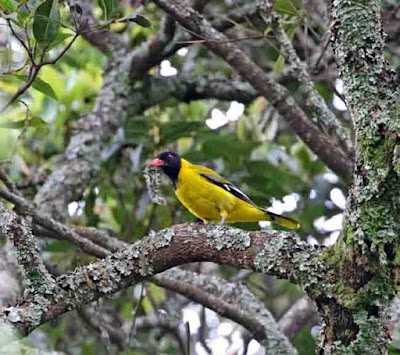
Mountain Oriole

I put the different bird and mammal families in single folders for easy viewing.

I have photos of 4 of the 129 species of white-eyes

I have photos of 5 of the 99 species of monarch flycatchers

I have photos of 4 of the 99 species of  cuckooo-shrikes

I have photos of 3 of the 37 species of  orioles

Happy birding and photography,

David McDonald


dkmmdpa@gmail.com

photos copyright 2006 - 2020 David McDonald

To have these trip reports sent to your email, please email me at the above address and ask to subscribe.

Sunday, January 3, 2021

Bulletin 374 - Uganda #18 woodpeckers & USA birds for 2020

 After the week in the Capetown area, the guide Casper Badenhorst, and I flew to Uganda and met a local guide. We started at Entebbe Airport on the southeast corner of Uganda and made a diagonal trip to Murchison Falls NP in the northwest corner. From there, we proceeded south through a chain of nature preserves and parks to the southwest corner at Bwindi Impenetrable Forest. We finished along the southern border back to the airport.

Woodpeckers are always a favorite of birders and I had 6 species for the Uganda portion of the trip. The 7.5" male Red-throated Wryneck (Jynx ruficollis) is a spotted brown bird with a red throat. They feed on ants on the ground and use old woodpecker holes for nesting. The 2 wryneck species are the first 2 species in the woodpeckers listing suggesting they are the most primitive of the woodpeckers.

Red-throated Wryneck - male

The 7.5" female Fine-banded Woodpecker (Campethera taeniolaema) has an olive green back and wings and finely barred underparts. She has red on the nape of her neck. The male would have the crown of his head also red. This is a recent split from Tullberg's Woodpecker in West Africa.

Fine-banded Woodpecker - female

Her cousin is the 8" male Nubian Woodpecker (Campethera nubica). He has a brown back and yellow underparts and is spotted all over. This is a male with the fully red head and red whisker.


Nubian Woodpecker - male

The smallest of the woodpeckers was the 5.5" Cardinal Woodpecker (Dendropicos fuscescens)The back is lightly streaked olive and the wings are black with white spots. The face is gray. The male of course would have red on his head where this female has black.

Cardinal Woodpecker - female

Her cousin is the larger 7.5" African Gray Woodpecker (Dendropicos goertae). This bird has a gray head and breast and plain olive back and wings. The male of course has red on his head.

African Gray Woodpecker - female

Lastly is the largest woodpecker I saw in Uganda, the 9" Yellow-crested Woodpecker (Chloropicus xantholophus). It is dark olive on the back with spotted underparts and a boldly patterned black and white face. The male has a tiny yellow tuft on the hindcrown which is difficult to see. This is another bird named for a field mark that is invisible.

Yellow-crested Woodpecker

I have not done much birding at all in the USA in 2020 due to Covid travel restrictions, but in the 4th quarter a few remarkable birds were found and I had to go and photograph them.

The first of these was a beautiful male 9" Varied Thrush (Ixoreus naevius).This is a western North America bird in the Rocky Mountains from Montana to Alaska and wintering south to California. A few birds end up far east of their normal range. This one was on Surfside Beach south of Galveston, a 30 minute drive for me to see him. It was just the 3rd time I have seen the bird and the only time in the lower 48 states.

Varied Thrush - male

His normal habitat is dense coniferous forests where he forages on the ground in deep shade. So he tended to stay in the shadow of the houses on stilts along the beach. Here he is on a garden hose in front of a trash can. Definitely an unusual place to find this bird.

Varied Thrush - male

A few day later I heard about an Eared Quetzal (Euptilotis neoxenus) being easily seen for the first time ever, in mountains east of Tucson AZ. So I called my Tucson guide Melody Kehl and she confirmed the bird was still present and easily seen. So I went to Tucson that weekend. Melody took me to the location and what a show this pair put on for birders from all over the USA. 

This bird is a regular in the Chiracahua Mountains in SE Arizona, but maybe only a couple of pairs. There are few roads and mostly the bird is found at the top of a trail and then even if spotted, it is gone the next day so it is always 'a 1 day wonder'. This year a pair of juveniles was found in June and were watched by a local resident - but in September, they started to come down into a valley to feed on fruiting trees and there was a road there - so BINGO everyone who has been waiting for a chance to see this fantastic bird finally got an opportunity.

This is a brightly colored 14" bird. The male has an iridescent green head, back, wings chest and tail with a red belly and white under the tail. This is a first year male who has not molted completely to adult plumage. The 'ears' are some wispy feathers on the cheeks that can be seen if you look closely. Obviously, this was a lifer for me.

Eared Quetzal - male

The female has a gray head and breast. The feathers are easier to see on her in this photo.

Eared Quetzal - female

While we were waiting for the Quetzal to appear, several beautiful 24" Chiricahua Fox Squirrels (Sciurus nayaritenesis) were feeding in the trees. This is the northern subspecies of the Mexican Fox Squirrel. This was a life mammal for me - so a bonus after finding the Quetzal.

Mexican Fox Squirrel

A Christmas treat was an exceedingly rare bird for the USA. The story of how it was found was serendipity. A lady who had started birding a few months ago went to a state park south of San Antonio Dec 19th. She had a small camera and took a photo of a bird along the edge of the lake. She could not find the bird in her bird book, so she showed it to the park personnel and it was IDed as a 10.5" Spotted Rail (Pardirallus maculatus). This is a bird from southern Mexico to Argentina. Rails as a group are secretive marsh birds and exceedingly difficult to see well.

Well word went out and people started coming from all over North America to see the bird as he seemed to stay in the same location along the shore in cattail patches. Apparently the best place to see this bird is in Peru or Argentina. The volunteer at the park said a man was even coming from London England to see it!

I went on Dec 26 - 4 hour drive each way and I spent 5 hours waiting for the bird to come out of hiding in the grass along the shore. I was rewarded with 2 looks as he ran between cattail patches for about 30 seconds each time, but the second time my camera was ready and I got a couple of photos. He is black and covered with white spots. He has a long bill that is dark. The adults have a yellow green bill, so this is thought to be a juvenile.

Spotted Rail

And the last bird was a 3.25" Calliope Hummingbird (Selasphorus calliope) I found in my yard on Dec 27th. He is a juvie male as he has just a couple of purple feathers on his throat. He is still here now and I hope he decides to spend the winter. It is only the second time I have had this bird at my house. This is the smallest bird in North America.

Calliope Hummingbird - juvenile male

So my year finished up with some amazing USA birds.

I put the different bird and mammal families in single folders for easy viewing

I have photos of 59 of the 235 species of woodpeckers

I have photos of 50 of the 167 species of  thrushes

I have photos of 16 of the 43 species of quetzals and trogons

I have photos of 20 of the 282 species of squirrels

I have photos of 19 of the 138 species of rails, coot, and gallinules

I have photos of 126 of the 358 species of hummingbirds

Happy birding and photography,

David McDonald

dkmmdpa@gmail.com

photos copyright 2006 - 2021 David McDonald

To have these trip reports sent to your email, please email me at the above address and ask to subscribe.

Sunday, December 20, 2020

Bulletin 373 - Uganda #17 - Owl, Cuckoos, Pratincoles

After the week in the Capetown area, the guide Casper Badenhorst, and I flew to Uganda and met a local guide. We started at Entebbe Airport on the southeast corner of Uganda and made a diagonal trip to Murchison Falls NP in the northwest corner. From there, we proceeded south through a chain of nature preserves and parks to the southwest corner at Bwindi Impenetrable Forest. We finished along the southern border back to the airport.

Unfortunately we did not do any night birding in Uganda because mostly we were exhausted from birding and driving long distances. But we did get one owl at dawn after a rainstorm overnight. And what an amazing owl it was. The 26" Verreaux's Eagle Owl (Bubo lacteus) is a grayish owl with dark eyes and pink eyelids! The pink eyelids are usually only seen if the owl has his eyes closed. But because of the rain all night, his feathers were matted down and the eyelids are plainly visible with his eyes open. This was the one owl I hoped to see on the trip as I missed it in the previous Africa trip. He is often seen on night drives on safari and people always remember seeing the "owl with the pink eyelids". It is the largest African owl and the only owl species in the world with pink eyelids.

Verreaux's Eagle Owl

Here he is watching us.

Verreaux's Eagle Owl

We saw a number of cuckoo species. The 16" Levaillant's Cuckoo (Clamator levaillantii) is  a black cuckoo with white underparts and streaking on the breast. It has a crest.

Levaillant's Cuckoo


The 12" Red-chested Cuckoo (Cuculus solitarius) is dark gray above and has stripes across the underside except for the red chest.

Red-chested Cuckoo

The stunning 9" African Emerald Cuckoo (Chrysococcyx cupreus) has an iridescent emerald green head, breast, body and wings. The belly is bright yellow.

African Emerald Cuckoo

The 13" Blue Malkoha (Ceuthmochares aereus) is a gray bird with some bl;ue on the wings and tail. But the bright yellow bill and bare blue skin around the eye are the easy ID marks.

Blue Malkoha

The 18" Blue-headed Coucal (Centropus monachus) is a beautiful showy bird with rufous wings, blue head and nape and a white breast. 

Blue-headed Coucal

The 16" White-browed Coucal (Centropus superciliosus) has reddish wings, a black crown, and a wide white stripe over the eye.

White-browed Coucal

Pratincoles are closely related to sandpipers. The 10" Collared Pratincole (Glareola pratincola) is a brown bird with a buffy throat surrounded by a thin black line.

Collared Pratincole

The 7.5" Rock Pratincole (Glareola nuchalis) is a brown bird with a black head and a prominent white stripe around back of the neck. It has a red bill and legs. It lives on rocks in the middle of rivers. I photographed this bird on the boat trip below Murchison Falls

Rock Pratincole


I just read an amazing nature book "World of Wonders" in praise of fireflies, whale sharks, and other astonishments. The author is Aimee Nezhukumatathil. She is a poet but a lover of all nature. The book is a compilation of many essays she had written over the past decade about various species in all nature - from dragon fruit and corpse flower to octopus and flamingo. I even learned a new interesting fact about Monarch Butterflies.

One amusing essay was a time she took her 2 young boys on a Christmas Bird Count and their comments as they were deep in the woods.

Barnes and Noble selected it as the book of the year 2020. It is so beautifully written as she is a poet. It is just delightful. I am sure you will love to read it.

I put the different bird and mammal families in single folders for easy viewing

I have photos of 33
 of the 216 species of owls

I have photos of 23 of the 147 species of  cuckoos

I have photos of 3 of the 17 species of courses and pratincoles


Happy birding and photography,

David McDonald


dkmmdpa@gmail.com

photos copyright 2006 - 2020 David McDonald

To have these trip reports sent to your email, please email me at the above address and ask to subscribe.

Sunday, December 6, 2020

Bulletin 372 - Uganda #16 - Old World Flycatchers - Part 1

After the week in the Capetown area, the guide Casper Badenhorst, and I flew to Uganda and met a local guide. We started at Entebbe Airport on the southeast corner of Uganda and made a diagonal trip to Murchison Falls NP in the northwest corner. From there, we proceeded south through a chain of nature preserves and parks to the southwest corner at Bwindi Impenetrable Forest. We finished along the southern border back to the airport.

This is a very large family (331 species) of small songbirds only 2 of which show up regularly in Alaska. Many of them are beautiful! Because of the number, of species, many will be found on any trip in Eurasia or Africa. They have many names flycatchers, chats, robins, wheatears, and many others.

The 7" Northern Black Flycatcher (Melaenornis edoliodes) is completely black.

Northern Black Flycatcher

The 7" male Sooty Chat (Myrmecocichla nigra) is black with a prominent white wing bar.

Sooty Chat - male

The 5" male African Stonechat (Saxicola torquata) has a black head, wings and back and white underparts except for a rusty breast.

African Stonechat - male

His cousin is the 5" male Whinchat (Saxicola rubetra). He is mostly buffy and brown, but with a black and white face. It is a winter migrant to Africa.

Whinchat - male

The 5" Cassin's Flycatcher (Muscicapa cassini) is gray above and lighter below with black wings. He is found along forest streams from 2200 to 5200' elevation. He perches on low branches or on rocks in the stream like this one. It is listed as uncommon.

Cassin's Flycatcher

His cousin is the 5" Swamp Flycatcher (Muscicapa aquatica). He is brown above and white below with a brown breast band.

Swamp Flycatcher

A species name I had not seen before was alethe. These are secretive thrush like forest birds. They are usually solitary and and follow ant swarms to feed. In fact they were in the thrush family until 2010.

The 7" Fire-crested Alethe (Alethe castanea) is brown above, with a gray face and underparts. There is a central orange median strip on the top of his head. They say it is not usually seen in the field. This is another bird named for an invisible field mark.

Fire-crested Alethe

The 6" Red-throated Alethe (Chamaetylas poliophrys) was a lucky find as we had ants moving across a mountain road and he popped in and out of the underbrush, as we waited for him. He has a brown back and wings with gray head and underparts. The red throat is distinct on this species.

Red-throated Alethe

A beautiful bird was the monotypic genus 7" Silverbird (Empidornis semipartitus). It is silvery gray above and rufous below. An easy ID if you know the bird.

Silverbird


I put the different bird and mammal families in single folders for easy viewing

I have photos of 52 of the 331 species of Old World Flycatchers


Happy birding and photography,

David McDonald


dkmmdpa@gmail.com

photos copyright 2006 - 2020 David McDonald

To have these trip reports sent to your email, please email me at the above address and ask to subscribe.

Sunday, November 22, 2020

Bulletin 371 - Uganda #15 - Hornbills and 3 monkeys

After the week in the Capetown area, the guide Casper Badenhorst, and I flew to Uganda and met a local guide. We started at Entebbe Airport on the southeast corner of Uganda and made a diagonal trip to Murchison Falls NP in the northwest corner. From there, we proceeded south through a chain of nature preserves and parks to the southwest corner at Bwindi Impenetrable Forest. We finished along the southern border back to the airport.

There are 2 species of ground hornbills. I saw the Southern Ground Hornbill in Kruger Park on my first Africa trip. Here is the other - the 36" Abyssinian Ground Hornbill (Bucorvus abyssinicus). It is a large black hornbill found walking along the ground searching for insects, snakes, lizards etc. It is an easy ID and the huge size cannot be confused with any other bird. This is a male with the blue around the eye and red throat patch


Abyssinian Ground Hornbill - male

The female has a blue throat patch.


Abyssinian Ground Hornbill - female

There are 59 species of hornbills with 27 in Africa and the rest in Asia. The 29" Black-and-white Casqued Hornbill (Bycanistes subcylindricus) has a huge bill with a casque protuberance on top. It has a black body, white belly and tail, and primaries on wings.


Black-and-white Casqued Hornbill

Very similar is the 28" White-thighed Hornbill (Bycanistes cylindricus). The only obvious difference is the white ring around the eye and the tail has a black stripe across the middle.


White-thighed Hornbill

The 22" Crowned Hornbill (Tockus alboterminatus) is a black hornbill with a bright red bill and bushy crest.


Crowned Hornbill


The 28" White-crested Hornbill (Tropicranus albocristatus) is a black hornbill with a very long graduated tail and a bushy white crest like a Mohawk haircut. It was a treat to find this bird as there are only 2 or 3 pairs in Uganda in the Semliki Forest along the Congo border.


White-crested Hornbill

We saw several species on monkeys in Uganda. The first is the well named Red-tailed Monkey (Cercopithecus ascanius). It is 40 - 60" in length with the tail being 60%. It is IDed by the red tail, white cheeks and nose. This monkey is in the same forest with the White-crested Hornbill above and the hornbill follows the monkeys as the monkeys shake the leaves and expose caterpillars which the hornbills eat.


Red-tailed Monkey

Next is L'Hoest's Monkey (Allochrocebus lhoesti). It is about 45" long and 50% tail. It is a black monkey with a brown lower back and white around the neck.


L'Hoest's Monkey

The last is Patas Monkey (Erythrocebus patas). It is a large red haired monkey 60" in length and the tail is 50%. The males can weigh up to 40 pounds. The adults have a white face but the babies have a black face. They are mostly terrestrial.


Patas Monkey


I put the different bird/mammal families in single folders for easy viewing

I have photos of 2 of the 2 species of ground hornbills

I have photos of 8 of the 59 species of  hornbills

I have photos of 9 of the 135 species of  old world monkeys

Happy birding and photography,

David McDonald


dkmmdpa@gmail.com

photos copyright 2006 - 2020 David McDonald

To have these trip reports sent to your email, please email me at the above address and ask to subscribe.

Sunday, November 8, 2020

Bulletin 370 - Uganda #14 - Weavers - part 2, Buntings

After the week in the Capetown area, the guide Casper Badenhorst, and I flew to Uganda and met a local guide. We started at Entebbe Airport on the southeast corner of Uganda and made a diagonal trip to Murchison Falls NP in the northwest corner. From there, we proceeded south through a chain of nature preserves and parks to the southwest corner at Bwindi Impenetrable Forest. We finished along the southern border back to the airport.

We saw some weavers in an earlier bulletin. Here are the rest of that family that I saw in Uganda.

The 7" Holub's Golden Weaver (Ploceus xanthops) is all yellow with a black bill. It reminds me of a female Summer Tanager.


Holub's Golden Weaver


The 5.5" male Black-necked Weaver (Ploceus nigricollis) is almost orange with a black back and throat. It sure resembles some of our orioles.


Black-necked Weaver - male

The 5" male Brown-capped Weaver (Ploceus insignis) is a bright yellow bodied weaver with black face, wings and tail and a brown crown.


Brown-capped Weaver - male

The 5.5" Northern Brown-throated Weaver (Ploceus castanops) is yellow with some dark streaks on wings and a brown face. He has a white eye. This one is in the papyrus reeds as you probably remember from previous photos.


Northern Brown-throated Weaver - male

A small group of red and black forest weavers are called malimbes. The only one I saw was the 6.5"  Crested Malimbe (Malimbus malimbicus). It is a black bird with a red throat, face and small crest.


Crested Malimbe


Widowbirds are in the same family as weavers. The males have long tails in breeding plumage. The 6" male Fan-tailed Widowbird (Euplectes axillaris) is all black with a red shoulder patch. It resembles our Red-winger Blackbird.


Fan-tailed Widowbird - male

The old world buntings were previously in the same family with the new world sparrows, but were separated in 2013. I added 2 buntings to my list in Uganda.

The 6" Cabanis's Bunting (Emberiza cabanisi) has a black and white striped head and a bright yellow belly.


Cabanis's Bunting

The 6" male Cinnamon-breasted Bunting (Emberiza tahapisi) has a similar black and white striped head but a rufous chest and belly.


Cinnamon-breasted Bunting - male


I put the different bird/mammal families in single folders for easy viewing

I have photos of 27 of the 117 species of weavers.

I have photos of 12 of the 44 species of  buntings

Happy birding and photography,

David McDonald


dkmmdpa@gmail.com

photos copyright 2006 - 2020 David McDonald

To have these trip reports sent to your email, please email me at the above address and ask to subscribe.