Sunday, July 10, 2022

Bulletin 398 - Colombia 2021 #15 - Puffbirds , vulture, motmot and boto

I finally made it back to Colombia for my second visit and again used the guide services of Pablo Florez. I went with my friend Martin Jackson. We visited Inirida on the Orinoco, Santa Marta of course, Guajira Peninsula on the Caribbean coast, and a couple of National Parks around Bogota.

Puffbirds are a small family of large headed and heavy-billed birds - usually brown or black in color. There are 38 species and 24 of them are in Colombia.

The 7" Chestnut-capped Puffbird (Bucco macrodactylus) is a brown puffbird with a plain breast and bright rufous cap.

Chestnut-capped Puffbird

His cousin the 7.5" Spotted Puffbird (Bucco tamatia) is similar but he has a rufous breast and heavy black spotting on his belly. Both these birds are listed as uncommon to rare in Amazonian Colombia.

Spotted Puffbird

The 8" Russet-throated Puffbird (Hypnelus ruficollis) is similar to the above but a different genus. He has a rufous throat but and a black chest band.

Russet-throated Puffbird


The 7" Swallow-winged Puffbird (Chelidoptera tenebrosa) looks and behaves more like a flycatcher. He is dark gray in color with a reddish belly.
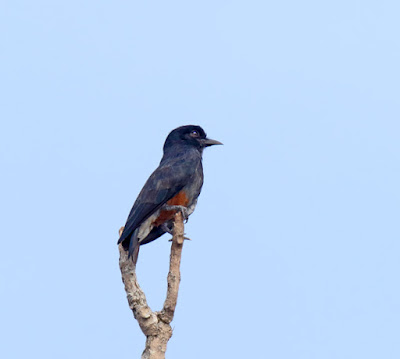
Swallow-winged Puffbird

Lastly a small group of puffbirds are call nunbirds. The 9.5" Black-fronted Nunbird (Monasa nigrifrons) is a dark gray bird with a black face and red bill. It is an easy ID.
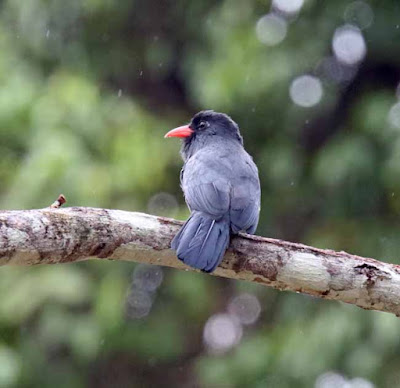
Black-fronted Nunbird

Motmots are colorful birds with long racquet tails. The only one for the trip was the 15" Whooping Motmot (Momotus subrufescens). What is distinctive is they swing their tails side-to-side rather than up and down.

Whooping Motmot

I finally got a photo of a 26" Lesser Yellow-headed Vulture (Cathartes burrovianus). I had seen this bird at a great distance soaring a few times, but now had one along the Caribbean coast. The head is actually yellow with a red forehead and red nape.

Lesser Yellow-headed Vulture

We also saw a juvenile King Vulture while we were having lunch one day. But I did not recognize what it was, so I missed the photo before the guide IDed it.

I love marine mammals, so I was excited that we might see a fresh water dolphin on the trip. The Amazon River Dolphin (Inia geoffrensis) is AKA Boto or Pink Dolphin. It is one of 2 species of fresh water dolphins in the Amazon basin. The first afternoon in Inirida we went to a small river that had a pod of maybe 20 dolphins and they were surfacing all around our boat.

Amazon River Dolphin

I put the different bird/mammal families in single folders for easy viewing

I have photos of 11 of the 38 species of puffbirds

I have photos of 10 of the 14 species of motmots

I have photos of 6 of the 7 species of New World vultures

Happy birding and photography,

David McDonald

dkmmdpa@gmail.com

photos copyright 2006 - 2022 David McDonald

To have these trip reports sent to your email, please email me at the above address and ask to subscribe.

Sunday, June 26, 2022

Bulletin 397 - Colombia 2021 #14 - Tanagers Pt 3

 I finally made it back to Colombia for my second visit and again used the guide services of Pablo Florez. I went with my friend Martin Jackson. We visited Inirida on the Orinoco, Santa Marta of course, Guajira Peninsula on the Caribbean coast, and a couple of National Parks around Bogota.

Tanagers are a large New World family of mostly colorful birds. They include seedeaters, conebills, tanagers, flowerpiercers etc. Any birding trip to the tropics will find a large number of them.

The 5.25 " Blue-backed Conebill (Conirostrum sitticolor) is an easy ID with his black head, rusty underparts, and blue back.

Blue-backed Conebill

The 5" Hooded Tanager (Nemosia pileata) is a rather plain colored tanager. The male is white below, gray above and he has a black hood. He has a bright yellow eye.

Hooded Tanager

The 7"  Blue-capped Tanager (Sporothraupis cyanocephala) has a blue head, olive back, light blue breast and yellow under the tail.

Blue-capped Tanager

The male 6" Red-shouldered Tanager (Tachyphonus phoenicius) is an all black bird with a silver bill. The small red shoulder patch is usually hidden.

Red-shouldered Tanager - male

The female Red-shouldered Tanager is dull brown on her head and back and white below.

Red-shouldered Tanager - female

T

he 7" Wedge-tailed Grass-Finch (Emberizoides herbicola) looks more like a non-descript sparrow than a brightly colored tanager.

Wedge-tailed Grass-Finch

Flowerpiercers are tanagers with hooked upper mandibles,. They make a small hole in the base of the flower and draw the nectar from there.

The 6" Glossy Flowerpiercer (Diglossa lafresmayii) is black with a light shoulder patch.

Glossy Flowerpiercer

The 6" Masked Flowerpiercer (Diglossa cyanea) is dark blue with a black mask and red eye.

Masked Flowerpiercer

The 5" male White-naped Seedeater (Dolospingus fringilloides) is the typical black and white pattern seen in other seedeaters. Its habitat is the white sand forest along the Orinoco River. This was a target bird for the Inirida section of the trip and we finally saw it the last morning.

White-naped Seedeater

Lastly is the 4.5" male Purple Honeycreeper (Cyanerpes caeruleus). It is bright purplish blue, with black wings, throat and mask. The best feature to ID is the bright yellow legs. This was my best ever view of this bird.

Purple Honeycreeper

I put the different bird/mammal families in single folders for easy viewing

I have photos of 114 of the 385 species of tanagers

Happy birding and photography,

David McDonald

dkmmdpa@gmail.com

photos copyright 2006 - 2022 David McDonald

To have these trip reports sent to your email, please email me at the above address and ask to subscribe.

Sunday, May 29, 2022

Bulletin 396 - Colombia 2021 #13 - Hawks and Falcons

 I finally made it back to Colombia for my second visit and again used the guide services of Pablo Florez. I went with my friend Martin Jackson. We visited Inirida on the Orinoco, Santa Marta of course, Guajira Peninsula on the Caribbean coast, and a couple of National Parks around Bogota.

Hawks and falcons are always favorites of birders because of the sense of power and strength. We saw several species of hawks as well as 2 falcon species. Some were life birds and some were 1st time photos of species.

The 20" Black-collared Hawk (Busarellus nigricollis) is a beautiful rufous colored raptor with a white head and black chest. It is found along swamps, mangroves and lakes. It usually perches low to the water as it hunts for fish, amphibians and snails. 

Black-collared Hawk

The 20" Common Black Hawk (Buteogallus anthracinus) is also found along waterways. This juvie was photographed in a palm tree on the Caribbean coast.

Common Black Hawk - juvenile

His larger cousin, the 24" Great Black Hawk (Buteogallus urubitinga) is found perched along the waters edge. This was a lifer for me. I had been looking for this bird on all my tropical trips. We were able to approach in the boat to within 10 meters from the bird. Wow

Great Black Hawk

Another smaller cousin is the 15" Slate-colored Hawk (Buteogallus schistaceus). He is also associated with water - but the still black water in flooded forests. He was also a life bird for me.

Slate-colored Hawk

The 18" Grey-lined Hawk (Buteo nitidis) is identical to the Grey Hawk in southern USA. They were split and this bird is south of Costa Rica. 

Grey-lined Hawk

The last hawk is the very common 15" Roadside Hawk (Rupornis magnirostris). It has a range from Mexico to Argentina - so a person should see it on every trip.

Roadside Hawk

The 11" Bat Falcon (Falco rufigularis) was a treat to see again. I saw it for the first time in 1993, on my first trip to the tropics in Belize. I had not seen it again until this trip.

Bat Falcon

The 17" adult Black Caracara (Daptrius ater) is an all black bird with reddish facial skin. The juvenile has yellow facial skin.

Black Caracara

I put the different bird/mammal families in single folders for easy viewing

I have photos of 76 of the 254 species of hawks, eagles and kites

I have photos of 18 of the 65 species of falcons and caracaras

Happy birding and photography,

David McDonald

dkmmdpa@gmail.com

photos copyright 2006 - 2022 David McDonald

To have these trip reports sent to your email, please email me at the above address and ask to subscribe.

Sunday, May 1, 2022

Bulletin 395 - Colombia 2021 #12 - Tanagers Pt 2

  I finally made it back to Colombia for my second visit and again used the guide services of Pablo Florez. I went with my friend Martin Jackson. We visited Inirida on the Orinoco, Santa Marta of course, Guajira Peninsula on the Caribbean coast, and a couple of National Parks around Bogota.

Tanagers are a large New World family of mostly colorful birds. They include seedeaters, conebills, tanagers, flowerpiercers etc. Any birding trip to the tropics will find a large number of them.

Grassquits are tiny finch like tanagers. The males are mostly black and the females dull brownish like sparrows. The 4" male Black-faced Grassquit (Tiaris bicolor) has a black head and breast and brown back.

Black-faced Grassquit - male

The 4" male Blue-black Grassquit (Volatinia jacarina) is solid glossy black.

Blue-black Grassquit - male

The 6.5" Glaucous Tanager (Thraupis glaucolpa) is mostly gray but has an aquamarine blue breast and wings.

Glaucous Tanager

The 6.5" Golden-crowned Tanager (Iridosonrnis rufivertex) is a stunning bird and an easy ID if you see it.

Golden-crowned Tanager

The 9" Hooded Mountain Tanager (Buthraupis montana) has a black head, yellow breast, blue back and red eye.

Hooded Mountain Tanager

The 7.5" Scarlet-bellied Mountain Tanager (Anisognathus igniventris) is another wow bird!

Scarlet-bellied Mountain Tanager

The 5" female Blue Dacnis (Dacnis cayana) is a green bird with bluish wash on her heaed. The male is blue and black.

Blue Dacnis - female

The 7" female Silver-beaked Tanager (Ramphocelus carbo) is reddish-brown with a light colored bill. The male is dark red and black.

 Silver-beaked Tanager - female

I put the different bird/mammal families in single folders for easy viewing

I have photos of 114 of the 385 species of tanagers

Happy birding and photography,

David McDonald

dkmmdpa@gmail.com

photos copyright 2006 - 2022 David McDonald

To have these trip reports sent to your email, please email me at the above address and ask to subscribe.

Sunday, April 17, 2022

Bulletin 394 - Colombia 2021 #11 - Tanagers Pt 1

 I finally made it back to Colombia for my second visit and again used the guide services of Pablo Florez. I went with my friend Martin Jackson. We visited Inirida on the Orinoco, Santa Marta of course, Guajira Peninsula on the Caribbean coast, and a couple of National Parks around Bogota.

Tanagers are a large New World family of mostly colorful birds. They include seedeaters, conebills, tanagers, flowerpiercers etc. Any birding trip to the tropics will find a large number of them.

The 5" Bay-headed Tanager (Tangara gyrola) is a fairly common bird from Costa Rica south into northern Amazonia. They usually have an aqua underside, but the Santa Marta range toddi subspecies is green. This is a likely future split.

Bay-headed Tanager
toddi ssp in Santa Marta range

The 7" Santa Marta Mountain Tanager (Anisognathus melanogenys) is a Santa Marta endemic and an easy ID with the blue back, yellow underside and black face.

Santa Marta Mountain Tanager

But the most exciting tanager we found in Santa Marta was the skulking 5.5" Plushcap (Catamblyrhynchus diadema). This is not an endemic to Santa Marta - but the only pair we saw and they flew across the trail and landed at eye level 8 feet away. The ID is easy if you are fortunate to see this bird.

Plushcap

Saltators are a group of tanagers that used to be in the cardinal family. The 8" Blue-grey Saltator (Saltator coerulescens) is a mostly grey bird with a white eye stripe.

Blue-grey Saltator

The 8" Olivaceous Saltator (Saltator olivascens) is similar and was split form the above species - but is a lighter grey and lacks the stripe over the eye.

Olivaceous Saltator


The 8" Orinocan Saltator (Saltator orenocensis) is dark above with a black face and rusty flanks and bright white stripe over the eye.

Orinocan Saltator

The 6" male Plumbeous Sierra Finch (Phrygilus unicolor) is a cute little bird of the paramo. The female is brown and streaky like a sparrow.

Plumbeous Sierra Finch - male

The 4.5" Grey Pileated Finch (Coryphospingus pileatus) is a rather dull greyish bird with  a pink bill.

Grey Pileated Finch

I put the different bird/mammal families in single folders for easy viewing

I have photos of 114 of the 385 species of tanagers

Happy birding and photography,

David McDonald

dkmmdpa@gmail.com

photos copyright 2006 - 2022 David McDonald

To have these trip reports sent to your email, please email me at the above address and ask to subscribe.

Sunday, April 3, 2022

Bulletin 393 - Colombia 2021 #10 - Hummingbirds - Pt 2

  I finally made it back to Colombia for my second visit and again used the guide services of Pablo Florez. I went with my friend Martin Jackson. We visited Inirida on the Orinoco, Santa Marta of course, Guajira Peninsula on the Caribbean coast, and a couple of National Parks around Bogota.

There are over 160 species of hummingbirds in Colombia! We saw many species with some rare and endemic ones.

The 4.25" male Blue-throated Starfrontlet (Coeligena helianthea) is a 'fancy one' to quote our guide Pablo. He has a pink belly and blue rump.

Blue-throated Starfrontlet - male

The female is duller with a spotted breast and belly. She has on orange throat.

Blue-throated Starfrontlet - female

Their cousin, the 4.5" White-tailed Starfrontlet (Coeligena phalerata) is endemic to the the Santa Marta mountains. He is green with a conspicuous white tail - an easy ID in that range.

White-tailed Starfrontlet

Woodstars are tiny hummingbirds. The 2.25" male Santa Marta Woodstar (Chaetocercus astreans) is the only woodstar in the Santa Marta range. They sit on top of the trees, so difficult to get a good photo. But he is a green hummer with a red throat and forked tail.

Santa Marta Woodstar - male


The female is buffy below with a square tail.

Santa Marta Woodstar - female

The 2.75" female White-bellied Woodstar (Chaetocercus mulsant) is green backed, mostly white below and rusaty flanks. The male has a purple throat.

White-bellied Woodstar - female


The 3.5" Brown Violetear (Colibri delphinae) is dull brown with the characteristic purple cheek feathers. The sexes are similar.

Brown Violetear

His cousin the 4.75" Sparkling Violetear (Colibri coruscans) is a stunning bird as all his feathers truly sparkle. The sexes are similar. I always enjoy seeing this hummer.

Sparkling Violetear

The 3" male Tyrial Metaltail (Metallura tyrianthina) is green with a bluish throat and reddish tail. 

Tyrial Metaltail - male

The female is paler with an orange throat. However, this is the Santa Marta subspecies (districta).It is a likely split.

Tyrial Metaltail - female Santa Marta ssp

The 3.5" male Crowned Woodnymph (Thalurania colombica)  has a green throat and chest and blue crown, belly and back. A real stunner!.

Crowned Woodnymph - male


The 4.5" male Lazuline Sabrewing (Campylopterus fulcatus) is a green hummer with a blue throat. He has a curved bill.

Lazuline Sabrewing - male

Lastly was a treat - the 3" male Ruby-Topaz Hummingbird (Chyrsolampis mosquitus). This bird has a red head and nape of neck along with  an orange throat. This was a lifer for me.

Ruby-Topaz Hummingbird - male

I put the different bird/mammal families in single folders for easy viewing


I have photos of 136 of the 359 species of hummingbirds.

Happy birding and photography,

David McDonald

dkmmdpa@gmail.com

photos copyright 2006 - 2021 David McDonald

To have these trip reports sent to your email, please email me at the above address and ask to subscribe.