Sunday, August 7, 2022

Bulletin 400 - Colombia 2021 #17 - Night Birds and Toucans

 I finally made it back to Colombia for my second visit and again used the guide services of Pablo Florez. I went with my friend Martin Jackson. We visited Inirida on the Orinoco, Santa Marta of course, Guajira Peninsula on the Caribbean coast, and a couple of National Parks around Bogota.

Here is another milestone - my 400th bulletin since I started sending a few spring migration photos to a half dozen friends 14 years ago. So I have put a couple of my favorite families of birds in this issue.

Owls are one of my favorite subjects to photograph. We saw 3 owls on the trip and all were lifers. The 17" Stygian Owl (Asio stygius) I had missed on all my previous trips. So I was surprised to see this bird high in the Santa Marta mountains, in the pre-dawn fog, sitting right over the road in our headlights. In reading about this bird, his food is other sleeping birds.

Stygian Owl


Further up the mountain we stopped a couple of time to call in the 10" Santa Marta Screech Owl (Megascops gilesi). This is a newly described species in 2018. Our guide for this portion of the trip specializes in the Santa Marta region and he was the one who discovered a nest and described the species as separate from the Tropical Screech Owl. So it was a treat to see such a new species. This is the first time an owl did not turn to face the camera and the light for me.

Santa Marta Screech Owl

The next day as we left the Santa Marta range and stayed in a village at the bottom, the guide had a friend who took us outside of town after dark and we saw the 9" Tropical Screech Owl (Megascops choliba).

Tropical Screech Owl

Another night bird was the 16" Common Potoo (Nyctibius griseus). They sleep during the day, often at the end of s broken branch so they become almost invisible. I had see this bird several times previously, but Martin was excited as it was a new family of birds for him and one he was hoping to see.

Common Potoo

We also saw hundreds of Sand-colored Nighthawks along the Orinco tributaries - all flying in the direction of Inirida - as the only lights in miles of jungle and the lights attracts the insects. We flushed a pair of Rufous Nightjars but I was not able to get a photo.

We also had the pleasure of seeing 5 species of Toucans. These colorful birds are a favorite of many people as kids grow up eating Fruit Loops with a toucan as the mascot for the brand.

The 19" Keel-billed Toucan (Ramphastos sulfuratus) is the fruit loops bird on the cereal box. It is mostly in Central America but gets in Colombia along the northern coast.

Keel-billed Toucan

The 18" Channel-billed Toucan (Ramphastos vitellinus) has a black or dark brown bill with a yellow stripe on the upper mandible.

Channel-billed Toucan

The 18" Black-billed Mountain Toucan (Andigena nigrirostris) is brown above and gray below.

Black-billed Mountain Toucan

Aracaris are smaller toucans with narrower, more pointed bills. The 15" Ivory-billed Aracari (Pteroglossus azara) is black above and several stripes below, along with a pale bill color.

Ivory-billed Aracari

Toucanets are smaller still. The 14" Groove-billed Toucanet (Aulacorhynchus sulcatus) is green with a bicolored bill. It is only found in the Santa Marta and adjacent ranges in Colombia.


Groove-billed Toucanet

I put the different bird/mammal families in single folders for easy viewing

I have photos of 36 of the 226 species of owls

I have photos of 17 of the 43 species of toucans

Happy birding and photography,

David McDonald

dkmmdpa@gmail.com

photos copyright 2006 - 2022 David McDonald

To have these trip reports sent to your email, please email me at the above address and ask to subscribe.

Sunday, July 24, 2022

Bulletin 399 - Colombia 2021 #16 - Wrens and Manakins

I finally made it back to Colombia for my second visit and again used the guide services of Pablo Florez. I went with my friend Martin Jackson. We visited Inirida on the Orinoco, Santa Marta of course, Guajira Peninsula on the Caribbean coast, and a couple of National Parks around Bogota.

Wrens are a modest sized family of 88 species - all but 1 are in the New World. Despite being mostly brown birds - they are very active and cute with their usually uplifted tails. Many of the species are a challenge to see, let alone photograph. That is another trait that makes them a favorite family of birds for me. Every time I photo a new species, I am very happy.

I photographed 4 new species and another one that is a likely split. All were lifers.

The easiest ID is the beautiful 7.5" Bicolored Wren (Campylorhynchus griseus).

Bicolored Wren

His cousin is the 7.5" Thrush-like Wren (Campylorhynchus turdinus). It is a brown-backed wren with a spotted breast.

Thrush-like Wren

The Grey-breasted Wood Wren complex contains many likely splits in various geographic areas. 2 of these are in Santa Marta and are endemic to Colombia.

The 4.25" Hermit Wood Wren (Henicorhina anachoreta) is found above 2000m elevation in Santa Marta mountains. When it was first split from the Grey-breasted Wood Wren complex, it was called Santa Marta Wood Wren.

Hermit Wood Wren

The 4.25" Bangs' Wood Wren (Henicorhina bangsi) has not been officially split yet, but does show as a split in the Birds of Columbia Field Guide, so I am sure it will be officially split soon. It is found between 1000 - 2000m elevation in the Santa Marta range. I was so happy to get both of these wrens on the one morning we had a chance to see them.

Bangs' Wood Wren


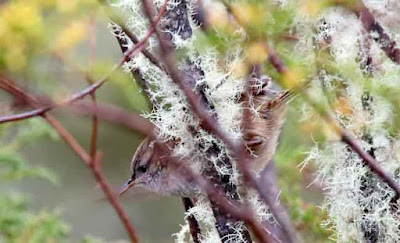
The 4" Apolinar's Wren (Cistothorus apolinari) is a resident around lakes in the paramo above Bogota. It took about 20 minutes of frustration as he moved around rapidly, before I got a photo. He is endemic to Colombia

Apolinar's Wren

In keeping with the small birds, manakins are another very small family of New World songbirds. I photographed 3 on the trip and all were life birds.

The female 4.75" Black Manakin (Xenopipo atronitens) is, like most female manakins, an olive color. The male is solid black.

Black Manakin - female

The 5" male Lance-tailed Manakin (Chiroxiphia lanceolata) is black , with a blue back, a red crown (here raised like a crest) and a few elongated tail feathers.

Lance-tailed Manakin - male

Lastly is the 4.5" male White-bearded Manakin (Manacus manacus). He has a black crown, back, wings and tail and the underparts are white. He has red legs.  This bird just sat for maybe 20 minutes and I got this one photo showing the beard extended. It was an exciting encounter, even though the guide book says it may be the most frequently seen manakin in Colombia due to its extensive range.

White-bearded Manakin - male

I put the different bird/mammal families in single folders for easy viewing

I have photos of 37 of the 86 species of wrens

I have photos of 10 of the 52 species of manakins

Happy birding and photography,

David McDonald

dkmmdpa@gmail.com

photos copyright 2006 - 2022 David McDonald

To have these trip reports sent to your email, please email me at the above address and ask to subscribe.

Sunday, July 10, 2022

Bulletin 398 - Colombia 2021 #15 - Puffbirds , vulture, motmot and boto

I finally made it back to Colombia for my second visit and again used the guide services of Pablo Florez. I went with my friend Martin Jackson. We visited Inirida on the Orinoco, Santa Marta of course, Guajira Peninsula on the Caribbean coast, and a couple of National Parks around Bogota.

Puffbirds are a small family of large headed and heavy-billed birds - usually brown or black in color. There are 38 species and 24 of them are in Colombia.

The 7" Chestnut-capped Puffbird (Bucco macrodactylus) is a brown puffbird with a plain breast and bright rufous cap.

Chestnut-capped Puffbird

His cousin the 7.5" Spotted Puffbird (Bucco tamatia) is similar but he has a rufous breast and heavy black spotting on his belly. Both these birds are listed as uncommon to rare in Amazonian Colombia.

Spotted Puffbird

The 8" Russet-throated Puffbird (Hypnelus ruficollis) is similar to the above but a different genus. He has a rufous throat but and a black chest band.

Russet-throated Puffbird


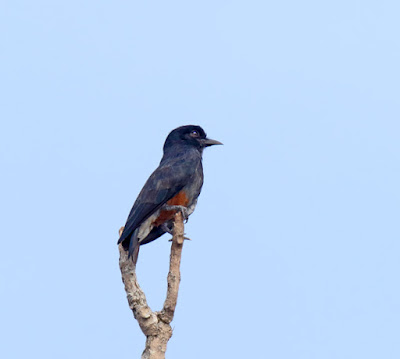
The 7" Swallow-winged Puffbird (Chelidoptera tenebrosa) looks and behaves more like a flycatcher. He is dark gray in color with a reddish belly.

Swallow-winged Puffbird

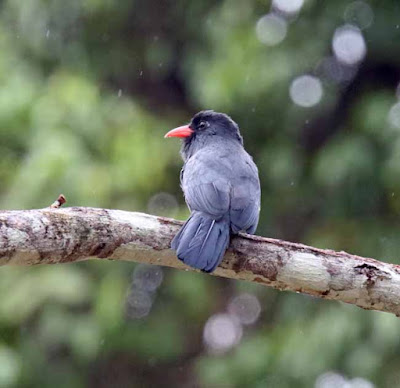
Lastly a small group of puffbirds are call nunbirds. The 9.5" Black-fronted Nunbird (Monasa nigrifrons) is a dark gray bird with a black face and red bill. It is an easy ID.

Black-fronted Nunbird

Motmots are colorful birds with long racquet tails. The only one for the trip was the 15" Whooping Motmot (Momotus subrufescens). What is distinctive is they swing their tails side-to-side rather than up and down.

Whooping Motmot

I finally got a photo of a 26" Lesser Yellow-headed Vulture (Cathartes burrovianus). I had seen this bird at a great distance soaring a few times, but now had one along the Caribbean coast. The head is actually yellow with a red forehead and red nape.

Lesser Yellow-headed Vulture

We also saw a juvenile King Vulture while we were having lunch one day. But I did not recognize what it was, so I missed the photo before the guide IDed it.

I love marine mammals, so I was excited that we might see a fresh water dolphin on the trip. The Amazon River Dolphin (Inia geoffrensis) is AKA Boto or Pink Dolphin. It is one of 2 species of fresh water dolphins in the Amazon basin. The first afternoon in Inirida we went to a small river that had a pod of maybe 20 dolphins and they were surfacing all around our boat.

Amazon River Dolphin

I put the different bird/mammal families in single folders for easy viewing

I have photos of 11 of the 38 species of puffbirds

I have photos of 10 of the 14 species of motmots

I have photos of 6 of the 7 species of New World vultures

Happy birding and photography,

David McDonald

dkmmdpa@gmail.com

photos copyright 2006 - 2022 David McDonald

To have these trip reports sent to your email, please email me at the above address and ask to subscribe.

Sunday, June 26, 2022

Bulletin 397 - Colombia 2021 #14 - Tanagers Pt 3

 I finally made it back to Colombia for my second visit and again used the guide services of Pablo Florez. I went with my friend Martin Jackson. We visited Inirida on the Orinoco, Santa Marta of course, Guajira Peninsula on the Caribbean coast, and a couple of National Parks around Bogota.

Tanagers are a large New World family of mostly colorful birds. They include seedeaters, conebills, tanagers, flowerpiercers etc. Any birding trip to the tropics will find a large number of them.

The 5.25 " Blue-backed Conebill (Conirostrum sitticolor) is an easy ID with his black head, rusty underparts, and blue back.

Blue-backed Conebill

The 5" Hooded Tanager (Nemosia pileata) is a rather plain colored tanager. The male is white below, gray above and he has a black hood. He has a bright yellow eye.

Hooded Tanager

The 7"  Blue-capped Tanager (Sporothraupis cyanocephala) has a blue head, olive back, light blue breast and yellow under the tail.

Blue-capped Tanager

The male 6" Red-shouldered Tanager (Tachyphonus phoenicius) is an all black bird with a silver bill. The small red shoulder patch is usually hidden.

Red-shouldered Tanager - male

The female Red-shouldered Tanager is dull brown on her head and back and white below.

Red-shouldered Tanager - female

T

he 7" Wedge-tailed Grass-Finch (Emberizoides herbicola) looks more like a non-descript sparrow than a brightly colored tanager.

Wedge-tailed Grass-Finch

Flowerpiercers are tanagers with hooked upper mandibles,. They make a small hole in the base of the flower and draw the nectar from there.

The 6" Glossy Flowerpiercer (Diglossa lafresmayii) is black with a light shoulder patch.

Glossy Flowerpiercer

The 6" Masked Flowerpiercer (Diglossa cyanea) is dark blue with a black mask and red eye.

Masked Flowerpiercer

The 5" male White-naped Seedeater (Dolospingus fringilloides) is the typical black and white pattern seen in other seedeaters. Its habitat is the white sand forest along the Orinoco River. This was a target bird for the Inirida section of the trip and we finally saw it the last morning.

White-naped Seedeater

Lastly is the 4.5" male Purple Honeycreeper (Cyanerpes caeruleus). It is bright purplish blue, with black wings, throat and mask. The best feature to ID is the bright yellow legs. This was my best ever view of this bird.

Purple Honeycreeper

I put the different bird/mammal families in single folders for easy viewing

I have photos of 114 of the 385 species of tanagers

Happy birding and photography,

David McDonald

dkmmdpa@gmail.com

photos copyright 2006 - 2022 David McDonald

To have these trip reports sent to your email, please email me at the above address and ask to subscribe.

Sunday, May 29, 2022

Bulletin 396 - Colombia 2021 #13 - Hawks and Falcons

 I finally made it back to Colombia for my second visit and again used the guide services of Pablo Florez. I went with my friend Martin Jackson. We visited Inirida on the Orinoco, Santa Marta of course, Guajira Peninsula on the Caribbean coast, and a couple of National Parks around Bogota.

Hawks and falcons are always favorites of birders because of the sense of power and strength. We saw several species of hawks as well as 2 falcon species. Some were life birds and some were 1st time photos of species.

The 20" Black-collared Hawk (Busarellus nigricollis) is a beautiful rufous colored raptor with a white head and black chest. It is found along swamps, mangroves and lakes. It usually perches low to the water as it hunts for fish, amphibians and snails. 

Black-collared Hawk

The 20" Common Black Hawk (Buteogallus anthracinus) is also found along waterways. This juvie was photographed in a palm tree on the Caribbean coast.

Common Black Hawk - juvenile

His larger cousin, the 24" Great Black Hawk (Buteogallus urubitinga) is found perched along the waters edge. This was a lifer for me. I had been looking for this bird on all my tropical trips. We were able to approach in the boat to within 10 meters from the bird. Wow

Great Black Hawk

Another smaller cousin is the 15" Slate-colored Hawk (Buteogallus schistaceus). He is also associated with water - but the still black water in flooded forests. He was also a life bird for me.

Slate-colored Hawk

The 18" Grey-lined Hawk (Buteo nitidis) is identical to the Grey Hawk in southern USA. They were split and this bird is south of Costa Rica. 

Grey-lined Hawk

The last hawk is the very common 15" Roadside Hawk (Rupornis magnirostris). It has a range from Mexico to Argentina - so a person should see it on every trip.

Roadside Hawk

The 11" Bat Falcon (Falco rufigularis) was a treat to see again. I saw it for the first time in 1993, on my first trip to the tropics in Belize. I had not seen it again until this trip.

Bat Falcon

The 17" adult Black Caracara (Daptrius ater) is an all black bird with reddish facial skin. The juvenile has yellow facial skin.

Black Caracara

I put the different bird/mammal families in single folders for easy viewing

I have photos of 76 of the 254 species of hawks, eagles and kites

I have photos of 18 of the 65 species of falcons and caracaras

Happy birding and photography,

David McDonald

dkmmdpa@gmail.com

photos copyright 2006 - 2022 David McDonald

To have these trip reports sent to your email, please email me at the above address and ask to subscribe.

Sunday, May 1, 2022

Bulletin 395 - Colombia 2021 #12 - Tanagers Pt 2

  I finally made it back to Colombia for my second visit and again used the guide services of Pablo Florez. I went with my friend Martin Jackson. We visited Inirida on the Orinoco, Santa Marta of course, Guajira Peninsula on the Caribbean coast, and a couple of National Parks around Bogota.

Tanagers are a large New World family of mostly colorful birds. They include seedeaters, conebills, tanagers, flowerpiercers etc. Any birding trip to the tropics will find a large number of them.

Grassquits are tiny finch like tanagers. The males are mostly black and the females dull brownish like sparrows. The 4" male Black-faced Grassquit (Tiaris bicolor) has a black head and breast and brown back.

Black-faced Grassquit - male

The 4" male Blue-black Grassquit (Volatinia jacarina) is solid glossy black.

Blue-black Grassquit - male

The 6.5" Glaucous Tanager (Thraupis glaucolpa) is mostly gray but has an aquamarine blue breast and wings.

Glaucous Tanager

The 6.5" Golden-crowned Tanager (Iridosonrnis rufivertex) is a stunning bird and an easy ID if you see it.

Golden-crowned Tanager

The 9" Hooded Mountain Tanager (Buthraupis montana) has a black head, yellow breast, blue back and red eye.

Hooded Mountain Tanager

The 7.5" Scarlet-bellied Mountain Tanager (Anisognathus igniventris) is another wow bird!

Scarlet-bellied Mountain Tanager

The 5" female Blue Dacnis (Dacnis cayana) is a green bird with bluish wash on her heaed. The male is blue and black.

Blue Dacnis - female

The 7" female Silver-beaked Tanager (Ramphocelus carbo) is reddish-brown with a light colored bill. The male is dark red and black.

 Silver-beaked Tanager - female

I put the different bird/mammal families in single folders for easy viewing

I have photos of 114 of the 385 species of tanagers

Happy birding and photography,

David McDonald

dkmmdpa@gmail.com

photos copyright 2006 - 2022 David McDonald

To have these trip reports sent to your email, please email me at the above address and ask to subscribe.