Sunday, June 18, 2023

Bulletin 415 - Colombia 2022 #12 - Tanagers - Part 2

I was planning to go to Peru in 2022 but there were riots and road closures in the areas we were planning to go. So at the last minute I went back to Colombia and saw some other places. 

Unfortunately, there was a lot of overlap, so I did not get a lot of new birds on the trip. However, many areas now have set up feeding stations and several were built for photography. I used the same guide Pablo Florez and I had my daughter with me on the trip this year.

However on the bright side, the setups for photography and the number of places that had feeders allowed me to get many improved photos of birds I had mediocre photos previously.

The tanager family (thraupidae) is another huge New World family of birds with 386 species currently. The range from the plain seedeaters to the gaudy Tangara genus of beautiful birds.

The 6.5" Blue-grey Tanager (Thraupis episcopus) is probably the most common tanager I have seen as I think I have seen it every trip. The range is from southern Mexico to Bolivia and Amazonia. It is also listed in Miami as an escaped cage bird. It is a beautiful bird and easily recognized. There is another variant with a white wing bar in the eastern part of the range. Maybe a split???

Blue-grey Tanager

The 6" Black-backed Bush-Tanager (Urothraupis stolzmanni) is listed as 'local and usually uncommon'. This was my second time to see it. We were on the same mountains Los Nevados.

Black-backed Bush-Tanager

The 4.5" Dull-colored Grassquit (Asemospiza obscura) is a plain grayish brown bird. The guide book says it has a pale lower mandible. So I looked online and I see some photos are like mine with an all black bill. It was IDed by my guide. It was a lifer.

Dull-colored Grassquit

Conebills are another group of tanagers. The 5.3" male Capped Conebill (Conirostrum albifrons) is a black bird with blue on the wings and a white cap.

Capped Conebill - male

The 6.8" male Crimson-backed Tanager (Ramphocelus dimidiatus) is a mostly red bird with a dark head and wings and a white lower mandible. This genus of tanagers is one of my favorites, as black and red colorations.

Crimson-backed Tanager - male

The 5" male Black-capped Tanager (Stilpnia heinei) is a beautiful blue and black bird that was formerly in the tangara genus. There were several 'tangara genus' tanagers moved to a different genus based on DNA studies.

Black-capped Tanager - male

The female is green with a speckled black cap.

Black-capped Tanager - female


Lastly is the beautiful 5.3" Silver-throated Tanager (Tangara icterocephala). This is another bird I remember from my first trip to Costa Rica in 1994. it is confined to the western slope of the Andes. However on an Ecuador trip, on the Amazonian slope we saw one and I photographed it. It was only the second record I could find for the Amazonian slope. It was a first at that lodge and the owner did not know what it was..hahahah

Silver-throated Tanager


I put the different bird/mammal families in single folders for easy viewing

I have photos of 118 of the 386 species of tanagers

Happy birding and photography,

David McDonald

dkmmdpa@gmail.com

photos copyright 2006 - 2023 David McDonald

To have these trip reports sent to your email, please email me at the above address and ask to subscribe.

Sunday, June 4, 2023

Bulletin 414 - Colombia 2022 #11 - Parrots, Owls, Doves, Porcupine

 I was planning to go to Peru in 2022 but there were riots and road closures in the areas we were planning to go. So at the last minute I went back to Colombia and saw some other places. 

Unfortunately, there was a lot of overlap, so I did not get a lot of new birds on the trip. However, many areas now have set up feeding stations and several were built for photography. I used the same guide Pablo Florez and I had my daughter with me on the trip this year.

However on the bright side, the setups for photography and the number of places that had feeders allowed me to get many improved photos of birds I had mediocre photos previously.

We had 3 parrots on the trip and 2 were lifers for me.

 The cute 5" Spectacled Parrotlet (Forpus conspicillatus) is green with blue around the eyes. I had seen this bird on a previous trip, but still a cute bird to see.

Spectacled Parrotlet

The 9" Saffron-headed Parrot (Pyrilia pyrilia) is an easy ID as the whole yellow head in unique.

Saffron-headed Parrot

The last one was another 'amazing luck' bird for me. It is the 8" Rufous-fronted Parakeet (Bolborhynchus ferrugineifrons). It is listed as endemic and vulnerable. The only place to have a chance to see it is at the tree-line in one of the National Parks. Pablo said that he had not seen the bird in 5 years and not been able to photo it in 7 years. As we were walking along a road - a pair of them flew past in front of us and disappeared behind a hill. We could not see if they had landed or continued flying away. I asked the guide to play the tape just in case. Sure enough, the pair flew back and landed right beside us 20' away. WOW 

Rufous-fronted Parakeet

I photographed 2 owls for the trip. The 6" Andean Pygmy Owl (Glaucidium jardinii) is diurnal so much easier to find then most owls. I has seen this bird before, but this was my first photo.

Andean Pygmy Owl

The 8" Choco Screech Owl (Megascops centralis) is part of a 5 way split of Middle American Screech Owl. Although there is still some discussion among ornithologists about all these being separate species. Its range is the western slope of the Andes in Colombia and northern Ecuador.

Choco Screech Owl


There were 2 interesting doves on the trip. Quail-doves are forest doves that usually are secretive. The 12" White-throated Quail-Dove (Geotrygon frenata) is a brown dove with a gray crown and the characteristic white cheek seen in most quail-doves.

White-throated Quail-Dove

The endemic and endangered 10" Tolima Dove (Leptotila conoveri) occurs in the Andes in southern Colombia. The only sure place to see it was at the lodge we stayed where they feed them.

Tolima Dove

The most unusual sighting on the trip was the Bicolor-spined Porcupine (Coendou bicolor).
This smallish porcupine weighs up to 20 pounds and has a prehensile tail. Pablo, the guide, said this was only the second time he has ever seen it. He was the only new mammal for the trip but what a rare prize!

Bicolor-spined Porcupine

I put the different bird/mammal families in single folders for easy viewing

I have photos of 46 of the 177 species of New World parrots.

I have photos of 38 of the 226 species of typical owls

I have photos of 43 of the 332 species of pigeons and doves.

I have photos of 2 of the 16 species of New World porcupines.

Happy birding and photography,

David McDonald

dkmmdpa@gmail.com

photos copyright 2006 - 2023 David McDonald

To have these trip reports sent to your email, please email me at the above address and ask to subscribe.


Sunday, May 14, 2023

Bulletin 413 - Colombia 2022 #10 - Tanagers - Part 1

I was planning to go to Peru in 2022 but there were riots and road closures in the areas we were planning to go. So at the last minute I went back to Colombia and saw some other places. 

Unfortunately, there was a lot of overlap, so I did not get a lot of new birds on the trip. However, many areas now have set up feeding stations and several were built for photography. I used the same guide Pablo Florez and I had my daughter with me on the trip this year.

However on the bright side, the setups for photography and the number of places that had feeders allowed me to get many improved photos of birds I had mediocre photos previously.

The tanager family (thraupidae) is another huge New World family of birds with 386 species currently. The range from the plain seedeaters to the gaudy Tangara genus of beautiful birds.

The 5" Bay-headed Tanager (Tangara gyrola) is a favorite of mine. On my first trip to the tropics in 1994 on a VENT tour to Costa Rica, it was the first bird I saw when we stopped the first morning. As it is on the cover of the guide book to Costa Rica I had been studying before the trip, I knew what it was. I have seen it many times since, but these are the best photos.

Bay-headed Tanager


Bay-headed Tanager


His cousin is the 5" Beryl-spangled Tanager (Tangara nigroviridis). No ID description is needed.

Beryl-spangled Tanager

The 5.3" male Paramo Seedeater (Catamenia homochroa) is a small dark gray bird with a rufous undertail and a light bill.

Paramo Seedeater - male

His cousin is the 5.3" male Plain-colored Seedeater (Catamenia inornata). It is a much lighter gray color. The females of both these species are brown.

Plain-colored Seedeater - male

The mountain tanagers are larger than the tangara tanagers and of course are restricted to the higher elevations. We saw 3 on the trip.

The 7" Lachrymose Mountain Tanager (Anisognathus lacrymosus) is blue on the black, yellow on the underside with a black face and a tiny yellow tear under his eye.

Lachrymose Mountain Tanager

His cousin is the 7" Blue-winged Mountain Tanager (Anisognathus somptuosus). He has a black face and back, mostly blue wings and tail and yellow below and a yellow nape.

Blue-winged Mountain Tanager

And the last one is the 7" Black-chinned Mountain Tanager (Anisognathus notabilis). He is similar to the one above, but his back is green and his underside is orange.

Black-chinned Mountain Tanager

I put the different bird/mammal families in single folders for easy viewing

I have photos of 118 of the 386 species of tanagers

Happy birding and photography,

David McDonald

dkmmdpa@gmail.com

photos copyright 2006 - 2023 David McDonald

To have these trip reports sent to your email, please email me at the above address and ask to subscribe.

Sunday, April 23, 2023

Bulletin 412 - Colombia 2022 #9 - Guans and other non-passerines

 I was planning to go to Peru in 2022 but there were riots and road closures in the areas we were planning to go. So at the last minute I went back to Colombia and saw some other places. 

Unfortunately, there was a lot of overlap, so I did not get a lot of new birds on the trip. However, many areas now have set up feeding stations and several were built for photography. I used the same guide Pablo Florez and I had my daughter with me on the trip this year.

However on the bright side, the setups for photography and the number of places that had feeders allowed me to get many improved photos of birds I had not so good photos before.

The cracidae family consists of about equal numbers of chachalacas, guans and curassows. The former are usually easy to see and come to feeders, but the curassows are some of the most difficult birds to find. All are spectacular due to their size.

The 20" Colombian Chachalaca (Ortalis columbiana) is an endemic. It is the only chachalaca in its range in the central and western Andes. The white tips of the breast feathers gives a scalloped look.

Columbian Chachalaca

Guans are similar but even larger. The 23" Andean Guan (Penelope montagnii) is much darker than the previous bird and the breast appears streaked rather than scalloped. I just love the genus name penelope - an old fashioned girls name.

Andean Guan

The last is the  25" Sickle-winged Guan (Chamaepetes goudotii). It is plain brown with a rufous belly.

Sickle-winged Guan

The next are single birds in each family that I photographed on the trip.

The 10" male Chestnut Wood-Quail (Odontophorus hyperythrus) was part of a covey of about 10 birds coming to a feeding station. These normally difficult to see birds are enchanting to see in the open and up close.

Chestnut Wood-Quail

Next is the 19" Andean Motmot (Momotus  aequatoralis). As you know motmots have racquet tails - with a bare shaft on the 2 long tail feathers before the racquet at the end of the tail. This is one of the 5 species that were split in the Blue-crowned Motmot complex. Here is the adult with the racquet tail. Another interesting habit is they swing their tails from side to side and not up and down like many birds.

Andean Motmot

So are they born with the racquet tail? No, here is a juvenile and his tail is normal. The adults strip the bare area themselves when preening. This is another wonder of nature!

Andean Motmot - juvenile

The only member of the trogon family for the trip was a 14" female Golden-headed Quetzal (Pharomachrus auriceps). She is the only quetzal in the Andes with a gray head and black undertail.

Golden-headed Quetzal - female

The last 2 birds were both lifers and surprising to find. I had never even heard of the 11" Spot-flanked Gallinule (Porphyriops melanops). It is mostly confined to Peru to Argentina but there is a small population in the mountains east of Bogota. It was in a pond in the middle of a cattle pasture - so I walked out to get the photo. It looks like our Common Gallinule but it has a greenish bill and shield and of course the white spots on the flank.

Spot-flanked Gallinule

The 13" Noble Snipe (Gallinago nobilis) was a special treat to see. It was in a boggy pasture and the farmer allowed us to go out to take the photos. The black line under the eye is diagnostic. Anytime I can find a snipe is always exciting.  This is the usual way that you see them - hunkered down in the grass. There are 7 snipes in South America and this was my second one to photograph.

Noble Snipe

But this one was wide open. The buffy spots on the tail are diagnostic for this species in the mountains.

Noble Snipe

I put the different bird/mammal families in single folders for easy viewing

I have photos of 18 of the 55 species of Chacalacas, Guans & Curassows

I have photos of 10 of the 34 species of New World Quail

I have photos of 10 of the 14 species of Motmots

I have photos of 20 of the 138 species of Rails and Gallinules

I have photos of 51 of the 93 species of Sandpipers

Happy birding and photography,

David McDonald

dkmmdpa@gmail.com

photos copyright 2006 - 2023 David McDonald

To have these trip reports sent to your email, please email me at the above address and ask to subscribe.

Sunday, April 2, 2023

Bulletin 411 - Colombia 2022 #8 - Flycatchers

I was planning to go to Peru in 2022 but there were riots and road closures in the areas we were planning to go. So at the last minute I went back to Colombia and saw some other places. 

Unfortunately, there was a lot of overlap, so I did not get a lot of new birds on the trip. However, many areas now have set up feeding stations and several were built for photography. I used the same guide Pablo Florez and I had my daughter with me on the trip this year.

However on the bright side, the setups for photography and the number of places that had feeders allowed me to get many improved photos of birds I had not so good photos before.

The New World flycatchers (tyrannidae) are the largest family of birds with 448 species currently. With the numbers of splits occurring, I would not be surprised if there will be 475 or even 500 species in the years ahead.

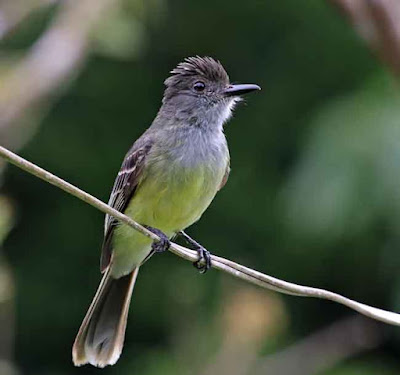
It is hard for me to remember which flycatchers I had photographed before. But I definitely know that this endemic to southwest Colombia was a lifer. The 7.5" Apical Flycatcher (Myiarchus apicalis) is a typical looking bird for that genus. It is probably the only genus I can recognize on sight. OK except for the Vermilion Flycatcher hahahaha. There are 3 of this genus in USA and 22 in total.

Apical Flycatcher

The 5.5" Mountain Elaenia (Elaenia frantzii) is a typical drab flycatcher and best IDed by voice. That is why I always have a guide!

Mountain Elaenia

The 3.8" Common Tody-Flycatcher (Todirostrum cinereum) is a widespread bird I have seen many times and I can recognize - the black cap, bright yellow breast and white eye.


Common Tody-Flycatcher

Another I can recognize is the 4.8" Ornate Flycatcher (Myiotriccus ornatus). The bright yellow breast and gray head and the white dot above the eye are diagnostic.

Ornate Flycatcher

The 6" Pacific Flatbill (Rhynchocyclus pacificus) is confined to the Choco region in Colombia and Ecuador. This would be another lifer as I had never been there before. The wide bill and gray eye ring are ID marks, but a guide who knows the voice is best hahaha.

Pacific Flatbill

Tyrannulets are dimunitive flycatchters is several genuses. The 4.5" Black-capped Tyrannulet (Phyllomyias nigrocapillus) is a yellowish flycatcher with wing bars and a black crest.

Black-capped Tyrannulet

The 4.5" Golden-faced Tyrannulet (Zimmerius chrysops) has a light breast and yellow on the face.

Golden-faced Tyrannulet


Chat-Tyrants are a colorful group of medium sized flycatchers. The 6" Brown-backed Chat-Tyrant (Ochthoeca fumicolor) has a brown back, black wings and a rusty breast.

Brown-backed Chat-Tyrant

His cousin, the 5.5" Rufous-breasted Chat-Tyrant (Ochthoeca rufipectoralis) has a striped face, white belly and orange throat and wing bars

Rufous-breasted Chat-Tyrant


Lastly is the 6" Rufous-tailed Tyrant (Knipolegus poecilurus). He has a distinctive red eye and rufous tail. Although the guide book says this bird is 'uncommon and seldom encountered' this was my second time to see it. 

Rufous-tailed Tyrant

I put the different bird/mammal families in single folders for easy viewing

I have photos of 134 of the 448 species of Tyrant Flycatchers

Happy birding and photography,

David McDonald

dkmmdpa@gmail.com

photos copyright 2006 - 2023 David McDonald

To have these trip reports sent to your email, please email me at the above address and ask to subscribe.

Sunday, March 19, 2023

Bulletin 410 - Colombia 2022 #7 - Puffbirds, Barbets, and Toucans

I was planning to go to Peru in 2022 but there were riots and road closures in the areas we were planning to go. So at the last minute I went back to Colombia and saw some other places. 

Unfortunately, there was a lot of overlap, so I did not get a lot of new birds on the trip. However, many areas now have set up feeding stations and several were built for photography. I used the same guide Pablo Florez and I had my daughter with me on the trip this year.

However on the bright side, the setups for photography and the number of places that had feeders allowed me to get many improved photos of birds I had not so good photos before.

Puffbirds, barbets and toucans are closely related families of birds - all in the order piciformes.

We saw 2 puffbirds - both in the Choco region of Colombia. The Choco is the Pacific slope of Colombia and northern Ecuador. 

The 5" Lanceolated Monklet (Micromonacha lanceolata) is probably the smallest puffbird. It has a range from Costa Rica to Bolivia - but is described as uncommon and inconspicuous. I had seen it at least once before, but it was well hidden and far away, so I was unable to get a photo. Well this time I hit the jackpot. We were on the main street of the little village and the guide heard it calling. He played the tape and the bird flew and landed on powerlines right beside us. My amazing luck was working today. He is sooo cute. The guide book says he takes very large prey for such a tiny bird, including lizards and snakes! This was definitely one of the highlights of the trip.

Lanceolated Monklet

The 8" Black-breasted Puffbird (Notharchus pectoralis) IDed by the location and the wide breast band. This was a lifer for me.


Black-breasted Puffbird


The 7" female Five-colored Barbet (Capito quinticolor) was another target bird as it is endemic to the Choco region of Colombia and northwestern Ecuador. I did not see a male with the 5 colors, but at least I photographed a female. This was, of course, a lifer.

Five-colored Barbet - female


The 6" male Red-headed Barbet (Eubucco bourcierii) is a beautiful bird and an easy ID. I had seen it many times but not so close as at this location.

Red-headed Barbet - male

The 9" Toucan Barbet (Semnornis ramphastinus) is in a 2 species family between the barbets and toucans as the name implies. It is an easy ID with all the colors.

Toucan Barbet

At this location, the birds were being fed and they were excavating a nest in a tree 3 feet above where we were standing. Here is a photo the bird has with a mouth full of the wood from the nest hole.

Toucan Barbet

So now we come to the toucans, which are a favorite of many people - birders and non-birders alike due to their huge size and gaudy colors. All these were at places where they were being fed - so have amazing close-up pics.

The 13" White-throated Toucanet (Aulacorhynchus albivitta) is a green toucan with a white throat. It is one of the multiple splits of the 'Emerald Toucanet'.

White-throated Toucanet


The 14" Crimson-rumped Toucanet (
Aulacorhynchus hematopygus) is green with a dark red bill.

Crimson-rumped Toucanet

And here he is showing his field mark.

Crimson-rumped Toucanet

The big toucans have been trained to come and eat grapes! Wow what a treat to see these birds almost within arms length.

The 18" Black-billed Mountain Toucan (Andigena nigrirostris) I had seen at long distance before, but this was amazing! These are my favorite photos, when I can see the individual feather detail.

Black-billed Mountain Toucan


His cousin, the 18" Grey-breasted Mountain Toucan (Andigena hypoglauca) was a lifer and we were watching, as they were being hand fed grapes by the staff.

Grey-breasted Mountain Toucan

I put the different bird/mammal families in single folders for easy viewing

I have photos of 13 of the 38 species of Puffbirds.

I have photos of 5 of the 15 species of New World Barbets

I have photos of 2 of the 2 species of Toucan Barbets

I have photos of 18 of the 43 species of Toucans

Happy birding and photography,

David McDonald

dkmmdpa@gmail.com

photos copyright 2006 - 2023 David McDonald

To have these trip reports sent to your email, please email me at the above address and ask to subscribe.