Wednesday, August 28, 2013

Bulletin 180 - Texas summer birds

Summer is a slow time for birding, but baby birds can be interesting and are readily found.

I had a quick trip to Kerrville in the hill country of Texas. That is the location of 2 special birds, the Golden-cheeked Warbler and Black-capped Vireo, both of whom are endangered. I had only seen them each once before, but before I was doing photography.

We went to the Kerr Wildlife Management Center outside of the town of Hunt. Both birds can be found there.

The Golden-cheeked Warbler (Setophaga chrysoparia) is a Texas specialty bird, as it only breeds in Texas and winters in Mexico. The male has a black throat, cap, and back. the bright yellow face has a black line through the eye. It superficially resembles the Black-throated Green Warbler, but the green is replaced by black. This bird was preening and pulled a small feather out which was stuck in his bill.

Golden-cheeked Warbler - male
He flew to a lower branch and I got another photo.


Golden-cheeked Warbler - male
I wasn't as lucky with the Black-capped Vireo (Vireo atricapillus). I found a pair of them, but they did their best to avoid any photographs. I finally got a single photo, but will need to go back. This vireo is IDed by the black head with white lores.

Black-capped Vireo
A pair of Turkey Vultures (Cathartes aura) on the fence allowed close up photos. The distinctive pink bare skin head is the field mark. Although they look black at a distance, the body is brownish in the sunlight.

Turkey Vulture - adult
Back home in July, I made several trips to Anahuac NWR. This is one of the best spots to find the Least Bittern  (Ixobrychus exilis). I saw about 6 this trip and this one sat in the open for an extended period of time.


Least Bittern
Anahuac is also a great place to find Common Nighthawks  (Chordeiles minor) roosting on fence posts at eye level. Notice the primary wing feathers have no markings beyond the white patch. The Lesser Nighthawk I found in the spring has buffy spots all the way along the primary feathers.


Common Nighthawk
I found a very young rail, which is most likely a King Rail (Rallus elegans) in the marsh at Anahuac. Notice how gray he is. The primary feathers are just about 1/2 inch long starting to sprout. There was a pair of them walking around below the boardwalk. He appeared to be fully grown in size.

King Rail - juvenile
I went back the next week, and refound one of them. The wing feathers are now perhaps 2" long.

King Rail - juvenile
Common Moorhens (Gallinula chloropus) downy chicks are black with red bills and a black ring around the bill. This one appears to have feet way too big for his size.


Common Moorhen - downy chick
I found a family with fully grown juveniles sitting up on some reeds..an adult with 3 young.

Common Moorhen - family group

Happy birding and photography,

David McDonald dkmmdpa@gmail.com

photos copyright 2013 David McDonald

To have these trip reports sent to your email, please email me at the above address and ask to subscribe.


Sunday, August 4, 2013

Bulletin 179 - Birds of the Big Island Hawaii

Lisa and I had a return trip to the Big Island in June. As luck would have it, we missed several birds on our trip in December and had to return to try and find them. Darn..LOL.

The native Hawaiian forest birds have been decimated, as I recounted in December in previous bulletins.

There were 3 of these birds on the Big Island that we missed on our previous trip, so we hired a guide, Jack Jeffrey, to take us to the Hakalau Forest NWR. Jack was, for many years, the resident biologist for the US Fish and Wildlife Service at Hakalau. This refuge is only open at certain times to the public, but guides have access virtually any time. As you can see on their web site, Jack took all the photos and is an excellent photographer. You can reach Jack by email jjphoto@hawaii.rr.com

All 3 of our target species were in the refuge. It is very definitely a rain forest as it rained almost all day of our visit. We were soaked before we even got there! Below 4000' elevation, Hakalau receives 250" rain annually, but above it is only 150". There are endangered plants as well, including some lobelias that Jack showed us that have less than 5 plants existing in the world.

The first bird is the Hawaii Creeper (Oreomystis mana). This small (5") endangered bird is olive to gray above and lighter below. It has a dark mask and straight bill. It is an insectivore, and creeps nuthatch-like up and down tree trunks and branches. Here is one that caught a large caterpillar. It is endemic to the Big Island.

Hawaii Creeper
The Akepa (Loxops coccineus) is small (4.5") honeycreeper that is unique in that it nests in holes in trees. This bird is found on both Maui and the Big Island. The Big Island males are bright orange with dark wings. We finally saw one in the mist, just before leaving for the day. Jack said that there only 2 other totally orange birds in the world.

Akepa - male
We did not find the 3rd bird. We also saw some other forest birds and of course took their photos. The Iiwi (Vestiaria coccinea) is the classic Hawaiian honeycreeper seen in all the travel brochures with its long curved red bill. The adults are red with black wings and tail. They can usually be found at the blooming Ohia trees. This one was completely upside down, while feeding on the nectar. The juveniles are green. We saw one this time, but were unable to get a photo.

Iiwi - adult
Interestingly, the Ohia trees also come with yellow blossoms. I don't recall seeing one before, so they must be much rarer than the red.

Ohia - yellow flowers
Another red bird with black wings is the Apapane (Himatione sanguinea). It is IDed by the short black beak, black legs, and white belly and undertail coverts.


Apapane - adult
The juvenile is brownish.


Apapane - juvenile
The male Hawaii Amakihi (Hemignathus virens) is bright yellow-green with a black mask. This one was preening and just once stuck his head out from under his wing.


Hawaii Amakihi - male
Females and juveniles are more olive coloration. The juveniles may lack the black mask entirely. I think this bird may be a juvenile.

Hawaii Amakihi - juvenile
There are many introduced birds in Hawaii as well. We found 3 that we did not see on our first trip. The only songbird was the Eurasian Skylark (Alauda arvensis). This 7" streaked brown bird is seen frequently on fence posts in open country. It is also on the ABA check list as it was introduced in Vancouver BC, but may already have died out.

Eurasian Skylark
The Chukar (Alectoris chukar) is an introduced gamebird in the partridge family. The large (13") bird is easily IDed by the gray overall color, black markings, and red bill and legs. The sexes are similar. It is also on the ABA check list as it has been introduced widely in American west as a game bird.
Chukar

The Hilton where we stayed has a lagoon that is used by Green Sea Turtles (Chelonia mydas) to feed and rest. It was exciting to see these gentle reptiles up close. The Hawaiian name is Honu.

Green Sea Turtle or Honu

Happy birding and photography,

David McDonald dkmmdpa@gmail.com


hotos copyright 2013 David McDonald

To have these trip reports sent to your email, please email me at the above address and ask to subscribe.


Monday, July 8, 2013

Bulletin 178 - Michigan #3 more birds and other things

I had a birding trip to northern Michigan in early June. I was accompanied by my stepson Seth for his first birding trip and we had a good time birding and photographing together. Also, we met some friends (Dutch and Bonnie Zonderman) from Northern Michigan and birded with them the first day to see the Kirtland's Warbler.

I employed a guide in the Upper Peninsula, Skye Haas. He doesn't have a web site yet, but his email is here. I would highly recommend him to anyone heading that way.
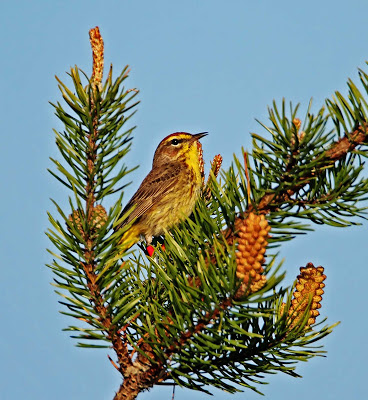
We got nice views of a banded Palm Warbler (Setophaga palmarum). You can see red bands on the , legs. This warbler is IDed by the rufous cap, brown back and yellow underparts and rump.

Palm Warbler

Here is a 3rd year Bald Eagle. It takes them 4 full years to get their adult plumage complete.

Bald Eagle - 3rd year
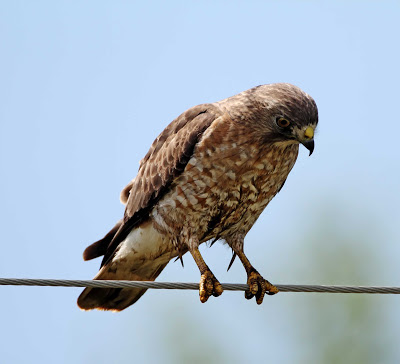
One raptor I needed was an adult plumaged Broad-winged Hawk (Buteo platypterus). This one perched on a phone wire was intent on a meal in the ditch below and didn't mind when we parked right beside him.


Broad-winged Hawk - adult
A moment later he pounced on a small mammal in the ditch beside the road, almost at our feet.

Broad-winged Hawk - adult
As he flew off, our guide saw the mammal in his talons and said it was a Star-nosed Mole.


Perhaps the most interesting finding on the trip was a pair of Sandhill Cranes (Grus canadensis), with 2 chicks only a couple of days old. The group was walking across the highway. All the cars stopped fortunately. One of the parents called the chicks down into the ditch. The other walked away from the group and proceeded to do the broken wing act to draw attention away from the chicks. I have seen Killdeers do this, but never such a large bird. Skye said he had seen that performance only 1 time previously with the cranes.

Here is the 2 day old chick.

Sandhill Crane - chick
Here is the one parent putting on the broken wing performance on the road.

Sandhill Crane - adult
He continued to walk farther away from his mate and the chicks and went down in to the roadside ditch. He then spread both his wings apart. Both parents were calling to each other while this was occurring.

Sandhill Crane - adult

Here is the other adult in the sunlight. Notice how rusty reddish the plumage is. I did not know that these cranes looked that color. It doesn't show in the bird guides. They are overall gray with a few rusty wing feathers. Skye said it was peculiar to that area, as there is a lot of iron in the ground water. When the birds preen, they put water on their feathers and gradually they become that rust color. Interesting!

Sandhill Crane - adult
Rusty colored due to iron in ground water
We were hoping to see some large mammals, but struck out. We did have an encounter with a Porcupine (Erethizon dorsatum). He was in a large open field, and when we got out, Seth left his car door open. We were photographing him and he circled around back to the car. I was afraid he would get into the car, but instead crawled under. This is my first photo of this mammal.

Here he is in defensive posture with the quills raised up on his back.


Porcupine
From behind, he is well armed. Pity the poor dog who takes on a porcupine and gets a face full of the quills.

Porcupine - from the back

As he got further away, he let his quills down.

Porcupine
We also found a good sized Snapping Turtle (Chelydra serpentina).

Snapping Turtle
Happy birding and photography,

David McDonald dkmmdpa@gmail.com

photos copyright 2013 David McDonald

To have these trip reports sent to your email, please email me at the above address and ask to subscribe.

Sunday, June 30, 2013

Bulletin 177 - other birds, wildflowers, and butterflies in Michigan

I had a birding trip to northern Michigan in early June. I was accompanied by my stepson Seth for his first birding trip and we had a good time birding and photographing together. Also, we met some friends (Dutch and Bonnie Zonderman) from Northern Michigan and birded with them the first day to see the Kirtland's Warbler.

I employed a guide in the Upper Peninsula, Skye Haas. He doesn't have a web site yet, but his email is here. I would highly recommend him to anyone heading that way.

This bird was a lifer for me. I had spent probably 3 entire days looking for it previously, first in the Sierras of Northern California and then in Duluth, Minnesota in winter. Finally I got it. The third time was the charmer. This bird is the Black-backed Woodpecker (Picoides arcticus). This woodpecker prefers trees killed by forest fires. Fortunately for me, there had been a small fire last year, and Skye found several pairs nesting in the burned forest. So here is the male. It has an all black back, black head and white stripe below the eye.

Black-backed Woodpecker - male
And he then flew to the nest hole that was only about 4' off the ground. Notice how he chipped off the burned bark below the hole.

Black-backed Woodpecker - male
This bird has 2 features not seen in most of the North American woodpeckers. Can you find them?
The male has a yellow patch on his head rather than red. Also, there are 3 toes on each foot, rather than the usual 4. The female would be similar, but she lacks the yellow patch on the head.

Another lifer was the Winter Wren (Troglodytes hiemalis). This tiny (4") hyperactive bird stayed deep in the brush, frustrating our attempts to get any photos.Finally, he popped into a small clearing among the branches and was spotted by Seth. I got off a couple of photos. As you know, this bird was split into Winter Wren and Pacific Wren several years ago. I had only seen the Pacific form in California. Thus I needed to see the eastern form as it was now a full species. It is IDed by the brown overall color, whitish spots and the short cocked up tail.

Winter Wren
The Bobolink (Dolichonyx orizyvorus) is a (7") member of the icterid or blackbird family. Its range is southern Canada and northern USA, east of the Rockies. It migrates through eastern USA with Houston being on the extreme western edge of the route. I remember this attractive bird from my childhood in Canada, but had seen it only twice in 20 years in Houston. It tends to be a late migrant in early May.

The male shown here has a black body, white rump and wing patches and a distinctive yellow occipital patch. The female and winter males are streaked brown like a large sparrow. He still has a few brownish feathers on his face, so has not completely finished molting.

Bobolink - breeding male
Seth got a great photo of him flying which shows the field marks.

Bobolink - breeding male
Photo by Seth Kelly
 
We found several species of flycatchers. The first is the Olive-sided Flycatcher (Contopus cooperi). This is a medium sized (7.5") flycatcher of the northern woods. It likes to perch on the tops of trees. It has one a memorable song "Quick..3 beers" and that is exactly what it sounds like!
It is IDed by the dark vest, no eye ring and faint or no wing bars.

Olive-sided Flycatcher
The empids are small flycatchers that have both eye rings and wing bars. Many of them are difficult to ID by appearance and can only be IDed by voice. The Yellow-bellied Flycatcher (Empidonax flaviventris) has yellow underparts.

Yellow-bellied Flycatcher
Two closely related species were formerly lumped together as Traill's Flycatcher until split about a decade ago. The Alder Flycatcher (Empidonax alnorum) is a small (5.75") flycatcher of the north woods of Canada and eastern USA, preferring alders as its name suggests. I had seen this bird in Houston in fall migration.

Alder Flycatcher
The second one is the Willow Flycatcher (Empidonax traillii). It is the same size as the alder, but it range is south of the Alder above, but ovelap occurs. It likes to be near water in willows. Our guide, Skye Haas, said this bird didn't occur on the Upper Peninsula, but told us of a place to check on our way back to the airport.

This location was Shiawassee NWR outside Saginaw Michigan. So Seth and I got up early and were able to take the 1 hour driving tour through the refuge. At the first group of willows we came to, we stopped and played the tape. Out popped several of the birds. This was another lifer for me. How easy to find the birds in the right location! Notice he has almost no eye ring, compared to the two empids above.

Willow Flycatcher
Other flycatchers seen were Eastern Kingbird, and Great-crested Flycatcher.

As this was spring in the north woods, there was a profusion of butterflies, wildflowers etc, all awakening from the long winter. We saw 2 species of wild orchids.

The first is the Pink Lady's-Slipper or Moccasin-Flower (Cypripedium acaule).

Pink Lady's-Slipper
There was also a similar yellow orchid, but I wasn't able to find the ID on line.


Yellow Orchid - upper peninsula Michigan

 
Several interesting butterflies were seen. The first is the Canadian Tiger Swallowtail (Papilio canadensis). The range is Alaska, Canada and USA along the Canadian border.

Canadian Tiger Swallowtail

The next one occurs all over the USA and Canada, althought I don't recall ever seeing it before.
It is the Mourning Cloak (Nymphalis antiopa).

Mourning Cloak
The Eastern Comma (Polygonia satyrus) has very indented wings.

Eastern Comma
Lastly a tiny. thumbnail sized butterfly, the Spring Azure (Celastrina ladon). This tiny butterfly has azure blue upper wings, but when perched has its wings closed, so only the spotted underside is visible.

Spring Azure

Happy birding and photography,

David McDonald davidkmcd@ymail.com

Lisa Kelly-McDonald lisajanekelly67@yahoo.com

photos copyright 2013 David McDonald and Lisa Kelly-McDonald

To have these trip reports sent to your email, please email me at the above address and ask to subscribe.


Thursday, June 13, 2013

Bulletin 176 - Michigan warblers

I had a birding trip to northern Michigan last weekend to photo the last of the eastern warblers that I did not have already. I was accompanied by my stepson Seth for his first birding trip and we had a good time birding and photographing together.

I employed a guide in the Upper Peninsula, Skye Haas. He doesn't have a web site yet, but his email is here. I would highly recommend him to anyone heading that way.

The rarest bird in North America is the Kirtland's Warbler. It is only found in the jack pine forests of northern Michigan, so anyone wanting to see all the birds has to make this trip to Grayling Michigan. The Michigan Audubon runs trips to see it. There are currently about 1000 pairs of birds left, however, in 1970 there were only 200 pairs, so the intensive recovery effort to save this bird is paying off.

Fortunately for birders, it breeds in areas where the pines are young and short. The males sit on top of the small trees to sing and are about 6-8 feet off the ground. This was of course a lifer, as it was my first trip there.


Kirtland's Warbler - male

Another lifer was the Connecticut Warbler. This bird doesn't migrate through Texas, so I had never seen it. The male has a gray hood, olive back and yellow breast. The complete white eye ring is an important field mark.

Connecticut Warbler - male
This photo shows the face a little clearer.

Connecticut Warbler - male

A similar, closely related bird is the Mourning Warbler. It also has the gray hood, olive back, and yellow belly. However, it has a black patch on the breast, and importantly, it lacks the eye ring. This bird is seen occasionally here in Houston, but I saw only one in the 7 years since doing photography and never got a picture.

Mourning Warbler - male
A beautiful bird is the Black-throated Blue Warbler. The male has a blue back, black face, throat and flanks and a white breast. Like the Mourning Warbler above, I had seen it only once in Houston since doing photography and missed the photo.

Black-throated Blue Warbler - male

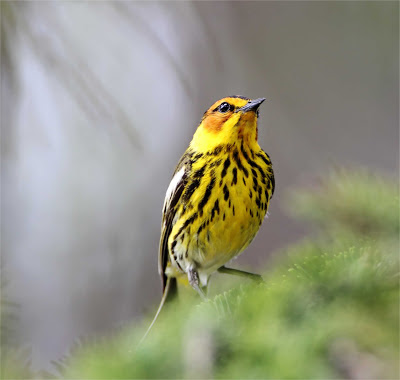
The last of the new warbler photos was the Cape May Warbler. The male is distinctive with bright yellow underparts with black streaking and rusty cheek patches. I had seen it before, but not once in the last 7 years.

Cape May Warbler - male
This second photo shows his underside

Cape May Warbler - male
It was a fantastic trip as I got all 5 warblers that I wanted to photograph.

Happy birding and photography,

David McDonald dkmmdpa@gmail.com

photos copyright 2013 David McDonald

To have these trip reports sent to your email, please email me at the above address and ask to subscribe.