Showing posts with label Andean Condor. Show all posts

Sunday, April 21, 2019

Bulletin 342 - 100 Birds to See Before You Die - # 3

I discovered this book "100 Birds to See Before you Die" by 2 Brits David Chandler and Dominic Couzens about 11 years ago while browsing in a bookstore on vacation. The sub title is "The Ultimate Wish List for Birders Everywhere". It sort of peaked my interest as a 'bucket list' of the rarest and most unusual birds in the world, according to the 2 authors.

It has the smallest (Bee Hummingbird)  and largest (Ostrich) birds, some of the most beautiful (Birds of Paradise) and some quite ugly (Shoebill) and strange (Hoatzin). There are birds on all the continents as well as Arctic and Antarctic regions. 

There are also a number of island endemics. In the south Pacific, there are entries for Hawaii (1), New Caledonia (2) , New Guinea (3), Sulawesi (1), Mindanao (1), and New Zealand (2). The Galapagos has 1 entry.  Madagascar has 3. The Caribbean is well represented with Cuba (1), Hispaniola (2) and Montserrat (1).

There are about 240 families of birds, so obviously they are not all represented on this list. There are 3 each of Birds-of-Paradise, Gulls and Terns, Cotingas, and Tyrant Flycatchers. There are several unique birds that are sole members of their family. These are the Hoatzin, Kagu, Oilbird, Crab Plover, Ibisbill, Wallcreeper and Shoebill, For those of us in North America, not a single New World Warbler is on the list.

Each entry has a full page photograph and facing page article of what makes the bird rare, unusual or interesting to warrant its inclusion.

This is the third group of 10 birds. The first installment is here. And the second is here.

Number 86 is the Paradise Tanager (Tangara chilensis). This very gaudy bird is what everyone thinks jungle birds should be like. It is a resident in Amazonia.


Paradise Tanager


Number 68 is the Golden-headed Manakin (Ceratopipra erythrocephala). These 3.5" birds are resident of northern South America. The males are black with a yellow head. the males perform elaborate dance displays on the lek to attract a female.

Golden-headed Manakin - male

Number 62 is the Little Forktail (Enicurus scouleri). This 5" black and white cutie is a resident along fast flowing streams in high mountains at an altitude of 5,500 to 11,000 feet in southest Asia. It is one of 8 species of forktails in the old world flycatcher family.


Little Forktail

Number 56 is the Pearled Treerunner (Margarornis squamiger). This brown bird with spotted breast is a common bird in the montane forests of the Andes from Venezuela to Bolivia. I have seen it several times. It is a member of the ovenbird family.

Pearled Treerunner
Number 53 is the magnificent Blue-and-yellow Macaw (Ara ararauna). It is resident in Amazonia and south-central South America. 

Blue-and-yellow Macaw
Number 51 is the Eurasian Hoopoe (Upupa epops). This 11" bird has a huge crest and long thin bill. It is a common bird across Eurasia and one of 3 species of hoopoe. The photos in the book show it with its crest elevated but I have not seen that yet.


Eurasian Hoopoe
Number 36 is the strange looking Hoatzin (Opisthocomus hoatzin). This prehistoric looking bird resides along slow moving streams in Amazonia. It is the sole member of the Hoatzin family.

Hoatzin

Number 29 is the Andean Cock-of-the-Rock (Rupicola peruvianus). This is one of the 3 cotingas in the book and the most beautiful with his bushy crest and red and black with silver plumage.

Andean Cock-of-the-Rock - male

Number 27 is the huge Andean Condor (Vultur gryphus). It is the worlds largest bird of prey with a length to 50 inches, weight to 33 pounds and wingspan of 10.5 feet.

Andean Condor
Number 19 is the Oilbird (Steatornis caripensis). It is a noctunal bird related to nightjars, but it is a fruit eater. It is unique in its own family. They roost in caves during the day. This one was photographed in Colombia. It is a resident from Panama across northern south America and on Trinidad.

Oilbird
Happy birding and photography,

David McDonald

dkmmdpa@gmail.com

photos copyright 2006 - 2019 David McDonald

To have these trip reports sent to your email, please email me at the above address and ask to subscribe.

Saturday, August 6, 2016

Bulletin 270 Ecuador 2016 #4 - Birds and Mammals of the Paramo

These are the places visited. At the end of each bird description, I will give the 2 letter code where the photo was taken. All these birds were from either of these locations.

Guango Lodge even higher on east slope (GU)
Antisana reserve on the paramo    (AN)

The paramo is the term for the tundra above the tree line in the Ecuador Andes. The first location was a short drive from Guango Lodge where it is possible to drive up high enough to see one of Ecuador's target birds. There are some radio antennae on a mountain top and the access road is the only way to somewhat easily find this bird. The guide book says it is a bird of barren slopes at very high elevations on the highest volcanoes. We were at 14,500 elevation. The guide went ahead and searched on the tundra and found a pair and came back to get me. We had to walk about 300 yards up and down muddy hills and I did get the bird. There were a pair of these 12"  grouse like birds called Rufous-bellied Seedsnipe (Attagis gayi) Despite their grouse like appearance, the 4 species of seedsnipes make up a family of shorebirds. All are found in South America. They are brick red below with an elaborate scalloped pattern on the back and wings. This is without question the most difficult bird I have ever photographed due to the elevation, cold and wind. Two other cars were up there while we were there, but the birds were a long way from the parking area and the people didn't see them. At the lodge in Mindo, there was a couple from Great Britain and they had looked for the bird on 4 different trips to Ecuador and still had not found it. Thanks Pablo!  GU


Rufous-bellied Seedsnipe
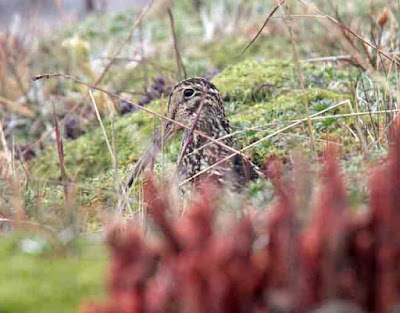
We saw another bird at that location, but it is more common and was close to the parking lot. The 11.5" Andean Snipe (Gallinago jamesoni) is a sandpiper with a long bill for probing in the muddy wet tundra.   GU


Andean Snipe
Antisana Preserve is the place to see Ecuador's national bird, the 50" Andean Condor (Vultur gryphus). It is the largest bird of prey in the world and has the largest wingspan 10.5 feet of any land bird. Of course, as a vulture, it just eats carrion and doesn't kill any thing. However, it is persecuted through ignorance and is declining rapidly, but captive breeding programs are reintroducing this magnificent bird just like the California Condor recovery efforts. On the drive into the preserve, there is an observation deck where roosting birds can be seen on a cliff about 75 yards away. We watched about 6 birds perched and taking off in the morning as the thermals started up. I got some distant photos and figured this was about as good as I would manage. That bird in the center is an adult condor with the extensive white on his wings.


Andean Condor - adult
Once higher up at about 15,000 feet on the paramo, there was a condor sitting on a cow carcass about 75 yards away. Pablo, my guide, asked if I wanted to try and walk closer. Of course!.So we made our way across the wet tundra to about 30 yards from the bird. Here he is on the carcass. You can see a tag on his wing #6. Also look at his immense size compared to the 20" brown caracara on the ground.


Andean Condor - juvenile male
As we approached closer, he flew off, but we were upwind as he has to take off into the wind, so he came towards us. Even with the wind, he hopped on the ground twice before getting fully airborne. One can see the white ruff on the neck that is only in males. He was essentially at eye level here. What an amazing bird!


Andean Condor - juvenile male
The caracara above is the Carunculated Caracara (Phalcoboenus carunculatus). It is a bird of the paramo as well. The juvie is brown, but the adult is black and white with an orange face.  AN


Carunculated Caracara
Another extremely rare bird here is the 30" Black-faced Ibis (Theristicus melanopis). In fact it is found at only 2 locations in Ecuador. It is a beautiful ibis with a buffy head and a black mask. We saw a flock of 6 birds.  I again had to walk across the flat tundra to get this shot. Even though it was higher at 15,000 feet, it was a warm sunny day and didn't seem as difficult as going for the seedsnipe.  AN


Black-faced Ibis

Of course, there were some small birds on the paramo as well and 2 of the more interesting were funarids or ovenbirds. The 8" Stout-billed Cinclodes (Cinclodes excelsior) is brown with a white eye-stripe, white throat and thick curved bill.   AN


Stout-billed Cinclodes
The 6.5" Many-striped Canastero (Asthenes flammulata) popped up from some shrubs when the tape was played. I found him to be an attractive funarid with his rufous cap, wings and the body completely streaked. Of course sitting on some flowers was great too.  AN


Many-striped Canastero

While walking out to see the condor on the carcass, several White-tailed Deer (Odocoileus virginianus), the same species as in North America. They must have migrated south once Panama connected North and South America.  AN


White-tailed Deer
This last is the absolute star of the whole trip. There is a single species of bear in South America which is mostly confined to the treeline and tundra areas of the Andes. The Spectacled Bear (Tremarctos ornatus) is still hunted and considered to be vulnerable. On the drive up to the paramo to see the seedsnipe, we kept passing signs saying Caution Bear Crossing. I just had a feeling we would see one. Well we rounded a curve and a van was pulled over and everyone was out with cameras and scopes. The people in the van had walked a trail over the tundra for 4 hours looking for the bear and seen nothing. but when they got back to their vehicle, he was there.The bear was in a valley below the road about 50 yards away. Pablo said later he sees it only about once each year! And we just drove up and there he was. He was walking away, but turned slightly here to see the side of his face and ear.


Spectacled Bear
Later he turned back and faced us. the light markings on his face can be seen.


Spectacled Bear
So the whole thing was a fluke and serendipity, as we got to Guango Lodge earlier in the day than expected, so Pablo said why not try for the seedsnipe this afternoon instead of tomorrow as planned. So we drove up and found the bear and the seedsnipe. I have the most amazing luck birding!

Happy birding and photography,

David McDonald

dkmmdpa@gmail.com

photos copyright 2006 - 2016 David McDonald

To have these trip reports sent to your email, please email me at the above address and ask to subscribe.