Showing posts with label Costa's Hummingbird. Show all posts

Sunday, November 8, 2015

Bulletin 241 - Best of 10 years #9 - Hummingbirds

Hummingbirds are unique in the bird world in that they can hover, fly backwards and fly upside down and even fly backwards while upside down. The are 345 species and all are in the New World. These sparkling birds are the jewels of the bird world and include the smallest bird. Hummers are favorites of birders and non-birders alike, who often try to attract them to their yards with feeders. I have photographed about 20% of all the hummer species and I have picked 14 for this bulletin.

There are 18 species in the the Sibley North American guide, 4 of which are vagrants from Mexico. The best place to see the many species in the USA is in southeast Arizona during late summer when up to a dozen species can occur. The first 2 here were taken in Arizona.

The Broad-billed Hummingbird has a bright blue throat and red bill.

Broad-billed Hummingbird - male
The Costa's Hummingbird has a bright purple throat and crown.


Costa's Hummingbird - male
My trip to Costa Rica in March 2015 produced several favorites. The first is the Black-crested Coquette. The male has a wispy black crest. Coquettes are target birds for all birders.


Black-crested Coquette - male
The tiny male Snowcap with his reddish-purple body and white top of head is another target bird in Costa Rica.


Snowcap - male
The Fiery-throated Hummingbird has the most amazing multi-colored gorget.


Fiery-throated Hummingbird
The large male Violet Sabrewing is a stunning purple with a contrasting white tail.


Violet Sabrewing - male
Another large hummer is the Magnificent Hummingbird. This photo was taken in Costa Rica, but this bird also can be found in Arizona. The male is a beautiful with his turquoise gorget and purple crown.


Magnificent Hummingbird - male


The Violet-headed Hummingbird produced a beautiful photo as he fed on a heliconia flower.


Violet-headed Hummingbird
The recent Ecuador trip also produced its share of favorites. The Long-tailed Sylph is the first of the hummers with long streamer tails I have found.


Long-tailed Sylph
This Brown Violetear posed right up close so all his feather detail could be seen.


Brown Violetear
The Violet-bellied Hummingbird sat on a leaf.


Violet-bellied Hummingbird - male
The Andean Emerald has snow white underparts. I just like his expression, the way his head is cocked up to the right.


Andean Emerald
Lastly, I have a couple of hummers from my yard. The first is a Buff-bellied Hummingbird that wintered in my yard for 6 years in a row.


Buff-bellied Hummingbird
The other is a beautiful male Rufous Hummingbird who sat on a dead hibiscus leaf that matched his coloration.
Rufous Hummingbird - male

Happy birding and photography,

David McDonald

dkmmdpa@gmail.com

photos copyright 2006 - 2015 David McDonald

To have these trip reports sent to your email, please email me at the above address and ask to subscribe.


Sunday, September 30, 2012

Bulletin 162 - AZ hummers #2

The Magnificent Hummingbird (Eugenes fulgens) is another large (5.25") hummingbird of southeast AZ. It is appropriately named, as the male has a bright green gorget and purple crown. The rest of his body appears dark.

Magnificent Hummingbird - male
We also saw for the first time, a juvenile male. He is just starting to get some of his bright green throat feathers and purple crown feathers.

Magnificent Hummingbird - juvenile male
The Black-chinned Hummingbird (Archilochus alexandri) is a common hummingbird of the USA southwest. It is very similar to his cousin, the Ruby-throated Hummingbird of eastern North America. The male has a black chin and thin purple gorget below the black. I have always found it difficult to photograph to show off the purple feathers. This time I got lucky.

Black-chinned Hummingbird - male
Here is another hovering while doing his business.

Black-chinned Hummingbird - male
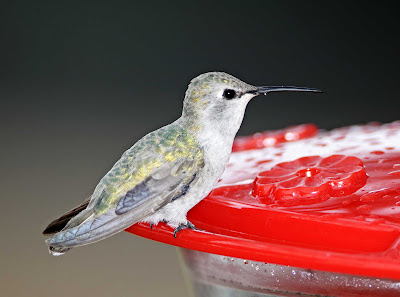
The Costa's Hummingbird (Calypte costae) is a very small (3.5") hummingbird of southern California and Arizona. I photographed a male bird last November in Tucson. This trip I got the female. She is IDed more by her shape. Notice the large round head and short thick neck. Also, the wing tips extend just beyond the tail.

Costa's Hummingbird - female
The familiar Rufous Hummingbird (Selasphorus rufus) is a small (3.75") hummingbird of the Pacific northwest. However, a few winter along the Gulf coast and I have been blessed to have had a few birds visiting my feeders the last 3 winters. The adult male is almost completely orange. We saw a single bird, but I wasn't able to get a photo. However, here is a juvenile male.

Rufous Hummingbird - juvenile male
Here is another juvenile male. He appears to have some sort of tumor on his face, as there is a tuft of feathers just above the beak.


Rufous Hummingbird - juvenile male
The female has less rufous and just a couple of red throat spots.

Rufous Hummingbird - female
Lastly we had a hybrid hummingbird. This was explained as a Lucifer x Costa's cross. The Costa's is evident with the purple crown. I am not sure how the Lucifer was delineated. The Lucifer does have a very narrow tail, and maybe this bird had that, but I didn't see it, if that was the case. They called it a Costifer Hummingbird for the parents.

Lucifer x Costas's Hummingbird - hybrid
Happy birding and photography,

David McDonald
dkmmdpa@gmail.com

photos copyright 2012 David McDonald

To have these trip reports sent to your email, please email me at the above address and ask to subscribe.

Tuesday, December 6, 2011

Bulletin #146 - Southeast Arizona#2 - hummers and sparrows

I spent a weekend in the Tucson, Arizona area with guide Melody Kehl. I was attempting to finish photographing the local birds, that I had missed on 3 previous visits.

One of my target birds was the last common North American hummingbird that I had not yet photographed. Melody took me to an arboretum with lots of flowers. She always found the bird here and we were not disappointed. The male Costa's Hummingbird (Calypte costae) is a real stunner with purple crown and throat extending onto the breast. He is a magnificent bird.


Costa's Hummingbird - male
The long extensions of the purple gorget are just long feathers as they stick out when the bird changes positions as can be seen in this male, while grooming.
Costa's Hummingbird
The female has a clean white throat, but grayish cheeks. Notice she has some yellow pollen on her bill.

Costa's Hummingbird - female
The juvenile male is starting to get some throat feathers. He also has pollen on his bell.

Costa's Hummingbird - juvenile male
As you all know, the beautiful gorget feathers of a male hummingbird appear gray or black until they catch the sunlight and then the color flashes. I assumed that when I started to photograph them, that using a flash would cause the gorget to show its color. Unfortunately, this doesn't usually happen. In most photos, the gorget appears dark, unless it is flashing when the photo is taken. This makes hummingbird photography even more challenging. Here is the male in shade with flash. the gorget just appears black.

Costa's Hummingbird - male
I took some photos of other hummers that we found. Here is a male Broad-billed Hummingbird (Cynanthus latirostris). This bird is IDed by blue throast, green back and breast and red bill.

Broad-billed Hummingbird - male
The Anna's Hummingbird (Calypte anna) is the only North American hummer with a red crown. This juvenile male has a start on his red throat and crown.

Anna's Hummingbird - juvenile male
Another target bird was the Baird's Sparrow (Ammodramus bairdii). This genus of sparrows all are distinguished by having flat heads and being very secretive and hard to see. The Baird's Sparrow nests in the southern prairie provinces of Canada as well as Montana and the Dakotas. It winters in west central Mexicao as well as the borders area from Big Bend in Texas to Arizona. This was a lifer for me as I had missed it on my Big Bend trip 2 years ago. It is IDed by the flat head, a necklace of black streaks that has a horizontal lower border - doesn't extend down onto the breast and some tan coloration under the streaks. I would have had a tough time figuring out this bird without Melody finding it for me.


Baird's Sparrow
Now, compare that bird to this Savannah Sparrow (Passerculus sandwichensis) that was seen in the same location. This very common sparrow can be very darkly streaked on the breast to fairly lightly streaked as this one is. It appears quite similar to the sparrow above, but the streaks extend onto the central breast and it lacks the tan color under the streaks. The head is more rounded as well.

Savannah Sparrow
The Brewer's Sparrow (Spizella breweri) at 5.5" in length is the smallest North American sparrow. This drab bird of the southwest is difficult to ID except by voice. Both times I have seen it was with a guide.

Brewer's Sparrow
From the smallest, hard to ID sparrow to one of the larger (7") easy ID sparrows, the White-crowned Sparrow (Zonotrichia leucophrys). This is an easy ID with large size, black and white striped crown, pink bill, and plain gray underparts.

White-crowned Sparrow
Happy birding and photography,

David McDonald
davidkmcdmd@yahoo.com

photos copyright 2011 David McDonald
To have these trip reports sent to your email, please email me at the above address and ask for subscribe.