Showing posts with label Mourning Warbler. Show all posts

Sunday, March 8, 2015

Bulletin 217 - Best of 10 years - #2 - warblers

There are 55 species of new world warblers in Sibley's birding guide, so selecting a dozen is a challenge, but here are my picks for the best of my first 10 years. I thought I would do them now with spring migration just around the corner.

The rarest bird in North America is the critically endangered Kirtland's Warbler. There are just several hundred pairs in the Jack Pine forests of northern Michigan. In the summer of 2013, I went there and took a tour into an area where they occur. They are easy to see as the males perch on top of the 6-8 foot trees to sing.


Kirtland's Warbler

The Connecticut Warbler is also a bird that we in Texas have to travel to see, as it migrates through Florida. I saw it on the same trip to Michigan. The gray hood and large white eye ring ID this warbler.


Connecticut Warbler

The Mourning Warbler was also seen on the Michigan trip. It can be found on the upper Texas coast both spring and fall, but is rare. The male is IDed by the gray hood, black breast band and no eye ring.

Mourning Warbler


There are 2 warblers in North America that occur only in Texas. Birders from Canada and the USA have to make a trip to Texas to see these ones. The endangered Golden-cheeked Warbler breeds only in the Hill Country of Texas. The male is IDed by the yellow face, black throat and black line through the eye.

Golden-cheeked Warbler
The Colima Warbler breeds in the Chisos Mountains in Big Bend National Park in west Texas. This is probably the most difficult bird I have photographed, as it took a whole day to hike up the trail to where they breed in the mountains. It is IDed by all gray color, yellow under the tail and the prominent eye ring.


Colima Warbler
Most warblers have some yellow coloration. However, this cute Red-faced Warbler from southeast Arizona, is gray with a red face and black hat.

Red-faced Warbler
The male Black-throated Blue Warbler has a blue back, black throat and prominent white wing patch. It is seen occasionally in spring and fall in southeast Texas.

Black-throated Blue Warbler
The last group are commonly seen during spring migration on the upper Texas coast. The dazzling male Blackburnian Warbler is my favorite.

Blackburnian Warbler


Another orange and black warbler is the male American Redstart.

American Redstart


The Yellow-throated Warbler is a common bird in the early spring. However, it was a nemesis bird for me to photograph. I finally got a photograph in 2010. It is IDed by the black and white overall color and bright yellow throat.
Yellow-throated Warbler


The male Bay-breasted Warbler  is striking with his rusty cap and flanks.


Bay-breasted Warbler

Happy birding and photography,

David McDonald dkmmdpa@gmail.com

photos copyright 2006 - 2015 David McDonald

To have these trip reports sent to your email, please email me at the above address and ask to subscribe.

Sunday, October 26, 2014

Bulletin 207 - fall birds

I have found some interesting birds the past few weekends. As you may recall, several months ago I featured the Common Nighthawk (Chordeiles minor) in both male and female plumages. They are very common at Anahuac NWR and one can easily see a dozen or more. In the Sibley bird guide, he also shows a juvenile plumaged bird which he lists as being found from July to September. He didn't point out the differences, and I studied the photos for a long time before I saw that the juvenile has white tips on the primary wing feathers. So I looked for a juvie at Anahuac and never saw one.

On Oct 12, I found this bird at LaFitte's Cove on Galveston. He has the white tips!

Common Nighthawk - juvenile
 
Another juvie was a male Belted Kingfisher (Ceryle alcyon). These birds tend to be skittish and when you try to approach them for a photo, they fly away. I saw this one on a post in a canal and stopped the car and took the photo out the window. The juveniles have a mahogany brown breast band, that gradually molts to blue the first fall. This one is partially molted.

Belted Kingfisher - juvenile male
One of the rarer warblers in Houston is the Mourning Warbler (Geothlypis philadelphia). I have probably seen it fewer than 5 times in 25 years here. I got my only photos in Michigan last summer. Here is a first winter plumaged bird at LaFitte's Cove on Oct 19th. Because it was the first juvenile plumaged bird, I wasn't sure what the ID was. Several experts confirmed it. The grayish hood is discernible and along with the dark breast band points to either Mourning or Connecticut, but the yellow throat is the field mark for Mourning.


Mourning warbler - 1st winter
The black streaky breast band is seen better in this photo. There is also a partial white eye ring which is lacking in the adults to add to the confusion. This is the first juvenile I have ever seen, and without a photo to review afterwards, I would not have known which bird it was.


Mourning warbler - 1st winter


Another juvenile was a Cooper's Hawk (Accipiter cooperii) who flew in and landed overhead at LaFitte's Cove. He was so close, I couldn't get the whole bird in the photo.

Cooper's Hawk - juvenile
 The last photo is of a skink I saw at the drip in Lafitte's Cove. It is a Broad-headed Skink juvenile. It is very colorful with orange head and blue and purple tail. The ID was made by a Texas reptile expert. When birds are slow, I photo other nature. This was a life reptile for me.

Broad-headed Skink - juvenile
 
 
 Happy birding and photography,

David McDonald dkmmdpa@gmail.com

Lisa Kelly-McDonald lisajanekelly67@yahoo.com

photos copyright 2006 - 2014 David McDonald & Lisa Kelly-McDonald

To have these trip reports sent to your email, please email me at the above address and ask to subscribe.


Thursday, June 13, 2013

Bulletin 176 - Michigan warblers

I had a birding trip to northern Michigan last weekend to photo the last of the eastern warblers that I did not have already. I was accompanied by my stepson Seth for his first birding trip and we had a good time birding and photographing together.

I employed a guide in the Upper Peninsula, Skye Haas. He doesn't have a web site yet, but his email is here. I would highly recommend him to anyone heading that way.

The rarest bird in North America is the Kirtland's Warbler. It is only found in the jack pine forests of northern Michigan, so anyone wanting to see all the birds has to make this trip to Grayling Michigan. The Michigan Audubon runs trips to see it. There are currently about 1000 pairs of birds left, however, in 1970 there were only 200 pairs, so the intensive recovery effort to save this bird is paying off.

Fortunately for birders, it breeds in areas where the pines are young and short. The males sit on top of the small trees to sing and are about 6-8 feet off the ground. This was of course a lifer, as it was my first trip there.


Kirtland's Warbler - male

Another lifer was the Connecticut Warbler. This bird doesn't migrate through Texas, so I had never seen it. The male has a gray hood, olive back and yellow breast. The complete white eye ring is an important field mark.

Connecticut Warbler - male
This photo shows the face a little clearer.

Connecticut Warbler - male

A similar, closely related bird is the Mourning Warbler. It also has the gray hood, olive back, and yellow belly. However, it has a black patch on the breast, and importantly, it lacks the eye ring. This bird is seen occasionally here in Houston, but I saw only one in the 7 years since doing photography and never got a picture.

Mourning Warbler - male
A beautiful bird is the Black-throated Blue Warbler. The male has a blue back, black face, throat and flanks and a white breast. Like the Mourning Warbler above, I had seen it only once in Houston since doing photography and missed the photo.

Black-throated Blue Warbler - male

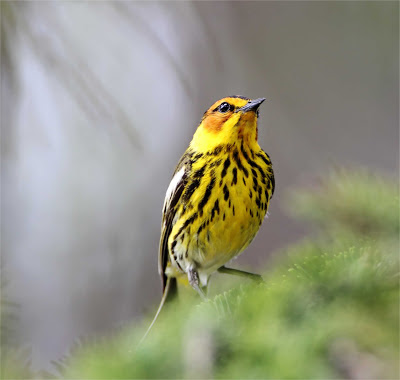
The last of the new warbler photos was the Cape May Warbler. The male is distinctive with bright yellow underparts with black streaking and rusty cheek patches. I had seen it before, but not once in the last 7 years.

Cape May Warbler - male
This second photo shows his underside

Cape May Warbler - male
It was a fantastic trip as I got all 5 warblers that I wanted to photograph.

Happy birding and photography,

David McDonald dkmmdpa@gmail.com

photos copyright 2013 David McDonald

To have these trip reports sent to your email, please email me at the above address and ask to subscribe.