The Icterids are a New World family of 109 species popularly called 'blackbirds'. They include blackbirds, cowbirds, and grackles. But many brightly colored birds are icterids such as orioles, meadowlarks, and the large tropical species of caciques and oropendolas.
The Tricolored Blackbird is an endangered bird of coastal California. Although it is not particularly colorful, it is distinguished from the more common Red-winged Blackbird by the white wing stripe. This bird also has a red wing patch above the white, but mostly it is hidden except when displaying. The best place to see this bird in the central California coast is the famous Moonglow Dairy north of Monterey, where this photo was taken.
 |
| Tricolored Blackbird - male |
His cousin the very common Red-winged Blackbird can be found all across North America in marshes. As above, the red patch is usually hidden except when displaying such as this one.
 |
| Red-winged Blackbird - male |
The Yellow-headed Blackbird breeds across western and central USA and western Canada. It can be found in winter in the Houston area in huge mixed blackbird flocks.
The male as a yellow head and breast with a white wing patch.
 |
| Yellow-headed Blackbird - male |
The Red-breasted Blackbird is actually the same genus as our meadowlarks. It is a resident from Costa Rica to central South America. The bright red underparts and black back are stunning.
 |
| Red-breasted Blackbird |
The distinctive Bobolink breeds across the northern states and southern Canada. It was a favorite of mine growing up in Ontario with his yellow patch across the back of the head. He also has a white rump and white wing patches. It can be seen in the Houston area late in migration (usually in May). I took this photo in northern Michigan.
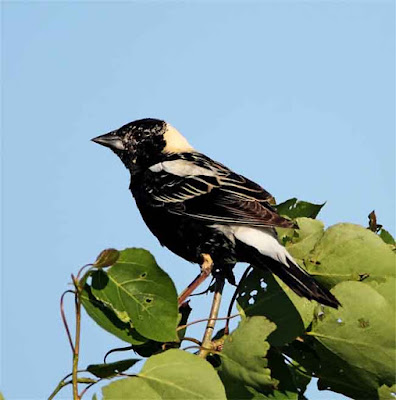 |
| Bobolink - male |
Orioles are generally orange and black or yellow and black. One exception is the common Orchard Oriole where the male is chocolate brown and black. It nests in the eastern and central USA and can be readily seen in spring migration. It also breeds in the Houston area.
 |
| Orchard Oriole - male |
There are 2 yellow and black orioles in the USA. The 9.5" Audubon's Oriole can be found in south Texas.
 |
| Audubon's Oriole |
The Bullock's Oriole is the western counterpart of the Baltimore Oriole. For a time in the 80's and 90's they were lumped together as Northern Oriole. It has a mostly orange head and extensive white on the wings.
 |
| Bullock's Oriole |
Our largest oriole is the 10" Altamira Oriole. It is another bird of the Rio Grande Valley in Texas.
 |
| Altamira Oriole |
The Black-vented Oriole is a resident of Mexico to Nicaragua. Periodically one will show up in south Texas. This was a lifer for me and it was photographed at Bentsen-Rio Grande State park in January 2012.
 |
| Black-vented Oriole |
An unusual oriole for the USA is the Spot-breasted Oriole. It is a resident of western Central America, but a small population can be found in Miami where presumably they were released cage birds. This bird in Miami is the only one of the species I have seen.
 |
| Spot-breasted Oriole |
The 11" Yellow-rumped Cacique is a resident from Panama to eastern South America. It has a pale yellow bill, blue eye and bright yellow rump.
 |
| Yellow-rumped Cacique |
Happy birding and photography,
David McDonald
dkmmdpa@gmail.com
photos copyright 2006 - 2015 David McDonald
To have these trip reports sent to your email, please email me at the above address and ask to subscribe.


