Showing posts with label Warbling Vireo. Show all posts

Sunday, December 2, 2012

Bulletin 164 - Fall/winter birds

I hope everyone had a wonderful Thanksgiving last weekend.

The majority of the fall migrants have passed through. However, a number of warbler species do winter over in limited numbers, according to the Checklist of Birds of the Upper Texas Coast.

The common winter resident warblers are Myrtle, Orange-crowned and Pine. So it is always fun to find some other species that are either very late migrants, or birds that have decided to go no further south.

Here is an Ovenbird that I found by the drip at LaFitte's Cove in Galveston on Oct 26th.

Ovenbird
And here is a Black-throated Green Warbler from Thanksgiving weekend.

Black-throated Green Warbler
This beautiful female Summer Tanager was also seen on Oct 26. According to the checklist, a few of this species also winter over here.

Summer Tanager - female
That same day also produced my first pair Lark Sparrows at LaFitte's Cove in Galveston. The distinctive facial pattern make this sparrow an easy ID.

Lark Sparrow
The White-tailed Kite (Elanus leucurus) is a beautiful all white raptor with black shoulder patches. I had been told about a pair of these birds nesting along Stewart Road in Galveston in a dead tree. It was difficult to get any photos of the birds on the nest as they sat very low down in the nest. Last weekend, the 3 babies had fledged. the family group of 5 birds were in the tree and 2 were on the wires beside the road. I stopped my car and took photos out of the car window. Using the car as a blind in this fashion doesn't disturb the birds like getting out of the car would.

Here is one of the adults. It is all white with a gray back and black shoulder patches.
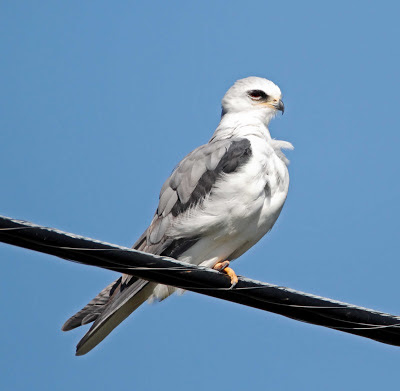
White-tailed Kite - adult
This was the first time that I had seen and photographed the juvenile plumage. They are washed on the head, breast and back with reddish brown.

White-tailed Kite - juvenile
Later I found another juvenile eating lunch on top of a post. The diet of these birds is insects and small rodents. Also notice on these juveniles, that the wing feathers are all edged in white.

White-tailed Kite - juvenile eating rodent
Now, what about that quiz bird form the last bulletin. Here it is again, a Yellow-throated Vireo.

Yellow-throated Vireo
The question was a missing field mark and why. I had a few people makes some guesses, but no one got the answer as to what was missing.

Here is a photo of another vireo.

Warbling Vireo
The field mark that isn't visible is the hook on the upper mandible. The beak is the differenting field mark of vireos from warblers. Warblers have thinner straight beaks. The vireos have thicker beaks and the upper mandible is hooked at the end.

Notice in the photo that the upper mandible of the quiz bird doesn't reach to the end of the lower mandible and the hook is not visible.

Why? I think the bird has a beak deformity. Here is a photo of the same bird head on and you can see the upper mandible is bent to the right. The hook is visible here and it almost looks like a crossbill.

Yellow-throated Vireo
I was interested in this phenomenon, as there had been an article in Birding magazine several years ago about beak deformities in Black-capped Chickadees in Alaska. I did a Google search for beak deformities and the only reference was the chickadees. So I guess it is a rare occurrence. I was pleased to get a photo of it. I only noticed it after getting home and looking at the photos on the computer and I knew something was wrong with the beak., Fortunately, I had a number of photos and could ascertain the problem. Thanks to those who took the time to send in their answers.

Happy birding and photography,

David McDonald   dkmmdpa@gmail.com

photos copyright 2012 David McDonald

To have these trip reports sent to your email, please email me at the above address and ask to subscribe.

Monday, May 31, 2010

Bulletin #112 – Spring Migration #7 misc birds

David McDonald Photography
Friendswood Texas

May 31, 2010

Bulletin #112 – Spring Migration #7 misc birds

Hello friends,

Here are the last of the photos from spring migration.


The first is the Northern Bobwhite (Colinus virginianus). This of course isn't a migrant, but a resident bird all year round. However, it is another of my nemesis birds and this is the first time I have seen this bird since starting photography in 2006. I have spent hours looking for one to photograph, and as luck would have it, one of the people who receive these bulletins happened to email me that they had a male in their backyard. I was invited to go over and immediately I jumped at the opportunity. Thanks Jim.


The bird is IDed by the black and white facial pattern.


Some young birds are already out of the nest here in SE Texas. Here is a juvenile Northern Cardinal (Cardinalis cardinalis). It is likely a female as there is no red on the breast. Notice that it is a juvenile by the black bill.


I also am interested in injured and or sick birds when I can find them. I have several photos of birds with injured feet. Here is a Swainson's Thrush (Catharus ustulatus) who was holding his right foot up.


As you have observed flocks of birds on the beach or on wires, they usually face into the wind. I assume this is to keep their feathers unruffled. Well sometimes, they get turned around. Here is a Tennessee Warbler (Vermivora peregrina) that appears to have a collar of feathers.


There are 6 vireo species that we find during spring migration. These are Red-eyed, White-eyed, Blue-headed, Yellow-throated, Philadelphia and Warbling. The Philadelphia and Warbling Vireos, at least for me, are the rarest and this year I saw 1 of each, but some years I don't find a single bird. These 2 also pose the most difficult ID problem for beginners.

Here is a Philadelphia Vireo (Vireo philadelphicus). Notice that it has a yellow throat. The black line extends through the eye to the beak, so that the lores (the area between the beak and eye) is dark.


In contrast, the Warbling Vireo (Vireo gilvus) has a white throat. The dark line just extends backwards from the eye. The lores are light. Here are a couple of photos of the same bird.


After the above photo, the Warbling Vireo flew to a branch by the drip (LaFitte's Cove). However, there was already an Indigo Bunting on the branch and they got into a squabble.


I managed to photograph the whole episode, so you can see the 7 photos and outcome in a slideshow here. Set the delay to 1 to speed it up. The photos are about 1/3 second apart in real time.

I will be leading a 9 day bird photography tour to Costa Rica in conjunction with Lillian Scott-Baer of Baer Travel March 3-11, 2011. We have worked out an itinerary to visit La Selva Preserve, Savegre Mountain Hotel in the central mountains for Resplendant Quetzal and other montane species and Wilson Botanical Gardens (Las Cruces). We have also retained the services of local guide Rudy Zamora to accompany us and locate and ID the birds for us to photograph. We will also have beautiful flowers and hopefully some mammals - tamanduas, monkeys etc.

I will be giving several talks in the evening on bird photography, Photoshop etc.


The price will be $1960 double to $2380 single. This includes hotels, all meals, guide, transportation in Costa Rica etc. The only other cost will be airfare and personal purchases (alcohol, souvenirs etc) . Space is limited to 10 persons to maximize our opportunity to see and photograph the birds. I have birded in Costa Rica previously. It is a wonderful country to visit and the bird life is exceptional. I hope that you can join us.


Here is the schedule of payments for the trip.


$ 25 reservation fee (not refundable)
$ 575 due April 30, 2010
$ 600 due July 30, 2010
$ 740 due January 15, 2011
Please send deposits to:


ScoBar Inc.
34 Galway Place
The Woodlands, TX 77382


Note - we will try to pair up singles and triple would be $1890 per person.


There are only 2 spaces left for this trip as of today, so please email me, if interested.


All comments and suggestions are welcomed and appreciated.


Happy birding and photography,

David McDonald

email: davidkmcd@comcast.net

photos copyright 2010 David McDonald

To have these trip reports sent to your email, please email me at the above address and ask for subscribe.