Wednesday, April 3, 2013

Bulletin 170 - early migrants

With the arrival of April, spring migration here is officially underway. However, some early migrants come in March and us hard core birders seek them out.

The Myrtle Warblers are getting yellow crown spots, This was the first time I recall noticing these crown patches.

Myrtle Warbler
Speaking of crown patches, the Orange-crowned Warbler keeps his patch hidden and the only time I have seen it was when one was bathing. I have never seen it otherwise and most birders will tell you it is never seen. Well this bird broke the rule. He kept his orange crown visible as he came to the drip at LaFitte's Cove Galveston last Friday.

Orange-crowned Warbler
Even this Nashville Warbler got in the act and showed the red feathers in his crown patch.

Nashville Warbler
A male Northern Parula came to the drip and posed nicely for a photo.

Northern Parula
A surprise bird was this Audubon's Warbler is almost full breeding plumage. This is the western form of Yellow-rumped Warbler and differs from the Myrtle Warbler above by having the yellow throat.


Audubon's Warbler
A couple of early Black-throated Green Warblers were found as well.

Black-throated Green Warbler
I was very pleased to find one of my nemesis birds, the Yellow-throated Warbler. This is only the third time in my life to see this common bird.

Yellow-throated Warbler
The Black-and-white Warbler is a favorite of mine. They work the trunks and larger limbs of trees in a style like a nuthatch.

Black-and-white Warbler
The Louisiana Waterthrush is the earlier of the waterthrushes to arrive. It is IDed by the long eye stripe going down the back of the neck as well as pink legs and buffy flanks.

Louisiana Waterthrush
An unusual find was a Calliope Hummingbird at LaFitte's Cove the last few weeks. This bird at 3.25" in length is the smallest North American bird. This was a juvenile male. My first photo on March 23, shows a few red throat feathers on the right side.

Calliope Hummingbird - juvenile male
By the next week, he had sprouted almost a full throat of feathers.

Calliope Hummingbird - juvenile male
I am looking forward to many more migrants coming through over the next month. I hope everyone can get out to see some of these birds as they pass through.

Happy birding and photography,

David McDonald
dkmmdpa@gmail.com

photos copyright 2013 David McDonald

To have these trip reports sent to your email, please email me at the above address and ask to subscribe.

Sunday, March 10, 2013

Bulletin 169 - Winter birds

The Upper Texas Coast (UTC) never ceases to amaze me with the rarities that show up here. In the last few years, we have had Ruff twice, first ABA record of Tropical Mockingbird, Fork-tailed Flycatcher, and 3 birds usually found in the arctic and Alaska that I missed on my Alaska trip in 2010. The first was lifer Smith's Longspur at New Years 2012, then a lifer Black-tailed Godwit last June and last month a juvenile Rough-legged Hawk on Galveston Island for my second sighting of that species.

The Rough-legged Hawk (Buteo lagopus)  is a large (21") buteo of the high arctic tundra in Canada and Alaska. It is listed as occasional in the UTC. However, I cannot remember in my 20 years birding, another mention of one, and there was no photo of it on the Houston Audubon web site. The males have dark streaks on the underside, but the juveniles and females have a black belly. This bird was easily seen over several weeks, as it hunted in the same area and returned to sit on top of a telephone pole. It was IDed as a female with the black belly, but when I posted my photos on Texbirds, an expert who has banded these hawks in Montana, sads it was a juvenile as the dark band was not on the underside of the tail. Notice the small bill and feet, an adaptation for the cold tundra. The legs have feathers and these can be seen in this photo.


Rough-legged hawk - juvenile on Galveston Island
Many ducks are found here in winter. I haven't shown many photos in the past couple of years, so yesterday I went out and took some.

Here is a male Northern Shoveler (Anas clypeata). The green head and brown and white body along with the huge bill make this guy an easy ID. However, in the photo, I had never seen the blue-gray feathers before. I checked Sibley and these are the upper wing coverts that usually are hidden unless the bird is in the air. So I always learn something new.

Northern Shoveler - male
In the last Bulletin, I showed and talked about the Redhead (Aythya americana). I had never seen them in the ponds at LaFitte's Cove on Galveston, but yesterday, there were almost a dozen birds. This male had his head stretched upwards in an unusual pose.

Redhead - male
Now look at this pair, swimming towards the camera. They have really fat cheeks, reminding me of chipmunks! I don't know whether all ducks have this peculiarly shaped head. I will have to watch more closely in the future.

Redhead - male

 Here is a female Lesser Scaup (Aythya affinis). She is all brownish except for the white spots behind the bill. Notice the small black spot on the end of the bill. This is called the nail and is very narrow like this in the Lesser Scaup and wider in ther Greater Scaup. Although some overlap occurs, it can be a good field mark to separate these species. It also happened to be my first photo of a female of this species.

Lesser Scaup - female
The last duck is probably my favorite, the smallest North American duck, the Bufflehead (Bucephala albeola). The males have black back, white body, dark iridescent head with a large white occipital quadrant.

Bufflehead - male
One of my favorite photos of ducks is when they rise out of the water and flap their wings. Here are a couple of photos of this duck doing just that.


Bufflehead - male
And another. In this one, despite the overcast day, you can get a hint of the iridescent purple on his head.


Bufflehead - male

So how do you get these neat action photos? If you have ever watched ducks for any length of time, occasionally they will bathe by ducking their head repeatedly under the water. After several times, they will always rise up like this and flap their wings back and forth a couple of times to dry off. So if you see a duck bathing, get ready to take some of these action shots.

Lastly as spring is here in Houston, our waders are getting their breeding plumage. For herons, they often change the color of the bare skin around the eye, as well as the bill getting very bright.

Here is a Reddish Egret (Egretta rufescens) with a bright blue patch of bare skin, and very pink base of the bill.

Reddish Egret - breeding
I just noticed that I crossed the 50,000 hits mark on this blog.

Happy birding and photography,

David McDonald
dkmmdpa@gail.com

photos copyright 2013 David McDonald

To have these trip reports sent to your email, please email me at the above address and ask to subscribe.

Sunday, February 17, 2013

Bulletin 168 - South Padre Island area

There was an exceptionl find of a rare bird on South Padre Island in January. This was a Flammulated Owl (Megascops flammeus). This small (6.75") migratory owl is likely the most difficult owl in North America for birders to find and see. One was located in a clump of bushes and trees at the South Padre Island Convention Center.

Lisa and I flew down for a weekend to try and see and photograph this bird that would be a lifer for both of us.

We did see the bird, but unfortunately, he kept himself very well hidden in the middle of the thicket and was almost totally obscurred by leaves.

Occasionally you could see the outline of the bird and perhaps 1/2 the body.  He is identified by the gray color with reddish streaks on his face and body. I did catch some red streaking a couple of times, so I know this was the bird. Also, there were dozens of other birders there, as this was only the second winter record for Texas of this species.

So here is the best of my photos which shows about 1/2 the bird. If you look at the blue sky in the middle, the gray feathers of the bird can be seen immediately to the left of the blue and below.

Flammulated Owl - South Padre Island

While we were waiting and hoping for the Flammulted Owl to come out of hiding, a female Western Tanager (Piranga ludoviciana) foraged in the thicket as well. This bird is yellow with 2 white wing bars. It was my first photo of a female. It was quite an unexpected find as this species normally winters in Central America.

Western Tanager - female
There is a very nice nature and birding center adjacent to the SP convention center. Lisa and I saw an American Bittern right under the boardwalk and too close to photograph. We watched it skulk through the reeds for at least 15 minutes. It was another lifer for her and so close too!

Here is a cute Pied-billed Grebe (Podilymbus podiceps) in the marsh at the nature center. It is in the winter plumage and has lost the ring around his bill.

Pied-billed Grebe - winter

Redheads (Aythya americana) are colorful ducks with the male exhibiting a very rounded red head. The similar Canvasback has a reddish brown head and a very sloped forehead . 90% of the North American population of Redheads winter in the Laguna Madre, the bay between South Padre Island and the mainland. Thus, large rafts of these birds can be seen in this area. Here were a few at the nature center on SPI.

Redheads
Northern Caracaras (Caracara cheriway) are distinctive raptors tha belong to the falcon family. Even though I have photgraphed them numerous times, their coloration, bare facial skin, and huge beak always make them an ideal subject.

The adult has a black head and body, with orange face and yellow feet.

Northern Caracara - adult
He allowed me to approach in my car, right beside him, for an extreme close-up portrait. Notice the fluffy neck feathers and shaggy crest.

Northern Caracara - adult
A while later I found this juvenile. He has a pink face, brown body and gray legs. Sibley shows the first year juvenile with a black head. I guess this might be a very young bird, as the head is obviously brown.

Northern Caracara - juvenile
 There was a butterfly enjoying some flowers while we were looking for the Flammulated Owl, so I had to photograph it as well. It superficially looked like a Monarch, but I knew the wing shape wasn't quite right. Here it is on a flower.


Queen - male

And here it is with his wings spread out.

Queen - male
I looked in my butterfly book and it is a Queen (Danaus gilippus). This is the same genus as the Monarch. Notice there are no black veins in the top of the wings above. Also, the 2 black dots in the hind wing seen in the second photo identify it as a male!

Happy birding and photography,

David McDonald
dkmmdpa@gmail.com

photos copyright 2013 David McDonald

To have these trip reports sent to your email, please email me at the above address and ask to subscribe.

Monday, January 14, 2013

Bulletin 167 - other Maui birds

One of the Hawaiian birds that has been a nemesis bird for me, is the Nene or Hawaiian Goose. The best spot to see the bird is in Haleakala National Park on the summit of the volcano. I had been to Maui previously and missed it on at least 2 occasions. Finally, on my second drive up the mountain I found it just as I was leaving.

The Nene (Branta sandvicensis) is a medium sized brown goose with black head and face and a beige neck with deep dark furrows giving a striped appearance. They are endangered but captive breeding programs have enabled them to be released back into the wild. This population on the volcano in Maui has retreated to the higher elevations (6000-8500') to avoid predation from the introduced mongoose. This bird is banded as can been seen so was probably a released bird. They are often seen along the road, eating the lush green grass along the shoulder of the road. The Nene is the state bird of Hawaii.

Nene
The Hawaiian Duck (Anas wyvilliana) is also known as the Koloa. They look like female Mallards, and are usually are found in pairs. I found this pair at the Kaelia Ponds. It was a lifer for me.

Hawaiian Duck
An unusual find at the Kaelia Ponds was a pair of White-faced Ibis (Plegadis chihi). This wader from the USA and western Mexico must have been blown over in a storm. I was lucky to see such an unusual bird in Maui. Of course it is a local bird here in the Houston area.

White-faced Ibis - Kaelia Ponds Maui
As oceanic islands, Hawaii has a number of seabirds. Surprisingly, there are no gulls except an occasional North American gull that arrives in a storm. However, they do have a number of oceanic seabirds and many species nest in the chain of islands. I found a number of these birds on offshore rocks along the coast on the famous 'road to Hana'. All 3 were lifers for me.

The first was the Black Noddy (Anous minutus). The local name is Noio. Noddies are closely related to terns. This charcoal bird has a white top of head. The race on the main islands has orange legs, while the others have black legs. This species occurs rarely in the Florida Keys in the ABA area.

Black Noddy
The local race of frigatebirds is the Great Frigatebird (Fregata minor). The local name is Iwa. These long-winged slender black birds harass other seabirds to release their catch, which the frigatebird then swoops down and seizes. They are black with the male having a red throat patch. Females have white breasts and the immatures have white heads and breasts. They also have deeply forked tails. Here is a female.

Great Frigatebird - female
The last seabird I managed to photograph was a Red-footed Booby (Sula sula). This is a juvenile with some brown streaking on the body.

Red-footed Booby - immature
Happy birding and photography,

David McDonald
dkmmdpa@gail.com

photos copyright 2012 David McDonald

To have these trip reports sent to your email, please email me at the above address and ask to subscribe.


Wednesday, January 2, 2013

Bulletin 166 - Maui forest birds

The Hawaiian Islands have the dubious distinction of having the most species of birds that have become extinct, of any place in the world. Why is this? As the most isolated archipelago, most native species were endemic to the islands. When the Polynesian settlers arrived from Tahiti about 800AD, the islands were completely forested. The Polynesians brought alien plants and animals with them to the islands and started clearing land for agriculture. It is estimated from fossil remains that 45 species of birds, went extinct in the next 1000 years.

Europeans arrived after 'discovery' of the islands by Captain Cook in 1778. They brought more alien plants as well as sheep, goats, cattle, horses, pigs, dogs, cats and rats. The grazing animals decimated the local flora, and native birds were forced higher on the mountains to find their usual food sources.

As we saw in the last bulletin, many species of shorebirds migrate back and forth from Hawaii to other continents. These birds carry diseases like avian malaria and avian pox. However, there were no native mosquitoes on Hawaii to transmit the disease to the local birds. In mid 1800s, there was a release of mosquito larvae from a ship's water tanks. This spread these diseases to the local birds who had no natural resistance at all. Fortunately, the mosquitoes breed only up to about 3000' elevation, so on those islands with tall mountains, (Kauai, Hawaii, Maui) there remained disease free areas still.

A further 25 species have gone extinct since the settlement by Europeans. Several species have become extinct in the last 20 years and some other critically endangered ones, are being bred in captivity in attempt to preserve them. For further reading and pictures of these beautiful birds that are gone forever, see this page.

On Maui, the only place to see some of these remaining rare birds is Hosmer Grove and the Waikamoi Preserve managed by the Nature Conservancy. Both places are in Haleakala National Park. I was fortunate to get the services of a docent to take me into the Nature Conservancy preserve, as access is severely restricted.

2 birds in the latest guide book by the Hawaii Audubon Society (2005) edition are extinct..the Poouli, and Nukupuu were last seen on Maui in the 1990s. so the rarest bird left is the Maui Parrotbill (population estimated about 500) which I did not see. The docent says he finds them about once a month making 2-3 visits per week.

The Akohekohe (Palmeri dolei) or Crested Honeycreeper is the 2nd rarest extant Maui endemic with a population estimated at 3,500 birds. It is a 7" predominately black bird with reddish orange nape of neck and similar colored spots on flanks. It was a cold raining day on my visit, but I did see a single bird and got 1 quick photo. A lifer for me, as I missed it on previous visits to Maui. I need to return to get a better photo!

Akohekohe
The Maui Alauahio (Paroreomyza montana) is also known as the Maui Creeper. It is a Maui endemic bird that is fairly common in native trees. It is yellow (male) to olive green (female).

Maui Alauahio - male
The Maui Amakihi (Hemignathus virens wilsoni) is an endemic subspecies of the Hawaii Amakihi and potential split, as the Amakihi complex was recently split in to 3 species. It is fairly common and unlike the other native birds, does frequent non-native trees. This photo was taken at the Hosmer Grove campground, not in the preserve. It is olive with black lores and curved bill.

Hawaii Amakihi - Maui subspecies
There are 2 red birds with black wings that occur on all the main islands. The Iiwi (Vestiaria coccinea) is often illustrated in books on Hawaii due to its remarkable curved red beak. It is completely red below. The sexes are similar. Here it is on an ohia blossom, a favorite food source and a good place to watch for this bird.

Iiwi
In contrast, the Apapane (Hematione sanguinea) has a short black beak and white belly. It also visits ohia blossoms. This is an adult. The juveniles are olive green.

Apapane - adult
Lastly, no photo tour of Maui would be complete without a picture of the Haleakala Silversword (Argyroxiphium sandwicense). This plant, a member of the daisy family is found in Haleakala National Park at elevations of 7000 feet to the summit at 10,000 feet on the volcano.

Haleakala Silversword
Happy birding and photography,

David McDonald
  dkmmdpa@gmail.com

photos copyright 2012 David McDonald

To have these trip reports sent to your email, please email me at the above address and ask to subscribe.

Friday, December 21, 2012

Bulletin 165 - Maui#1 marsh and shorebirds

Lisa and I spent last week on Maui supposedly attending a wedding. However, the wedding was cancelled, so we had the honeymoon in Hawaii!

There are a number of familiar North American breeding shorebirds, that winter on Maui, so it was fun to see them again. Maui has 2 wetland areas, both of which are wildlife refuges. The commonly occurring birds have local Hawaiian names but some of the rarer birds do not.

The Hawaiian Coot (Fulica alae) is known locally as 'Alae Ke'oke'o. It was recently split as a separate species from the American Coot. It looks identical. It is an endangered species. I had seen the coot on an earlier trip to Maui before the split, so it was not a lifer.

Hawaiian Coot
The local subspecies of Black-necked Stilt (Himantopus mexicanus) is also endangered. Locally it is known as the Ae'o. The population was estimated at 1300 birds in the islands a decade ago. Like the coot above, this might be a potential split in the future.


Black-necked Stilt
The familiar Black-crowned Night-Heron (Nycticorax nycticorax) is known locally as 'Auku'u.

Black-crowned Night-Heron

The most common shorebird is the Pacific Golden-Plover (Pluvialis fulva). The local name is Kolea. As well as in the wet lands, this bird is found on lawns, golf courses etc all over the islands. In North America, however, it is found only in western Alaska while breeding, and occasionally as a vagrant along the west coast. Here are a couple of photos of the plover. Some golden feathers can still be seen on the back.

Pacific Golden-Plover

Pacific Golden-Plover
The next 4 birds were all firsts for me in Hawaii. The Ruddy Turnstone (Arenaria interpres) is known as the 'Akekeke. It was fairly common in the pond areas and is IDed by the bright orange legs.

Ruddy Turnstone
Some Sanderlings (Calidris alba) also winter in Hawaii, where they are known as Hunakai.

Sanderling

The last of the common wintering shorebirds I found was the Wandering Tattler (Heteroscelus incanus). Its local name is 'Ulili. This 11" shorebirebird is all gray with a white belly and yellow legs. It is found on the west coast of North America, but seldom in the east. I have only seen it a few times in the past.


Wandering Tattler
The last shorebird is uncommon in Hawaii and does not have a local name. It isn't even illustrated in the Audubon Hawaiian Birds guide. A local survey of birds on Maui had been done a couple of weeks before and found just one of this species, so it was a stroke of luck to see it on a large mud flat among hundreds of other birds. This is the Semi-plamated Plover (Charadrius semipalmatus). This bird summers in Alaska and mostly winter in the Americas, but a few must head over the ocean to Hawaii.


Semi-palmated Plover - Maui
Happy birding and photography,

David McDonald
dkmmdpa@gmail.com

photos copyright 2012 David McDonald

To have these trip reports sent to your email, please email me at the above address and ask to subscribe.

Sunday, December 2, 2012

Bulletin 164 - Fall/winter birds

I hope everyone had a wonderful Thanksgiving last weekend.

The majority of the fall migrants have passed through. However, a number of warbler species do winter over in limited numbers, according to the Checklist of Birds of the Upper Texas Coast.

The common winter resident warblers are Myrtle, Orange-crowned and Pine. So it is always fun to find some other species that are either very late migrants, or birds that have decided to go no further south.

Here is an Ovenbird that I found by the drip at LaFitte's Cove in Galveston on Oct 26th.

Ovenbird
And here is a Black-throated Green Warbler from Thanksgiving weekend.

Black-throated Green Warbler
This beautiful female Summer Tanager was also seen on Oct 26. According to the checklist, a few of this species also winter over here.

Summer Tanager - female
That same day also produced my first pair Lark Sparrows at LaFitte's Cove in Galveston. The distinctive facial pattern make this sparrow an easy ID.

Lark Sparrow
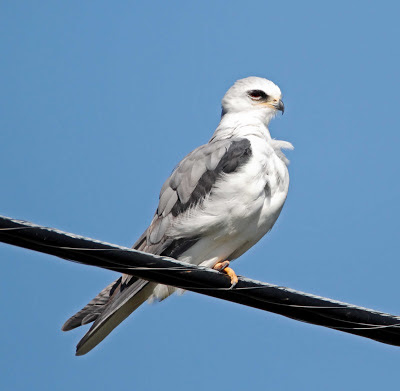
The White-tailed Kite (Elanus leucurus) is a beautiful all white raptor with black shoulder patches. I had been told about a pair of these birds nesting along Stewart Road in Galveston in a dead tree. It was difficult to get any photos of the birds on the nest as they sat very low down in the nest. Last weekend, the 3 babies had fledged. the family group of 5 birds were in the tree and 2 were on the wires beside the road. I stopped my car and took photos out of the car window. Using the car as a blind in this fashion doesn't disturb the birds like getting out of the car would.

Here is one of the adults. It is all white with a gray back and black shoulder patches.

White-tailed Kite - adult
This was the first time that I had seen and photographed the juvenile plumage. They are washed on the head, breast and back with reddish brown.

White-tailed Kite - juvenile
Later I found another juvenile eating lunch on top of a post. The diet of these birds is insects and small rodents. Also notice on these juveniles, that the wing feathers are all edged in white.

White-tailed Kite - juvenile eating rodent
Now, what about that quiz bird form the last bulletin. Here it is again, a Yellow-throated Vireo.

Yellow-throated Vireo
The question was a missing field mark and why. I had a few people makes some guesses, but no one got the answer as to what was missing.

Here is a photo of another vireo.

Warbling Vireo
The field mark that isn't visible is the hook on the upper mandible. The beak is the differenting field mark of vireos from warblers. Warblers have thinner straight beaks. The vireos have thicker beaks and the upper mandible is hooked at the end.

Notice in the photo that the upper mandible of the quiz bird doesn't reach to the end of the lower mandible and the hook is not visible.

Why? I think the bird has a beak deformity. Here is a photo of the same bird head on and you can see the upper mandible is bent to the right. The hook is visible here and it almost looks like a crossbill.

Yellow-throated Vireo
I was interested in this phenomenon, as there had been an article in Birding magazine several years ago about beak deformities in Black-capped Chickadees in Alaska. I did a Google search for beak deformities and the only reference was the chickadees. So I guess it is a rare occurrence. I was pleased to get a photo of it. I only noticed it after getting home and looking at the photos on the computer and I knew something was wrong with the beak., Fortunately, I had a number of photos and could ascertain the problem. Thanks to those who took the time to send in their answers.

Happy birding and photography,

David McDonald   dkmmdpa@gmail.com

photos copyright 2012 David McDonald

To have these trip reports sent to your email, please email me at the above address and ask to subscribe.