Monday, July 8, 2013

Bulletin 178 - Michigan #3 more birds and other things

I had a birding trip to northern Michigan in early June. I was accompanied by my stepson Seth for his first birding trip and we had a good time birding and photographing together. Also, we met some friends (Dutch and Bonnie Zonderman) from Northern Michigan and birded with them the first day to see the Kirtland's Warbler.

I employed a guide in the Upper Peninsula, Skye Haas. He doesn't have a web site yet, but his email is here. I would highly recommend him to anyone heading that way.
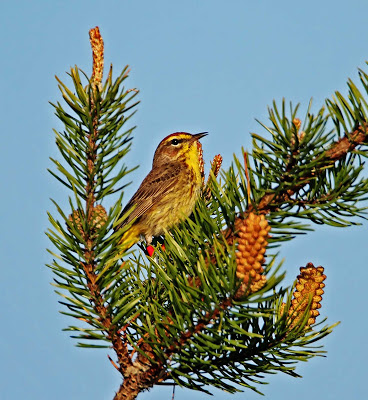
We got nice views of a banded Palm Warbler (Setophaga palmarum). You can see red bands on the , legs. This warbler is IDed by the rufous cap, brown back and yellow underparts and rump.

Palm Warbler

Here is a 3rd year Bald Eagle. It takes them 4 full years to get their adult plumage complete.

Bald Eagle - 3rd year
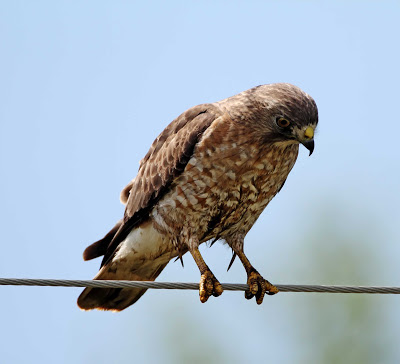
One raptor I needed was an adult plumaged Broad-winged Hawk (Buteo platypterus). This one perched on a phone wire was intent on a meal in the ditch below and didn't mind when we parked right beside him.


Broad-winged Hawk - adult
A moment later he pounced on a small mammal in the ditch beside the road, almost at our feet.

Broad-winged Hawk - adult
As he flew off, our guide saw the mammal in his talons and said it was a Star-nosed Mole.


Perhaps the most interesting finding on the trip was a pair of Sandhill Cranes (Grus canadensis), with 2 chicks only a couple of days old. The group was walking across the highway. All the cars stopped fortunately. One of the parents called the chicks down into the ditch. The other walked away from the group and proceeded to do the broken wing act to draw attention away from the chicks. I have seen Killdeers do this, but never such a large bird. Skye said he had seen that performance only 1 time previously with the cranes.

Here is the 2 day old chick.

Sandhill Crane - chick
Here is the one parent putting on the broken wing performance on the road.

Sandhill Crane - adult
He continued to walk farther away from his mate and the chicks and went down in to the roadside ditch. He then spread both his wings apart. Both parents were calling to each other while this was occurring.

Sandhill Crane - adult

Here is the other adult in the sunlight. Notice how rusty reddish the plumage is. I did not know that these cranes looked that color. It doesn't show in the bird guides. They are overall gray with a few rusty wing feathers. Skye said it was peculiar to that area, as there is a lot of iron in the ground water. When the birds preen, they put water on their feathers and gradually they become that rust color. Interesting!

Sandhill Crane - adult
Rusty colored due to iron in ground water
We were hoping to see some large mammals, but struck out. We did have an encounter with a Porcupine (Erethizon dorsatum). He was in a large open field, and when we got out, Seth left his car door open. We were photographing him and he circled around back to the car. I was afraid he would get into the car, but instead crawled under. This is my first photo of this mammal.

Here he is in defensive posture with the quills raised up on his back.


Porcupine
From behind, he is well armed. Pity the poor dog who takes on a porcupine and gets a face full of the quills.

Porcupine - from the back

As he got further away, he let his quills down.

Porcupine
We also found a good sized Snapping Turtle (Chelydra serpentina).

Snapping Turtle
Happy birding and photography,

David McDonald dkmmdpa@gmail.com

photos copyright 2013 David McDonald

To have these trip reports sent to your email, please email me at the above address and ask to subscribe.

Sunday, June 30, 2013

Bulletin 177 - other birds, wildflowers, and butterflies in Michigan

I had a birding trip to northern Michigan in early June. I was accompanied by my stepson Seth for his first birding trip and we had a good time birding and photographing together. Also, we met some friends (Dutch and Bonnie Zonderman) from Northern Michigan and birded with them the first day to see the Kirtland's Warbler.

I employed a guide in the Upper Peninsula, Skye Haas. He doesn't have a web site yet, but his email is here. I would highly recommend him to anyone heading that way.

This bird was a lifer for me. I had spent probably 3 entire days looking for it previously, first in the Sierras of Northern California and then in Duluth, Minnesota in winter. Finally I got it. The third time was the charmer. This bird is the Black-backed Woodpecker (Picoides arcticus). This woodpecker prefers trees killed by forest fires. Fortunately for me, there had been a small fire last year, and Skye found several pairs nesting in the burned forest. So here is the male. It has an all black back, black head and white stripe below the eye.

Black-backed Woodpecker - male
And he then flew to the nest hole that was only about 4' off the ground. Notice how he chipped off the burned bark below the hole.

Black-backed Woodpecker - male
This bird has 2 features not seen in most of the North American woodpeckers. Can you find them?
The male has a yellow patch on his head rather than red. Also, there are 3 toes on each foot, rather than the usual 4. The female would be similar, but she lacks the yellow patch on the head.

Another lifer was the Winter Wren (Troglodytes hiemalis). This tiny (4") hyperactive bird stayed deep in the brush, frustrating our attempts to get any photos.Finally, he popped into a small clearing among the branches and was spotted by Seth. I got off a couple of photos. As you know, this bird was split into Winter Wren and Pacific Wren several years ago. I had only seen the Pacific form in California. Thus I needed to see the eastern form as it was now a full species. It is IDed by the brown overall color, whitish spots and the short cocked up tail.

Winter Wren
The Bobolink (Dolichonyx orizyvorus) is a (7") member of the icterid or blackbird family. Its range is southern Canada and northern USA, east of the Rockies. It migrates through eastern USA with Houston being on the extreme western edge of the route. I remember this attractive bird from my childhood in Canada, but had seen it only twice in 20 years in Houston. It tends to be a late migrant in early May.

The male shown here has a black body, white rump and wing patches and a distinctive yellow occipital patch. The female and winter males are streaked brown like a large sparrow. He still has a few brownish feathers on his face, so has not completely finished molting.

Bobolink - breeding male
Seth got a great photo of him flying which shows the field marks.

Bobolink - breeding male
Photo by Seth Kelly
 
We found several species of flycatchers. The first is the Olive-sided Flycatcher (Contopus cooperi). This is a medium sized (7.5") flycatcher of the northern woods. It likes to perch on the tops of trees. It has one a memorable song "Quick..3 beers" and that is exactly what it sounds like!
It is IDed by the dark vest, no eye ring and faint or no wing bars.

Olive-sided Flycatcher
The empids are small flycatchers that have both eye rings and wing bars. Many of them are difficult to ID by appearance and can only be IDed by voice. The Yellow-bellied Flycatcher (Empidonax flaviventris) has yellow underparts.

Yellow-bellied Flycatcher
Two closely related species were formerly lumped together as Traill's Flycatcher until split about a decade ago. The Alder Flycatcher (Empidonax alnorum) is a small (5.75") flycatcher of the north woods of Canada and eastern USA, preferring alders as its name suggests. I had seen this bird in Houston in fall migration.

Alder Flycatcher
The second one is the Willow Flycatcher (Empidonax traillii). It is the same size as the alder, but it range is south of the Alder above, but ovelap occurs. It likes to be near water in willows. Our guide, Skye Haas, said this bird didn't occur on the Upper Peninsula, but told us of a place to check on our way back to the airport.

This location was Shiawassee NWR outside Saginaw Michigan. So Seth and I got up early and were able to take the 1 hour driving tour through the refuge. At the first group of willows we came to, we stopped and played the tape. Out popped several of the birds. This was another lifer for me. How easy to find the birds in the right location! Notice he has almost no eye ring, compared to the two empids above.

Willow Flycatcher
Other flycatchers seen were Eastern Kingbird, and Great-crested Flycatcher.

As this was spring in the north woods, there was a profusion of butterflies, wildflowers etc, all awakening from the long winter. We saw 2 species of wild orchids.

The first is the Pink Lady's-Slipper or Moccasin-Flower (Cypripedium acaule).

Pink Lady's-Slipper
There was also a similar yellow orchid, but I wasn't able to find the ID on line.


Yellow Orchid - upper peninsula Michigan

 
Several interesting butterflies were seen. The first is the Canadian Tiger Swallowtail (Papilio canadensis). The range is Alaska, Canada and USA along the Canadian border.

Canadian Tiger Swallowtail

The next one occurs all over the USA and Canada, althought I don't recall ever seeing it before.
It is the Mourning Cloak (Nymphalis antiopa).

Mourning Cloak
The Eastern Comma (Polygonia satyrus) has very indented wings.

Eastern Comma
Lastly a tiny. thumbnail sized butterfly, the Spring Azure (Celastrina ladon). This tiny butterfly has azure blue upper wings, but when perched has its wings closed, so only the spotted underside is visible.

Spring Azure

Happy birding and photography,

David McDonald davidkmcd@ymail.com

Lisa Kelly-McDonald lisajanekelly67@yahoo.com

photos copyright 2013 David McDonald and Lisa Kelly-McDonald

To have these trip reports sent to your email, please email me at the above address and ask to subscribe.


Thursday, June 13, 2013

Bulletin 176 - Michigan warblers

I had a birding trip to northern Michigan last weekend to photo the last of the eastern warblers that I did not have already. I was accompanied by my stepson Seth for his first birding trip and we had a good time birding and photographing together.

I employed a guide in the Upper Peninsula, Skye Haas. He doesn't have a web site yet, but his email is here. I would highly recommend him to anyone heading that way.

The rarest bird in North America is the Kirtland's Warbler. It is only found in the jack pine forests of northern Michigan, so anyone wanting to see all the birds has to make this trip to Grayling Michigan. The Michigan Audubon runs trips to see it. There are currently about 1000 pairs of birds left, however, in 1970 there were only 200 pairs, so the intensive recovery effort to save this bird is paying off.

Fortunately for birders, it breeds in areas where the pines are young and short. The males sit on top of the small trees to sing and are about 6-8 feet off the ground. This was of course a lifer, as it was my first trip there.


Kirtland's Warbler - male

Another lifer was the Connecticut Warbler. This bird doesn't migrate through Texas, so I had never seen it. The male has a gray hood, olive back and yellow breast. The complete white eye ring is an important field mark.

Connecticut Warbler - male
This photo shows the face a little clearer.

Connecticut Warbler - male

A similar, closely related bird is the Mourning Warbler. It also has the gray hood, olive back, and yellow belly. However, it has a black patch on the breast, and importantly, it lacks the eye ring. This bird is seen occasionally here in Houston, but I saw only one in the 7 years since doing photography and never got a picture.

Mourning Warbler - male
A beautiful bird is the Black-throated Blue Warbler. The male has a blue back, black face, throat and flanks and a white breast. Like the Mourning Warbler above, I had seen it only once in Houston since doing photography and missed the photo.

Black-throated Blue Warbler - male

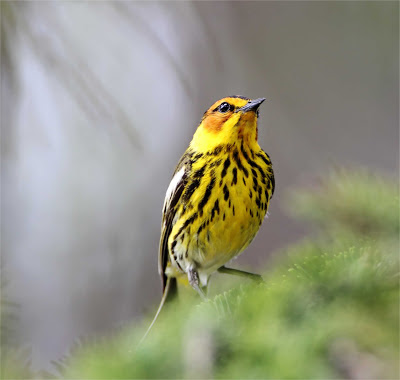
The last of the new warbler photos was the Cape May Warbler. The male is distinctive with bright yellow underparts with black streaking and rusty cheek patches. I had seen it before, but not once in the last 7 years.

Cape May Warbler - male
This second photo shows his underside

Cape May Warbler - male
It was a fantastic trip as I got all 5 warblers that I wanted to photograph.

Happy birding and photography,

David McDonald dkmmdpa@gmail.com

photos copyright 2013 David McDonald

To have these trip reports sent to your email, please email me at the above address and ask to subscribe.

Thursday, May 23, 2013

Bulletin 175 - odds and ends from the spring

There were a couple of interesting and rare birds  at the end of migration.

The first I saw with my buddy from NYC on Sunday April 28th at the Texas A&M woodlot on Galveston Island. It was a nightjar that flushed up from close to the ground and landed on a dead fallen tree. We observed it closely for about 20 minutes as it flew back and forth between perches. The 3 nightjars here in Galveston, are the Common Nighthawk, Whip-poor-will (WPW) , and Chuck-will's-widow (CWW). I had been hoping to find a Whip-poor-will to photograph. The Common Nighthawk has very long wings that extend beyond the tail. The other 2 have shorter wings and the tail extends to or beyond the wings. This bird became an ID challenge.

Here are my first 2 photos of the bird perched, both showing the tail as longer than the wings.


Also, we clearly saw that when it flew, it had a buffy stripe across the wing near the tip. I knew that Common Nighthawks of both sexes, have a white stripe across the wing. So both of these marks, the shorter wings and no white wing bar, led me to believe it wasn't a Common Nighthawk. I have photographed several CWWs and they have a very dark brown throat. Obviously not our bird. So by default, I was left with an ID of a Whip-poor-will. I have never seen them flying, so I didn't know what they looked like aloft.

I posted the images to Texbirds, and had a few responses, but the important one was that this bird is a Nighthawk. Only in Sibley can you find the field mark shown of the white feathers under the edge of the wing at the shoulder when perched. This bird clearly had those white feathers at the shoulder. This IDs the bird as a nighthawk.

So I was disappointed that I didn't have a WPW photo, but what was this bird? I want back to the same place after work the next day on Monday 29th and fortunately, he was still there and I had a chance to look at it again. Definitely, it had a buffy wing bar. The only other nighthawk possible is a Lesser Nighthawk. This bird is a bird of the south Texas to south Arizona. It is listed as an occasional vagrant here, but I can only recall a couple of mentions in my 20+ years birding here. The female Lesser Nighthawk (Chordeiles acutipennis) does have a buffy wing stripe and the male has a white one. Bingo! Also, the Lesser Nighthawk has a tail as long or longer than the wing tips.

The other interesting thing was that a Lesser Nighthawk had been reported at the west end of Galveston Island 2 weeks before. The next week, one was positively IDed at LaFitte's Cove in the center of the island. Then I had this bird at the extreme east end. The following week, a Lesser was found at High Island, a further 40 miles east along the coast. It appears that this bird was moving slowly up the coast.

The other important field mark is small buffy spots on the primary wing feathers of a Lesser. This can be seen in this photo.

Lesser Nighthawk - female
Here is a Common Nighthawk (Chordeiles minor) for comparison. Notice the white patch on the primary feathers, but there are no buffy spots at all.

Common Nighthawk
So this was a great find. I have never seen a Lesser Nighthawk perched before as they normally roost on the ground. I only had a couple of photos in the air.

The other rare bird was the European subspecies of Whimbrel (Numenius phaeopus) found by an astute birder on Bolivar. This distinct subspecies (N. phaeopus phaeopus) has a white back, rump and tail. The local subspecies (N. phaeopus hudsonicus) is all brownish. This subspecies is a rare visitor to the Atlantic states (perhaps 6 records). There is also a Siberian subspecies that has a few records for Alaska and also has the white back and rump. This is the first Texas record of this subspecies.

The Whimbrel has already been proposed to be split into 2 species, Hudsonian Whimbrel and Eurasian Whimbrel. The British Ornithology society as well as the International Ornithologists' Union are both considering this split. So it is neat to have the bird already recorded prior to the split.

Here is an article I found discussing the proposed split and why some of these similar species in North America and Eurasia eventually drift apart genetically.

So here is the bird. The curved bill and striped head indicate the Whimbrel. The white back, rump and tail are obvious.

Eurasian Whimbrel
Large owls often eat small rodents and as they eat them whole, they regurgitate the fur and bones in a lump called a 'pellet' after the digestive process. I found a pile of these pellets at a spot in LaFitte's Cove. They appeared like a glob of mud. However, a close up shows it is mostly fur.


Owl pellet
I pulled it apart and sure enough, there were numerous small bones.

Owl pellet
Lastly, we had a pleasant surprise at home when we first unfurled the umbrella over the table on our patio in mid April. A tiny bat was found roosting inside the umbrella. It flew off with the commotion of the party and being exposed, but he returned the next morning. He has been present ever since, now going on 6 weeks. I have named him Mr. Ding.

I dug out my mammal book to try and ID the species and also looked up to see what species were recorded in the Houston area (11 species). I measured him while he was asleep and found him to be only 2" long. I took some photos, as one of the important features that help in bat ID is the shape and size of the ears. My diagnosis was Tricolored Bat (Perimyotis subflavus). It was formerly known as the Eastern Pipistrelle. It is named for the fur which is black at the root, lighter brown in the middle and dark at the tip. I sent the photos to Bat Conservation International in Austin and my ID was confirmed.

So here are 3 photos of Mr. Ding.


Tricolored Bat


Tricolored Bat
And lastly, a face on photo to show his ears clearly. The ears are rounded. The tragus (the small cartilaginous flap in front of the ear canal) is short and rounded.

Tricolored Bat

Male Tricolored Bats are solitary in the summer, while the females roost together in small colonies of 10-30 animals to raise their pups. It will be fun to see how long he stays with us and whether he returns next year, as the life span is up to 15 years.

This is the first bat species I have been able to photograph, as well as being a life mammal.

Happy birding and photography,

David McDonald dkmmdpa@gmail.com

photos copyright 2013 David McDonald

To have these trip reports sent to your email, please email me at the above address and ask to subscribe.
Wednesday, May 22, 2013

Bulletin 174 - more end of migration birds

A formerly nemesis bird for me was the American Golden Plover (Pluvialis dominica). I first saw this bird on the Texas coast in 2010. Now I see it annually. This was my first time to find them on Galveston Island, on Settegast Road, very close to my favorite haunt at LaFitte's Cove. I actually saw about 5 birds over 2 weekends there. This is a beautiful bird in breeding plumage, but unfortunately, it doesn't molt to breeding plumage until it reaches breeding grounds in the Arctic.

American Golden-Plover - non-breeding

The Dickcissel (Spiza americana) is a sparrow like bird with its brown back. However, as can be seen by the large beak, it actually is in the cardinal family. The large beak, yellow breast and black throat actually make it look like a small meadowlark. This is a male. The female lacks the color on the underparts. It is named for its call (like the Killdeer and Chickadee). The rufous ahoulder patches are distinctive in both sexes.

Dickcissel - male


and

Dickcissel - male

My most exciting photos were finally getting some of the Golden-winged Warbler (Vermivora chrysoptera), This is one of the rarer birds in Texas during migration. I started doing photography in 2006, and finally got a glimpse of one last year but didn't get a photo. this year I saw 3 of them. It was a great year for Golden-wingeds on the coast. This bird is overall gray with a bright gold wing patch. It has a yellow cap. The female has a plain face.

Golden-winged Warbler - female
The male has 2 black marks on his face. This photo from behind shows some black. These aren't the best photos, but I was ecstatic to finally get any photos of this tough bird.

Golden-winged Warbler - male
The Northern Waterthrush (Parkesia noveboracensis) is the later of the 2 waterthrushes to migrate. It is brown with breast streaks and a buffy eye stripe. The sexes are similar.

Northern Waterthrush
Magnolia Warblers (Setophaga magnolia) especially the male are dramatic with dark backs, wing bars, bright yellow breasts and black streaking on the breast. Here is one bathing in the drip puddle.

Magnolia Warbler
A tough to photo bird is the Yellow-breasted Chat (Icteria virens). This large  (7.5") bird was once in the warbler family, but now is in a family by itself as ornithologists try to resolve where it belongs. It is normally secretive and stays well hidden. However, I got lucky and this bird popped out onto a bare branch. The bright yellow breast, olive brown back and black and white facial markings ID this bird. The sexes are similar.

Yellow-breasted Chat

Everyone's favorite is the male Painted Bunting (Passerina ciris). I only saw 2 of them this spring, but this greenish female came to the drip.

Painted Bunting - female
I got another photo of a male Scarlet Tanager (Piranda olivacea) with a green hackberry seed in his mouth.

Scarlet Tanager - male
The 1st year male Summer Tanagers (Pirangra rubra) are greenish and molt into their all red color in the spring. Sometimes they have some weird patterns. Sibley says that the amount of each color can be quite variable. here is one that is almost all red, with just some green on the belly.

Summer Tanager - 1st year male
This one is really peculiar looking. He sort of looks like a green bird with a sunburn on his face.

Summer Tanager - 1st year male

Happy birding and photography,

David McDonald dkmmdpa@gmail.com

photos copyright 2013 David McDonald

To have these trip reports sent to your email, please email me at the above address and ask to subscribe.