Sunday, November 4, 2018

Bulletin 322 - Guatemala #8 - Cardinals, Manakins, Blackbirds, Wrens

I went for a third visit to Guatemala in May. Once again, I used the wonderful local guide Knut Eisermann of Cayaya Birding. On this visit, we went to different locations to see different species.

The 6.5" Blue Grosbeak (Passerina caerulea) is well known to North American birders. It is also a breeding bird in Guatemala. We had a pair feeding beside the road and here is the bright male with his brown wing patch.


Blue Grosbeak - male
Another member of the cardinal family was a life bird. The 5" Gray-throated Chat (Granatellus sallaei) is a gray backed bird with red belly and white flanks.


Gray-throated Chat - male

A pair of manakin species were seen as well. The 4.5" male White-collared Manakin (Manacus candei) is a black and white and yellow bird and an easy ID.


White-collared Manakin - male
The 9.5" male Long-tailed Manakin (Chiroxiphia linearis) is a black bird with a blue back and red cap. He has 2 long tail feathers. The females of both these manakins are dull olive colored.


Long-tailed Manakin - male
Every family seemed to come in pairs and so it was with blackbirds. The 20" male Montezuma Oropendola (Psarocolius montezuma) is an easy ID with the colorful face and 2 tone bill.


Montezuma Oropendola - male
His nest is parasitized by the 14" Giant Cowbird (Molothrus oryzivorus). It is a black bird with a red eye. The female is smaller and browner.


Giant Cowbird - male
I also found 2 wren species. The 4.5" Northern Nightingale Wren (Microcerculus philomela) is a dark brown almost tailless wren that stays in dense shadows near the ground. It was a life bird for me to see.


Northern Nightingale Wren


The other was also a lifer. The 4" White-bellied Wren (Uropsila leucogastra) It is brown with white underparts. He never came into the open for a good photo.


White-bellied Wren
I have put the different bird families in single folders for easy viewing

I have photos of 29 of the 53
 species of cardinals

I have photos of 9 of the 52 species of manakins

I have photos of 45 of the 108 species of blackbirds

I have photos of 33 of the 86 species of wrens

Happy birding and photography,

David McDonald
dkmmdpa@gmail.com

photos copyright 2006 - 2018 David McDonald

To have these trip reports sent to your email, please email me at the above address and ask to subscribe.

Wednesday, October 24, 2018

Bulletin 321 - Guatemala #7 - Hummingbirds, Toucan, Swift, Trogon, Mammals

I went for a third visit to Guatemala in May. Once again, I used the wonderful local guide Knut Eisermann of Cayaya Birding. On this visit, we went to diferent locations to see new species.

There were several hummingbirds photographed on the trip including 2 new species. The 4.5" male Green-breasted Mango (Anthracothorax prevostii) is all dark green with a reddish tail and median black stripe on underparts.


Green-breasted Mango - male
The 5" female Purple-crowned Fairy (Heliothryx barroti) is a large flash hummer with snow white underparts and green above. The male is similar except he has a purple crown.


Purple-crowned Fairy - female
The 6" female Violet Sabrewing (Campylopterus hemileucurus) is green above and white below. The male is dark purple and both have a mostly white tail.


Violet Sabrewing - female
The 4.5" Green-throated Mountaingem (Lampornis viridipallens) is a green backed hummer with a speckled green throat. He also has the vertical white stripe behind his eye typical of this genus.


Green-throated Mountaingem
The next 2 species are the new ones. The 5" Wedge-tailed Sabrewing (Campylopterus pampa) is a drab hummer green above and grayish below. There is also a purple crown and a white spot behind the eye. The sexes are similar


Wedge-tailed Sabrewing
The last is the 3.5" White-bellied Emerald (Amazilia candida). This small hummer is green above, light below and the reddish bill typical of the amazilia genus.


White-bellied Emerald
The 14" Emerald Toucanet (Aulacorhynchus prasinus) is a small green toucan with rusty tail and a yellow upper mandible.


Emerald Toucanet
The 11" male Collared Trogon (Trogon collaris) has a green back, head and breast and red belly with a white collar across his chest.


Collared Trogon - male
Lastly, swifts are a family of birds that I have few photos as they never perch. But my guide showed me the settings to use to photo them in flight. Here is the 8.5" White-collared Swift (Streptoprocne zonaris). He is brown with a white collar.


White-collared Swift
I got a couple of mammals as well. Here is the Gray Fox (Urocyon cinereoargenteus). It has a range from southern Canada to northern South America. This fox was being fed daily at one of the lodges we stayed at.


Gray Fox

And of course a funny monkey photo. Here is a Central American Spider Monkey (Ateles geoffroyi) running along a path. It has an alternate name Geoffroy's Spider Monkey


Central American Spider Monkey


I have put the different bird families in single folders for easy viewing

I have photos of 125 of the 348
 species of hummingbirds

I have photos of 15 of the 47 species of toucans

I have photos of 14 of the 43 species of trogons


I have photos of 3 of the 108 species of swifts

Happy birding and photography,

David McDonald
dkmmdpa@gmail.com

photos copyright 2006 - 2018 David McDonald

To have these trip reports sent to your email, please email me at the above address and ask to subscribe.

Sunday, October 14, 2018

Bulletin 320 - Guatemala #6 - Jays, swallows, sparrows

I went for a third visit to Guatemala in May. Once again, I used the wonderful local guide Knut Eisermann of Cayaya Birding. On this visit, we went to different locations to see new species.

I got photos of 4 different species of jays on the trip, 2 of which were life birds for me. The 16" Brown Jay (Psilorhinus morio) is a dark brown jay with light belly. The adult has a black bill and I had photographed it in south Texas where it is an vagrant. But the juvenile has a yellow bill and I got a photo of a juvie.


Brown Jay - juvenile

The 12" Bushy-crested Jay (Cyanocorax melanocyaneus) I had photos before, but got better pics on this trip. It has a black head and royal blue body and yellow eye. The crest is usually held flat so not visible.


Bushy-crested Jay
The 13.5" Unicolored Jay (Aphelocoma unicolor) is a dark blue bird with a darker face.


Unicolored Jay
The smallest is the 11" Azure-hooded Jay (Cyanolyca cucullata). He is a deep purplish blue with a turquoise hat. 


Azure-hooded Jay
I also got photos of 3 species of sparrows, 2 of which were lifers. The one I saw previously was the 7" Rusty Sparrow (Aimophila rufescens). He is rufous on the back and cap and had a gray face.


Rusty Sparrow
The 6" Green-backed Sparrow (Arremonops chloronotus) is very similar to the Olive Sparrow in south Texas. It has a greenish back, and gray face with some stripes.


Green-backed Sparrow
The last is the 7.5" White-eared Ground Sparrow (Melozone leucotis). It is easily IDed by the distinctive facial pattern.


White-eared Ground Sparrow
Swallows are a delight to watch as they are magnificent flyers taking insects on the wing. However to photograph them, they need to land and perch. The 5" Black-capped Swallow (Notiochelidon pileata) has a restricted range in the mountains from southern Mexico to El Salvador. It had a black head and back and light underparts. It was a lifer. Here is a group at the top of a dead tree.


Black-capped Swallow
The 5.5" Northern Rough-winged Swallow (Stelgidopteryx serripennis) is a common bird in North America. However this is the rigdwayi subspecies in the Yucatan and adjacent Belize and Guatemala. It is 10% larger, has white spots above bill, black undertail coverts and a forked tail. It also nests on cliffs. All these differentiate it from the other subspecies of the bird. It is listed as a possible future split to be called Ridgway's Swallow.


Northern Rough-winged Swallow - ridgwayi ssp

I have the different bird families in single folders for easy viewing

I have photos of 37 of the 130
 species of crows and jays

I have photos of 67 of the 136 species of New World sparrows

I have photos of 15 of the 88 species of swallows

Happy birding and photography,

David McDonald
dkmmdpa@gmail.com

photos copyright 2006 - 2018 David McDonald

To have these trip reports sent to your email, please email me at the above address and ask to subscribe.

Sunday, October 7, 2018

Bulletin 319 - Guatemala #5 - Night Birds and Marsh Birds

I went for a third visit to Guatemala in May. Once again, I used the wonderful local guide Knut Eisermann of Cayaya Birding. On this visit, we went to new locations to get different species.

My guide Knut loves the nocturnal birds, so we always look for nightjars and owls. I got 2 new owl species for the trip, both were life birds.

The 8.5" Middle America Screech Owl (Megascops guatemalae) comes in both gray and rufous morphs. This one is the gray morph.


Middle America Screech Owl
The other is the rare 7" Bearded Screech Owl (Megascops barbarus). It is an uncommon resident in just southern Mexico and Guatemala. It was a tough bird as he does not come in to the tape and you have to go to him. We had to walk down a 45 degree slope by flashlight and try not to fall. I had to brace myself against a tree to get the pics. He also has 2 colors and this is obviously the rufous morph.


Bearded Screech Owl
There were also 2 nightjars. The 11.5" Common Paraque (Nyctidromus albicollis) is a common bird in Latin America with a range from south Texas to Brazil. They are best seen right after dusk on the ground. This is my best pic of this bird.

Common Paraque
The other was a life bird, the 8.5" Yucatan Poorwill (Nyctiphrynus yucatanicus), It has a dark brown face and white tip on the long tail.

Yucatan Poorwill
The last night bird was another lifer, the 16" Northern Potoo (Nyctibius jamaicensis). This is the third of the 7 potoo species and the second with a baby.

Northern Potoo and baby
And a close up.

Northern Potoo and baby
Also I got some photos of a couple of marsh birds. The 9" Northern Jacana (Jacana spinosa) is a brown bird black neck and a yellow bill. They have large toes to walk across floating vegetation. Here is an adult with several chicks.

Northern Jacana with chicks
And here is a juvenile bird.

Northern Jacana - juvenile
And the last is perhaps the easiest rail to be found. It is the 16" Russet-naped Wood Rail (Aramides albiventris). It is large, quite common and often in the open.

Russet-naped Wood Rail
I have the different bird families in single folders for easy viewing

I have photos of 29 of the 216
 species of owls

I have photos of 9 of the 98 species of nightjars

I have photos of 3 of the 7 species of potoos

I have photos of 3 of the 8 species of jacanas

I have photos of 14 of the 138 species of rails, coots


Happy birding and photography,


David McDonald

dkmmdpa@gmail.com

photos copyright 2006 - 2018 David McDonald

To have these trip reports sent to your email, please email me at the above address and ask to subscribe.


Sunday, September 30, 2018

Bulletin 318 - Guatemala 2018 #4 - Flycatchers

I went for a third visit to Guatemala in May. Once again, I used the wonderful local guide Knut Eisermann of Cayaya Birding. On this visit, we went to different locations to get new species.

Tyrant flycatchers are the largest family of birds with 435 species all in the New World, so wherever you go in the Americas, you will see many different species. This trip was no exception.

The 5" White-throated Flycatcher (Empidonax albigularis) is the last of the 15 species of empid flycatchers. I have now photographed them all. Empids are IDed by the eye ring and wing bars. They are best IDed by voice and that is why I always have a guide to show me the birds.


White-throated Flycatcher
The 6.5" Eye-ringed Flatbill (Rhynchocyclus brevirostris) is a drab olive flycatcher with an eye ring and broad based bill.


Eye-ringed Flatbill
The 3.5" Yellow-bellied Tyrannulet (Ornithion semiflavum) is a tiny yellow bellied bird with a long white eye stripe.


Yellow-bellied Tyrannulet
The 5" Ochre-bellied Flycatcher (Mionectes oleagineus) is an olive backed small flycatcher with buffy underparts.


Ochre-bellied Flycatcher
The 8" Bright-rumped Attila (Attila spadiceus) is a rufous flycather with a bright yellow rump. It has a range from Mexico to Brazil.


Bright-rumped Attila
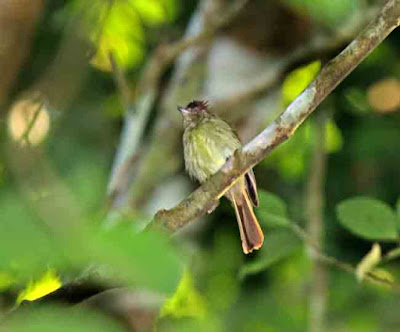
The 5" Belted Flycatcher (Xenotriccus callizonus) was the hardest of the flycatchers to date to photograph. It is a very rare secretive bird with a range from Chiapas in southern Mexico to El Salvador. We found a pair one afternoon and despite 1 hour trying, they never come out of the brush. The next day we went back and had success. This is a cute gray headed flycatcher with a wispy crest and brown chest band.


Belted Flycatcher
And a side view shows 2 beige wing bars.


Belted Flycatcher
The 5" Sepia-capped Flycatcher (Leptopogon amaurocephalus) is an olive backed and yellow underside flycatcher with brown cap.


Sepia-capped Flycatcher
Lastly are 2 in the same genus. The 8.5" Great Crested Flycatcher (Myiarchus crinitus) is a common bird in eastern North America. We had them nesting in a bird house when I was growing up in Ontario. It is one of few bird songs I recognize since I remember it from childhood. They are brown backed with a gray or pale chest and bright yellow belly.


Great Crested Flycatcher
The 7.5" Yucatan Flycatcher (Myiarchus yucatanensis) is similar but paler overall.


Yucatan Flycatcher
I have the different bird families in single folders for easy viewing

I have photos of 121 of the 435
 species of tyrant flycatchers


Happy birding and photography,

David McDonald
dkmmdpa@gmail.com

photos copyright 2006 - 2018 David McDonald

To have these trip reports sent to your email, please email me at the above address and ask to subscribe.

Sunday, September 23, 2018

Bulletin 317 - Guatemala 2018 #3 - Raptors, Puffbird

I went for a third visit to Guatemala in May. Once again, I used the wonderful local guide Knut Eisermann of Cayaya Birding. On this visit, we went to new locations to get different species.

I got some wonderful photos of raptors on this trip including a life bird. The best was the 14" Orange-breasted Falcon (Falco deiroleucus). This was only my second time ever to see this bird.


Orange-breasted Falcon
And another


Orange-breasted Falcon

Another falcon was my first time ever to see one of the group of Forest Falcons. It is not a great pic, but after almost 30  years birding I finally saw one at dusk, the 14" Barred Forest Falcon (Micrastur ruficollis). It has a striped breast.


Barred Forest Falcon
Another first was a photo of the beautiful white 28" King Vulture (Sarcoramphus papa). I have never seen this bird perched, always overhead. It has a white body and black trailing edge of the wings. 


King Vulture

The life bird was the 18" Hook-billed Kite (Chondrohierax uncinatus). This bird occasionally is found in south Texas, but I have never seen it before.

Hook-billed Kite - dark morph

Also we found a 14" Plumbeous Kite (Ictinia plumbea) on the nest.


Plumbeous Kite
The 14" Roadside Hawk (Rupornis magnirostris) is a very common hawk in the tropics, This one was beside the road (of course) but sitting at eye level watching the action around an army ant swarm. He was perhaps only 25 feet from me when I took this photo and not concerned in the least.


Roadside Hawk
I have seen the 8" White-whiskered Puffbird (Malacoptila panamensis) before, but always the male. This time we saw a pair of them. The male is bright rufous.


White-whiskered Puffbird - male

The female is plain brown with a streaked breast


White-whiskered Puffbird - female


I have put the different bird families in single folders for easy viewing

I have photos of 13 of the 65
 species of falcons

I have photos of 5 of the 7 species of new world vultures

I have photos of 38 of the 254 species of hawks, eagles

I have photos of 8 of the 38 species of puffbirds


Happy birding and photography,


David McDonald

dkmmdpa@gmail.com

photos copyright 2006 - 2018 David McDonald

To have these trip reports sent to your email, please email me at the above address and ask to subscribe.