Sunday, October 24, 2021

Bulletin 387 - Colombia 2021 #4 - Warblers, Donacobius, Cardinal

  I finally made it back to Colombia for my second visit and again used the guide services of Pablo Florez. I went with my friend Martin Jackson. We visited Inirida on the Orinoco, Santa Marta of course, Guajira Peninsula on the Caribbean coast, and a couple of National Parks around Bogota.

The Sierra Nevada de Santa Marta mountain range in northeast Colombia is the tallest coastal mountain range in the world and the tallest peak in Colombia. It is the most important area of endemism in the world with about 27 endemic species of birds. There are 3 warblers, 4 hummingbirds, and 2 sparrows among others. Naming them often leads to a Santa Marta species and another one Sierra Nevada same species. If a bird has either of these names, it is in the Santa Marta mountain range and endemic.

We saw all 3 endemic warblers, but I was unable to photo the Santa Marta Warbler as it is a skulker. The next 2 photos are Santa Marta endemics. The 5.5" White-lored Warbler (Myiothlypis conspicillatus) has an olive back, yellow breast and gray head with white eye-ring.

White-lored Warbler

The 5" Yellow-crowned Whitestart (Myioborus flavivertex) has a black face, all yellow below and yellow cap with white under the tail.

Yellow-crowned Whitestart

The 5" Slate-throated Whitestart (Myioborus miniatus) has a gray head, back and throat and a yellow belly. It is a potential split as the birds in northern Central America have a rusty belly.

Slate-throated Whitestart

Another potential split is the 5" Golden-fronted Whitestart (Myioborus ornatus). This bird is gray above, has a yellow cap and underparts and a white face. The birds in the western Andes, I photographed on my previous Colombia trip, have a yellow face.

Golden-fronted Whitestart

A new warbler name for many of you is the 5" Chestnut-capped Warbler (Basileuterus delattrii). This was split from the Rufous-capped Warbler in July 2021 - just before my trip.

Chestnut-capped Warbler

The 8" Black-capped Donacobius (Donacobius atricapilla) is a bird that resembles a large wren and used to be included in the wren family. But now it is the only member of its own family. It is described as a skulker - more often heard than seen, but this bird landed right beside our boat, to give me my best ever photo of the species. It is an easy ID with the bright yellow eye.

Black-capped Donacobius

The 7.5" male Vermilion Cardinal (Cardinalis phoenicius) looks like our Northern Cardinal but with a taller crest and a white bill.


Vermilion Cardinal - male


The female is also similar to our female Northern Cardinal - but paler and with a white bill.

Vermilion Cardinal - female

We also saw the Rose-breasted Chat, another member in the cardinal family, in the Amazon portion of the trip - but I was unable to gat a photo.

I put the different bird/mammal families in single folders for easy viewing

I have photos of 77 of the 120 species of New world warblers.

I have photos of 30 of the 53 species of cardinals.

Happy birding and photography,

David McDonald

dkmmdpa@gmail.com

photos copyright 2006 - 2021 David McDonald

To have these trip reports sent to your email, please email me at the above address and ask to subscribe.

Sunday, October 10, 2021

Bulletin 386 - Colombia 2021 #3 - Water Birds

 I finally made it back to Colombia for my second visit and again used the guide services of Pablo Florez. I went with my friend Martin Jackson. We visited Inirida on the Orinoco, Santa Marta of course, Guajira Peninsula on the Caribbean coast, and a couple of National Parks around Bogota.

Much of the trip was on or near the water - in the Orinoco basin, Caribbean coast and some mountain lakes and streams. We did see a lot of herons, egrets and ducks that we have in the USA, so I did not bother to photograph them. So here are the more interesting ones. The first 3 were in the Orinoco part of the trip.

The 17" Large-billed Tern (Phaetusa simplex) was the only gull or tern we saw in the Orinoco region which was very surprising to me.

 Large-billed Tern

The beautiful 21" Capped Heron (Pilherodius pileatus) with his long plumes and blue face, he is an easy ID.

Capped Heron

Lastly is the peculiar 24" Hoatzin (Opisthocomus hoazin). This prehistoric looking bird is endemic to Amazonia. It is the only bird in its family.

Hoatzin

The 2 interesting ducks were in the Andes. The  18" Andean Teal (Anas andium) is a gray brown bird on paramo lakes

Andean Teal

The exciting duck was a close encounter with the 16" Torrent Duck (Merganetta armata). We stopped on a bridge across a 30' stream where the guide had seen the ducks before. Well as luck would have it, the pair was about 30 yards upstream from the bridge. As we watched, they swam and drifted down until they were right below us.

Torrent Duck

The last 3 birds were on the Caribbean coast in northeastern Colombia. There is a flamingo preserve, but at the time of year we were there, we were lucky to find a half dozen birds. Here is an adult 47 " American Flamingo (Phoenicopterus ruber).

American Flamingo

and a juvenile.

American Flamingo - juvenile

The 24" Scarlet Ibis (Eudocimus ruber) is white as a juvenile and then gets his color as he matures. There is some question if the White Ibis and this species are a single species. Time will tell as details are worked out.

Scarlet Ibis

The last was the 39" Magnificent Frigatebird (Fregata magnificens). This is an immature with all the white. It is always a treat to see these pelagic birds.

Magnificent Frigatebird - juvenile

We also saw a Parasitic Jaeger but I did not get a photo. It seems so far south for that species.

Happy birding and photography,


David McDonald


dkmmdpa@gmail.com

photos copyright 2006 - 2021 David McDonald

To have these trip reports sent to your email, please email me at the above address and ask to subscribe.

Sunday, September 26, 2021

Bulletin 385 - Colombia 2021 #2 - Icterids

 I finally made it back to Colombia for my second visit and again used the guide services of Pablo Florez. I went with my friend Martin Jackson. We visited Inirida on the Orinoco, Santa Marta of course, Guajira Peninsula on the Caribbean coast, and a couple of National Parks around Bogota.

First a correction on the ID of Scaled Piculet on the previous bulletin. It is actually the Golden-spangled Piculet. Thanks to Pablo Florez for the correct ID. 

Icterids are the New World blackbirds such as orioles, grackles and meadowlarks. Orioles are obviously the most colorful and we had 2 lifers for me - both on the Caribbean coast in extreme northeast Colombia.

The 8" Yellow Oriole (Icterus nigrogularis) was admiring his reflection in our vehicle window. He looks more orange than yellow to me but I am not the person who named the bird.

Yellow Oriole

The other was the shy 8" Orange-crowned Oriole (Icterus auricapillus). He has more black than the first one - but the orange/yellow looks the same??

Orange-crowned Oriole

I also had 2 lifer grackles. The first was the peculiarly named 7" Velvet-fronted Grackle (Lampropsar tanagrinus). Here is where the name comes from. The feathers at the front of the crown are very short and dense, giving a velvet-like appearance at close quarters.

Velvet-fronted Grackle


The other is the 10.5" Carib Grackle (Quiscalus lugubris). It is similar to the Great-tailed Grackle but considerably smaller.

Carib Grackle


Caciques are larger then orioles. Both the species we saw were not new for me. The 11" Yellow-rumped Cacique (Cacicus cela) is black with a yellow bill, rump and undertail.


Yellow-rumped Cacique


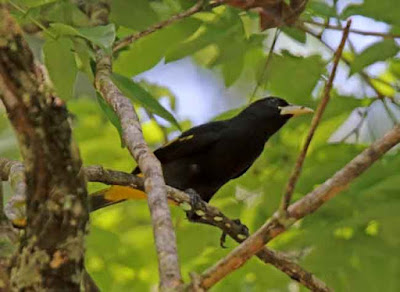
The Solitary Cacique (Cacicus solitarius) is all black with a yellow bill.


Solitary Cacique

Oropendolas are larger still. I photographed 2 species and 1 was a lifer. The 21" Olive Oropendola (Psarocolius bifasciatus) was the lifer. He has an olive green body, ruflos wings, yellow tail and red tip on the bill. But the easiest ID mark is the pink cheeks.

Olive Oropendola


The other was the 18" Crested Oropendola (Psarocolius decumanus). It is black with an ivory bill and yellow tail.

Crested Oropendola


The last was a surprise for me to find the 9.5" Eastern Meadowlark (Sturnella magna) as a resident bird in mountains around Bogota. I had no idea that they had such an extensive range.

Eastern Meadowlark

So you may be wondering why I photograph the birds that I already have seen and photographed before. Well there are several reasons.

First is I always want to upgrade the photos. The Solitary Cacique here was much better than the other photo I had.

Second, is the possibility of the bird being split by subspecies in 2 or more species. If I have several photos from different locations, if a split occurs, I may already have the photos of both. The Eastern Meadowlark has 16 subspecies from eastern Canada to Brazil and Cuba.

I put the different bird/mammal families in single folders for easy viewing

I have photos of 50 of the 109 species of icterids

Happy birding and photography,

David McDonald


dkmmdpa@gmail.com

photos copyright 2006 - 2021 David McDonald

To have these trip reports sent to your email, please email me at the above address and ask to subscribe.

Sunday, September 12, 2021

Bulletin 384 - Colombia 2021 #1 - Woodpeckers

I finally made it back to Colombia for my second visit and again used the guide services of Pablo Florez. I went with my friend Martin Jackson. We visited Inirida on the Orinoco, Santa Marta of course, Guajira Peninsula on the Caribbean coast, and a couple of National Parks around Bogota.

The woodpeckers were amazing and I photographed more new species than on any previous trip. I was most surprised to find 3 species of piculets - the tiniest woodpeckers. The 3.5" Orinoco Piculet (Picumnus pumilus) is a brown bird with a speckled cap.

Orinoco Piculet

Next is the 3.5" Golden-spangled Piculet (Picumnus exilis). He has a brown back and yellow and black breast. This is a male with the red on his crown


Golden-spangled Piculet - male

The last is the 3.5" Chestnut Piculet (Picumnus cinnamomeus). He has an all brown body with a black crown and pale forehead.

Chestnut Piculet

The Celeus genus of woodpeckers are mostly brown and some have yellow heads. They usually have a crest also. The 8.5" Scaly-breasted Woodpecker (Celeus grammicus) is all brown with barring on the back and underside. He has a pale bill

Scaly-breasted Woodpecker


The 11" Chestnut Woodpecker (Celeus elegans) is plain rich brown and he has a golden rump. This is a male with the red malar stripe.

Chestnut Woodpecker - male

The 10.5" Cream-colored Woodpecker (Celeus flavus) is a spectacular ochre color with brown wings.


Cream-colored Woodpecker

The last of this genus is the 11" Ringed Woodpecker (Celeus torquatus). He is brown with an ochre head. He is named for a black ring around his neck which is not seen in this photo.

Ringed Woodpecker

The 7.5" Yellow-throated Woodpecker (Piculus flavigula) has a plain brown back, yellow face and scaled underparts. The male here has an all red crown.

Yellow-throated Woodpecker - male

The previous species were all new for me. The next 3 I had photographed previously. The 8" Spot-breasted Woodpecker (Colaptes punctigula) has a black and white patterned head, spotted breast and barred back.

Spot-breasted Woodpecker - female

Next is the 7" Red-crowned Woodpecker (Melanerpes rubricapiilus) . He is very similar to out Red-bellied Woodpecker.


The last is the 7.5" Yellow-tufted Woodpecker (Melanerpes cruentatus). He is mostly black but with a yellow ring around his head and a yellow eye.

Yellow-tufted Woodpecker


I put the different bird/mammal families in single folders for easy viewing

I have photos of 67 of the 237 species of woodpeckers

Happy birding and photography,

David McDonald


dkmmdpa@gmail.com

photos copyright 2006 - 2021 David McDonald

To have these trip reports sent to your email, please email me at the above address and ask to subscribe.


Thursday, August 19, 2021

Bulletin 383 - Colorado

 I went to the Denver area on July 4th weekend to pick up some birds, I had not yet photographed. I contacted guide Carl Bendorf in Longmont and with my list, we did one day in the Pawnee Grasslands and a second day in Rocky Mountain National Park.

The bird of the trip was definitely a male White-tailed Ptarmigan (Lagopus leucurus). This 12.5" grouse lives on the tundra above the visitors center. He was a lifer for me.

White-tailed Ptarmigan - male

And a close-up shows the red wattle above the eye.

White-tailed Ptarmigan - male

The second new bird to photograph was the 12" Clark's Nutcracker (Nucifraga columbiana). This member of the jay family is usually easy to see up close - but they all stayed away. It is gray with black wings.

Clark's Nutcracker

The next bird was a lifer, the 6" Thick-billed Longspur (Rhyncophanes mccownii). The breeding male looks like a sparrow with black and white patterned face and a red shoulder patch.

Thick-billed Longspur - male

The other longspur in the area was the beautiful 6" male Chestnut-collared Longspur (Calcarius ornatus). He is all black underneath with the beautiful collar.

Chestnut-collared Longspur - breeding male

The 7" male Lark Bunting (Calamospiza melanocorys) is a large black sparrow with a white wing patch. It was my first time to photograph him in breeding plumage. It is the state bird of Colorado.

Lark Bunting - breeding male


We also saw the 9.5" Burrowing Owl (Athene cunicularia). This owl often nests in abandoned prairie dog holes.

Burrowing Owl

I also photographed several mammal species. The first was the Elk. Here is a group of 3 males on the tundra.

Elk - male

Another member of the deer family was this mother and baby Moose.

Moose

The beautiful Pronghorn resembles a deer with the horns, but is more closely related to the giraffe. The male has the pronghorn, but the female just has a small straight horn and unlike deer with antlers that are shed every year, the pronghorn does not lose his horn. Also different is the Pronghorn does not jump over fences, but crawls under them. Consequently, many farmers leave the bottom strand of barbed wire off the fences to enable these animals to cross more easily.

Pronghorn - male

The cute  8" American Pika is a relative of rabbits. They live at or above the tree line in rock piles. They harvest grass during the summer to store in their burrow for the winter.

American Pika

I also photographed several rodents is the squirrel family. The largest is the Yellow-bellied Marmot.

Yellow-bellied Marmot

And the one is was most hoping to see was the Black-tailed Prairie Dog. Just the tip of his tail is black. This was my first time to see a prairie dog.

Black-tailed Prairie Dog

There were several more squirrel species and if you would like to see them, just click the link.

Least Chipmunk

Golden-mantled Ground Squirrel

Wyoming Ground Squirrel


Happy birding and photography,

David McDonald

dkmmdpa@gmail.com

photos copyright 2006 - 2021 David McDonald

To have these trip reports sent to your email, please email me at the above address and ask to subscribe.