Showing posts with label Squacco Heron. Show all posts

Monday, October 19, 2020

Bulletin 369 - Uganda #13 - Herons, Crane, Ibis, Fruit Bat

After the week in the Capetown area, the guide Casper Badenhorst, and I flew to Uganda and met a local guide. We started at Entebbe Airport on the southeast corner of Uganda and made a diagonal trip to Murchison Falls NP in the northwest corner. From there, we proceeded south through a chain of nature preserves and parks to the southwest corner at Bwindi Impenetrable Forest. We finished along the southern border back to the airport.

With many lakes, rivers and marshes in Uganda, herons were common and I photographed 2 new species.

The 33" Purple Heron (Ardea purpurea) is a common heron, but this was the first time I got one close by, for a good photo.

Purple Heron

The taller 38" Gray Heron (Ardea cinerea) resembles our Great Blue Heron.

Gray Heron

The giant 60" Goliath Heron (Ardea goliath) is a bird I had seen in the guide book. As the largest heron in the world, it was one I wanted to see. It has a gray body and reddish neck.

Goliath Heron

3 smaller herons include the 18" Squacco Heron (Ardeola ralloides). It is a squat beige heron.

Squacco Heron

The 20" Black Heron (Egretta ardesiaca) is all black. It is often found creating an umbrella like posture with its wings forward.

Black Heron

Lastly is the 22" Western Cattle Egret (Bubulcus ibis). This is the common white egret with a yellow bill and orange plumes in breeding season. It is widespread in the Americas.

Western Cattle Egret

Surprisingly, I only found a single ibis species, the 32" African Sacred Ibis (Threskiornis aethiopicus). It is an elegant bird and an easy ID with its bare black neck and white body with black wings.


African Sacred Ibis

Probably the most elegant bird of the trip is the 44" Gray Crowned Crane (Balearica regulorum). It is the National Bird of Uganda.

Gray Crowned Crane


and another photo of this magnificent bird.

Gray Crowned Crane

The Straw-colored Fruit Bat (Eidolon helvum) is the most common African large bat. It is found in most of sub-Saharan Africa. They live in large colonies of 100 thousand to 1 million animals. And each year in the largest mammal migration on the planet, 10 million bats roost in a 5 acre forest in Zambia. Despite its relatively small size, 6-9 inches and 8-12 oz weight, many are hunted for 'bush meat' in Central and West Africa.

Straw-colored Fruit Bat


I put the different bird/mammal families in single folders for easy viewing

I have photos of 28 of the 66 species of herons, bitterns and egrets

I have photos of 11 of the 35 species of  ibises and spoonbills

I have photos of 7 of the 15 species of  cranes

Happy birding and photography,

David McDonald


dkmmdpa@gmail.com

photos copyright 2006 - 2020 David McDonald

To have these trip reports sent to your email, please email me at the above address and ask to subscribe.

Sunday, January 13, 2019

Bulletin 332 - South Africa #9 - Part 1 - Tall Waders, Primates

I had an amazing 2 week trip to South Africa and scored almost 280 new species of birds as well as fantastic mammals and a few reptiles. My guide Casper Badenhorst was outstanding. You can see his web site here. He can be contacted through the web site or if you want his email it is info@birdingandwildlifesafaris.com. I recommend him highly as he showed me so many rare birds and animals. I will use him again when I go to Southern Africa.

As usual my birding luck was 100% and we saw almost every thing expected to be found and many that were not expected!

We saw several storks on the trip which was nice, as we have only a single species in North America. The 45" Woolly-necked Stork (Ciconia episcopus) has a black body, white fluffy neck, blackish head and dark bill tipped with red.

Woolly-necked Stork
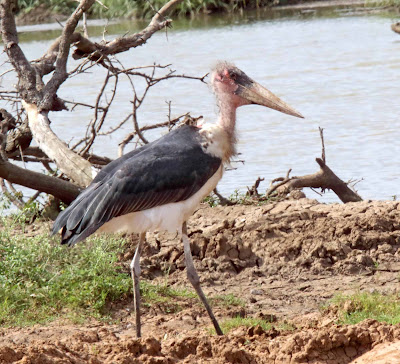
If the old tales we were told as kids are true, that storks brought the babies to the house, this ugly stork would not be the one you would want. The 60" Marabou Stork (Leptoptilos crumenifer) has a dark back, white undersides bare red skin on head like a vulture. This is a juvie with the downy feathers on his neck

Marabou Stork
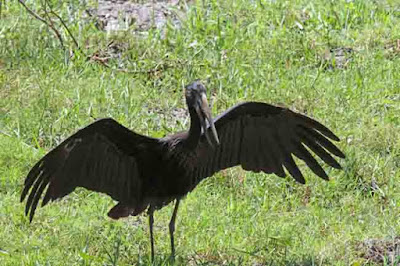
The unusual 35" African Openbill (Anastomus lamelligerus) is all black and is named for the fact that when his bill is closed, there is a gap between mandibles in the middle. You will notice the curve in the lower mandible in the photo.

African Openbill
Next is the beautiful 40" Yellow-billed Stork (Mycteria ibis). It is white with some black on the wings, red face and legs, and a bright yellow bill.

Yellow-billed Stork
The last one is the most amazingly colored of all. The 60" male Saddle-billed Stork (Ephippiorhynchus senegalensis) is an easy ID once you see him. We only saw a pair of these storks once on the trip. The female is similar but duller.

Saddle-billed Stork - male
One of the nice things these reserves in South Africa provide is many bird blinds or as they call them 'hides'. The Saddle-billed Stork above was taken from one of them as well as this 40" Gray Heron (Ardea cinerea). I had seen him from afar in Hong Kong before.

Gray Heron
Likewise I got my best photo of a 17" Striated Heron (Butorides striata). I had photographed this one before in South America.

Striated Heron
The 20" Western Cattle Egret (Bubulcus ibis) arrived in the New World from Africa in the 1930s and is very common now, but sitting in a blind and this one in full breeding plumage with his orange feathers above me. I just had to take his photo taken and is my best photo of this species.


Western Cattle Egret


I found 2 new species for lifers. The 36" Black-headed Heron (Ardea melanocephala). It is similar to the Gray Heron above, but the back of the neck and top of head are black.


Black-headed Heron
The other new heron is the 17" Squacco Heron (Ardeola ralloides). It is a shy crouching beige heron.

Squacco Heron
I also saw the Black Heron, but he was too far away for a useful photo and I missed the one I really wanted to see, the huge 60" Goliath Heron.


Continued on Part 2