Showing posts with label Striated Heron. Show all posts

Sunday, January 14, 2024

Bulletin 428 - Brazil 2023 #9 - Herons, Ibises, Falcon

After 3 trips to Colombia with diminishing returns, it was time to go further afield. Pablo Flores the guide in Colombia is now leading trips to Brazil as well. So my birding buddy Martin Jackson and my daughter Chantel and I decided to go there. We visited the Pantanal, the Atlantic forest in the Sao Paulo area and had 1 day in the Chapada. The Pantanal is the largest wetland in the world, so it is teeming with wildlife. The Atlantic Forest is a unique ecosystem from sea level to about 1 mile elevation. It contains 800 species of birds (225 endemic) and 26 species of primates. Unfortunately it also contains 2 mega cities - Sao Paulo and Rio de Janeiro and the resulting sprawl and clearing for agriculture since the Portuguese arrived 500 years ago, has wiped out 90%+ of the original forest. About 250 species of amphibians, birds and mammals have gone extinct in the past 400 years. The good news is that many preserves and parks have been set aside to try and preserve the remaining biodiversity.

I had 4 heron photos for the trip, but only one was a lifer. The 16" Striated Heron (Butorides striatus) is the southern cousin of our Green Heron. The neck is gray rather than brown.

Striated Heron

The 26" adult Rufescent Tiger Heron (Tigrisoma lineatum) is an easy ID with his gray back and wings and rufous neck.

Rufescent Tiger Heron - adult

The juvenile is completely striped from head to tail.

Rufescent Tiger Heron - juvenile

The 22" Capped Heron (Pilherodius pileatus) is another easy ID with his white body, pale yellow neck and blue bare facial skin and blue bill. He also has a black cap and 2 long plumes.

Capped Heron

The lifer was the attractive 22" Whistling Heron (Syrigma sibilatrix). He is an easy ID. We saw this bird on each of the last 2 days of the trip, with the second time being quite close by the road.

Whistling Heron

We searched for the Agami and Zigzag Herons, but no luck.

The 30" Plumbeous Ibis (Theristicus caerulescens) is a gray ibis with red legs and a yellow eye. He has a very long shaggy crest.

Plumbeous Ibis

His cousin is the 30" Buff-necked Ibis (Theristicus caudatus). He is also an easy ID.

Buff-necked Ibis

Lastly is the 22" Green Ibis (Mesembrinibis cayennensis). He is all dark green (blacker in juveniles) including the bill. He has shiny green feathers on the back of his neck.

Green Ibis

The 20" Laughing Falcon (Herpetotheres cachinnans) is always a delight to see. On all my trips I have seen it perhaps 6 times. It is an easy ID.

Laughing Falcon

I put the different bird/mammal families in single folders for easy viewing

I have photos of 29 of the 66 species of herons

I have photos of 15 of the 35 species of ibises and spoonbills

I have photos of 18 of the 65 species of falcons

Happy birding and photography,

David McDonald

dkmmdpa@gmail.com

photos copyright 2006 - 2023 David McDonald

To have these trip reports sent to your email, please email me at the above address and ask to subscribe.

Sunday, January 13, 2019

Bulletin 332 - South Africa #9 - Part 1 - Tall Waders, Primates

I had an amazing 2 week trip to South Africa and scored almost 280 new species of birds as well as fantastic mammals and a few reptiles. My guide Casper Badenhorst was outstanding. You can see his web site here. He can be contacted through the web site or if you want his email it is info@birdingandwildlifesafaris.com. I recommend him highly as he showed me so many rare birds and animals. I will use him again when I go to Southern Africa.

As usual my birding luck was 100% and we saw almost every thing expected to be found and many that were not expected!

We saw several storks on the trip which was nice, as we have only a single species in North America. The 45" Woolly-necked Stork (Ciconia episcopus) has a black body, white fluffy neck, blackish head and dark bill tipped with red.

Woolly-necked Stork
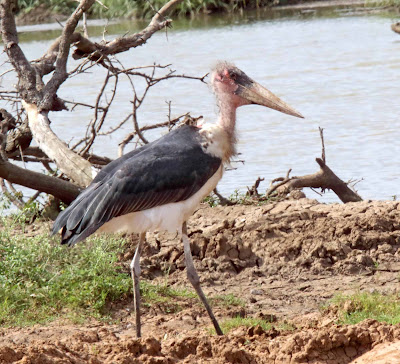
If the old tales we were told as kids are true, that storks brought the babies to the house, this ugly stork would not be the one you would want. The 60" Marabou Stork (Leptoptilos crumenifer) has a dark back, white undersides bare red skin on head like a vulture. This is a juvie with the downy feathers on his neck

Marabou Stork
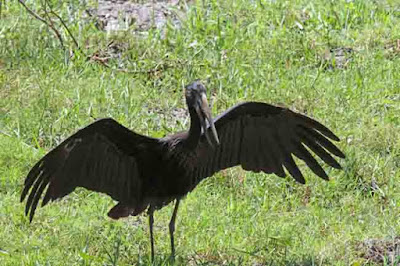
The unusual 35" African Openbill (Anastomus lamelligerus) is all black and is named for the fact that when his bill is closed, there is a gap between mandibles in the middle. You will notice the curve in the lower mandible in the photo.

African Openbill
Next is the beautiful 40" Yellow-billed Stork (Mycteria ibis). It is white with some black on the wings, red face and legs, and a bright yellow bill.

Yellow-billed Stork
The last one is the most amazingly colored of all. The 60" male Saddle-billed Stork (Ephippiorhynchus senegalensis) is an easy ID once you see him. We only saw a pair of these storks once on the trip. The female is similar but duller.

Saddle-billed Stork - male
One of the nice things these reserves in South Africa provide is many bird blinds or as they call them 'hides'. The Saddle-billed Stork above was taken from one of them as well as this 40" Gray Heron (Ardea cinerea). I had seen him from afar in Hong Kong before.

Gray Heron
Likewise I got my best photo of a 17" Striated Heron (Butorides striata). I had photographed this one before in South America.

Striated Heron
The 20" Western Cattle Egret (Bubulcus ibis) arrived in the New World from Africa in the 1930s and is very common now, but sitting in a blind and this one in full breeding plumage with his orange feathers above me. I just had to take his photo taken and is my best photo of this species.


Western Cattle Egret


I found 2 new species for lifers. The 36" Black-headed Heron (Ardea melanocephala). It is similar to the Gray Heron above, but the back of the neck and top of head are black.


Black-headed Heron
The other new heron is the 17" Squacco Heron (Ardeola ralloides). It is a shy crouching beige heron.

Squacco Heron
I also saw the Black Heron, but he was too far away for a useful photo and I missed the one I really wanted to see, the huge 60" Goliath Heron.


Continued on Part 2

Saturday, October 24, 2015

Bulletin 239 - Ecuador #3 - large non-passerines

This bulletin will look as some large birds that, for the most part, are seldom seen by birders. They are in 4 families, herons, tinamous, cracids and screamers.

The heron is common throughout South America (SA). The Striated Heron (Buteroides striatus) is the counterpart in SA to our Green Heron. He is brownish and not rufous backed like his northern cousin.


Striated Heron
The 36" Horned Screamer (Anhima cornuta) was a life bird for me. The screamers are a family of just 3 species, all in South America. Despite their chicken-like appearance, they are most closely related to ducks and geese. They have partially webbed feet and nest near water. An unusual feature unique to screamers is the fact that they have air cells under the skin that can be inflated. Wikipedia says these air cells makes the birds unattractive as a food source. However, another source states that this species is hunted for food and is very good eating. Anyway, on the Pacific slope, they are limited to a remnant population in a preserve south of Guayaquil where we saw a pair of them. I was able to get close enough to see and photo the bird and the white horn. The guide book states that the horn can be 'surprisingly hard to see in the field'.


Horned Screamer
The tinamous are another New World family of 47 species of ground dwelling chicken-like birds. Again, these birds are very secretive and hard to see well. I got my first photos of a tinamou in Costa Rica this year. Some places feed, and have blinds to observe, these birds and Copalinga Lodge provided one. It was truly an experience to see 2 different species 20 feet away in the space of 15 minutes.

The 18" Gray Tinamou (Tinamus tao) is found in Amazonia and listed as very rare on the eastern slope. It is unusual in coloration as most tinamous are brown.


Gray Tinamou
The 9" Little Tinamou (Crypturellus soui) is listed as common and has a huge range from Mexico to Brazil. However, despite being common, the guide book states that they are 'exceptionally difficult to see' and are most often heard. For the most part they are all brown, but the birds in northern Peru and southern Ecuador have gray heads as does this bird. I saw this species in Costa Rica, but was unable to get a photo.


Little Tinamou
Lastly, the cracids (not crackheads) are large pheasant like game birds in the New World. There are 55 species and one occurs in south Texas with the rest in the tropics.They have 3 different names chachalacas, guans and currasows. There are about an equal number of each in the family.

The 23" Rufous-headed Chachalaca (Ortalis erythroptera) occurs on the west slope in Ecuador. A pair of birds hung around the lodge at Buenaventura.


Rufous-headed Chachalaca
The 20" Speckled Chachalaca (Ortalis guttata) occurs on the east slope in Ecuador. A family group came to the banana feeders at Copalinga Lodge. This one was showing off his tail.


Speckled Chachalaca
The 34" Crested Guan (Penelope purpurascens) is found on the west slope in Ecuador. This one was at Buenaventura where the guide says it is rare, despite being in a protected preserve.


Crested Guan

The Sickle-winged Guan (Chamaepetes goudotii) occurs on both slopes with a marked size difference that strikes me as peculiar. The west slope birds are 21" and the eastern slope birds are 25" in length. They occur at 2700 to 8000' elevation. They have a bare blue skin on the face. This bird was at the Copalinga Lodge on the east slope.


Sickle-winged Guan

Happy birding and photography,

David McDonald

dkmmdpa@gmail.com

photos copyright 2006 - 2015 David McDonald

To have these trip reports sent to your email, please email me at the above address and ask to subscribe.